
What Shapes a Consumer’s Buying Decision?
What a consumer eats, wears, and believes is rarely decided in isolation. It is learned and shaped by the culture a person grows up in, their family, and the wider social environment around them. Kotler and Armstrong group the forces behind a consumer’s buying decision into four broad categories: cultural, social, personal, and psychological (Kotler & Armstrong, 2018). This lesson introduces the social side of that model — the groups, roles, and situational pressures that push a decision one way rather than another — before the next lessons in this section look at culture, social class, and family influence in more depth.
Groups and Social Power
People are social, and they want to belong to particular groups — family, friends, co-workers, clubs, and associations among them. Groups that a person actually belongs to and interacts with directly are called membership groups; groups a person looks to for guidance without belonging to them, such as a football team’s fans or a professional body, are reference groups (Kotler & Armstrong, 2018). Primary groups, like family, tend to have the most day-to-day influence; secondary groups, like clubs and societies, interact less often but can still shape opinions and preferences. As children grow into teenagers, family influence typically fades a little while peer-group influence grows.
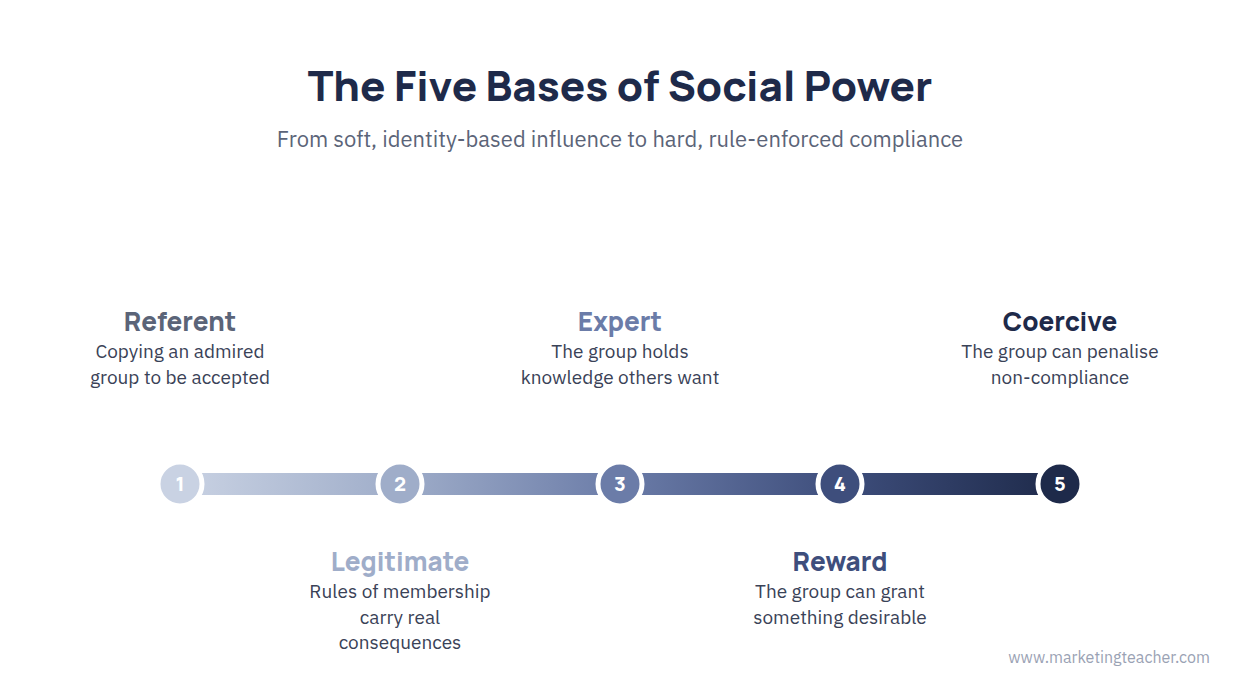
Not every group influences a consumer the same way. French and Raven’s classic typology (French & Raven, 1959) identifies five distinct types of social power a group can hold over its members:
- Referent — a person admires a group and copies it to be accepted (a teenager dresses like a group they want to join).
- Legitimate — membership comes with agreed rules, and there are consequences for breaking them (an employer can dismiss a worker for poor performance).
- Expert — the group holds knowledge others want access to (a professional health body’s advice is followed because of its expertise).
- Reward — the group can grant something desirable (a sports club awarding trophies to its top performers).
- Coercive — the group can penalise members who don’t comply (a workplace disciplinary process).
A marketer trying to reach a target audience through group influence needs to know which of these is actually doing the work — a referent-driven youth trend calls for a very different campaign than an expert-driven professional recommendation, and mistaking one for the other can waste an entire campaign budget on the wrong message.
Situational Influences: Atmospherics
Beyond stable group memberships, external influences also include situational factors — sometimes called atmospherics — sensory details in an environment that can shift buying behaviour in the moment, such as music, colour, scent, and lighting. A shop playing loud, fast-tempo music tends to draw in younger shoppers while discouraging older ones; the same layout with softer background music produces the opposite effect. Colour carries meaning too, and that meaning is culturally learned rather than fixed — white is the traditional colour for a wedding dress in much of the Western world, while red traditionally signals celebration and good fortune at a wedding in China. A bakery pumping the scent of fresh bread out onto the street is using atmospherics quite deliberately, to draw passers-by in before they’ve consciously decided to buy anything.
Why Marketers Study External Influences
None of these factors act on a consumer in isolation, and a marketer rarely controls any of them directly. What a marketing team can do is recognise which external influences matter most for a particular product or audience, and design around them — choosing a spokesperson likely to carry referent power with a target group, working with an expert body a segment already trusts, or shaping a store or website’s sensory environment to suit the mood a purchase calls for. Getting this diagnosis wrong is a common and costly mistake: a campaign built around expert endorsement will fall flat with an audience that is really being moved by referent, peer-driven pressure instead. The remaining lessons in this section look at three of the biggest external influences in more depth: culture, social class, and family.
Summary
External influences on consumer behaviour include cultural, social, personal, and psychological factors (Kotler & Armstrong, 2018). Social influence works through membership and reference groups, and French and Raven’s five bases of social power (French & Raven, 1959) explain why some groups sway a consumer’s choices more than others. Situational atmospherics — music, colour, and scent — can shift a decision without changing the product at all. Culture, social class, and family, covered next in this section, are three of the most powerful external influences a marketer needs to understand.
The slides, worksheet, lesson plan and poster for this lesson are free to download and free to use in your course — no sign-up, no permission needed. See the teacher resources →
Assign this lesson to your class:
Using Canvas, Blackboard or Moodle? Copy the link and paste it into your course page or assignment. More ways to add lessons to your LMS.

