
What Are the Four Branding Alternatives?
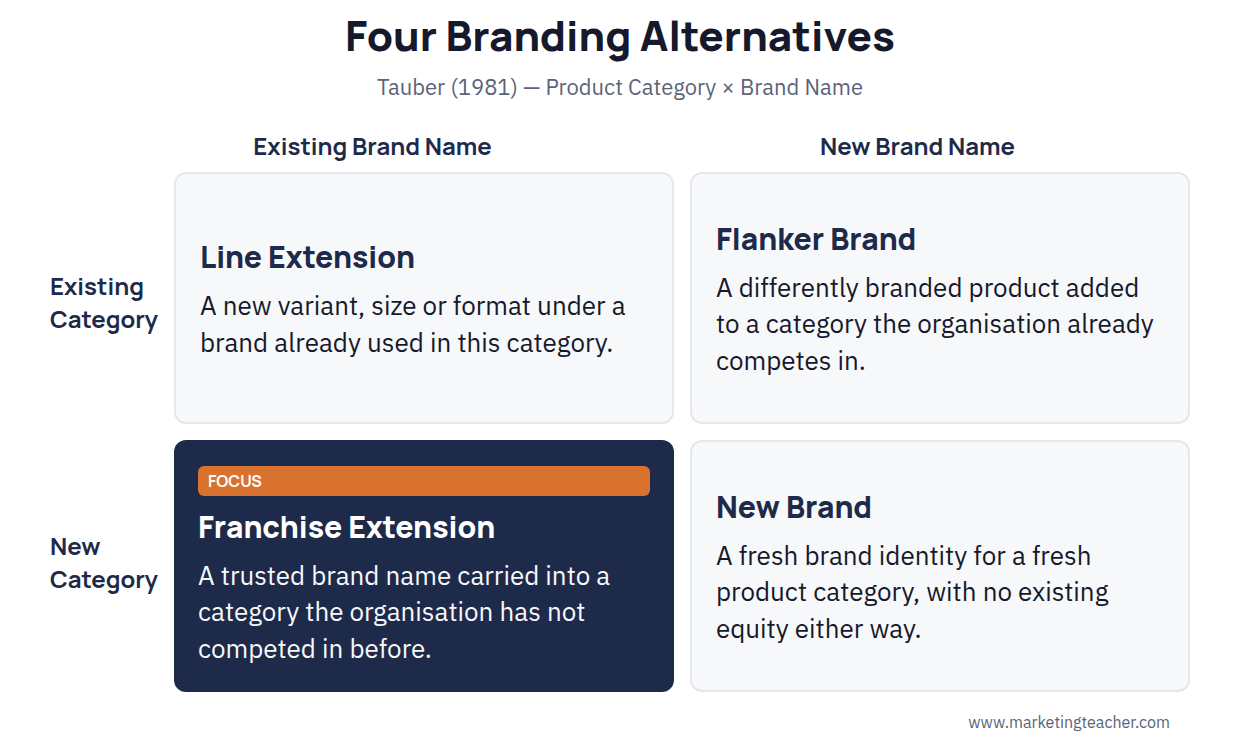
When a large organisation considers adding a new product to its portfolio, it faces a branding decision as much as a product decision: should the new product carry an existing brand name, or a new one? Edward Tauber (1981) framed this choice as a simple two-by-two matrix, built from two variables, whether the product category is existing or new to the organisation, and whether the brand name attached to it is existing or new. The four resulting quadrants are known as line extension, flanker brand, franchise extension and new brand.
The Four Quadrants
Line extension sits where an existing product category meets an existing brand name: the organisation adds a variant, a new flavour, size or format, under a brand it already uses in that category (Tauber, 1981). Flanker brand sits where an existing product category meets a new brand name: the organisation introduces an additional, differently branded product into a category it already competes in, often to cover a different price point or segment without diluting the existing brand. Franchise extension, sometimes called brand extension, sits where a new product category meets an existing brand name: a familiar, trusted brand is carried into a category the organisation has not competed in before. New brand sits where a new product category meets a new brand name: the organisation builds an entirely fresh brand identity for an entirely new kind of product, with no existing brand equity to draw on either way.
Why the Matrix Matters
Each quadrant carries a different balance of risk and reward. Line extension and franchise extension both trade on existing brand equity, so they tend to launch faster and cheaper, but they also risk diluting the parent brand if the new product performs poorly or feels like a poor fit for what the brand stands for. Flanker brand and new brand both avoid that dilution risk by keeping the new offering separate, but both cost more to build awareness for, since neither can borrow trust the organisation has already earned elsewhere. Choosing the right quadrant is therefore rarely just a naming decision: it is a judgement about how much of the parent brand’s reputation a new product should be allowed to borrow, and how much risk that borrowing is worth taking on.
Applying the Framework
A useful first question when applying Tauber’s matrix to a real branding decision is simply whether the target customer already associates the organisation’s existing brand with the new product category at all. A strong, well-fitted association favours franchise extension or line extension; a poor or nonexistent association points toward a flanker brand or an entirely new brand instead. A second useful check is what happens to the existing brand if the new product fails: an extension that shares a name with an established, high-reputation brand can do real reputational damage on failure, while a flanker or new brand insulates the parent brand from that same risk. Weighing both questions together, rather than defaulting to whichever option is cheapest to launch, is what separates a considered branding decision from a purely tactical one.
A Common Pitfall: Choosing on Cost Alone
Because line extension and franchise extension are almost always cheaper to launch, since existing brand awareness does much of the marketing work for free, organisations can be tempted to default to one of these two options regardless of fit. This is a common pitfall: a poorly fitted extension, a premium brand attaching its name to a low-quality budget product, or a serious brand attaching its name to a category that feels frivolous or unrelated, can damage the parent brand’s reputation far more than the launch cost saved was worth. The matrix works best as a starting question, which quadrant does this decision naturally sit in, followed by a second, harder question, is the brand equity being borrowed actually a good fit for what is being launched, rather than as a shortcut to the cheapest available option.
Summary
Tauber’s (1981) four branding alternatives give marketers a simple way to frame a branding decision whenever a new product is being added to a portfolio: line extension and franchise extension both draw on existing brand equity in a familiar or new category respectively, while flanker brand and new brand both introduce a fresh brand name, in a familiar or new category respectively. Working through which quadrant fits, and what it implies for both opportunity and risk, turns a naming choice into a genuine strategic decision.
The slides, worksheet, lesson plan and poster for this lesson are free to download and free to use in your course — no sign-up, no permission needed. See the teacher resources →
Assign this lesson to your class:
Using Canvas, Blackboard or Moodle? Copy the link and paste it into your course page or assignment. More ways to add lessons to your LMS.

