
What Is Five Forces Analysis?
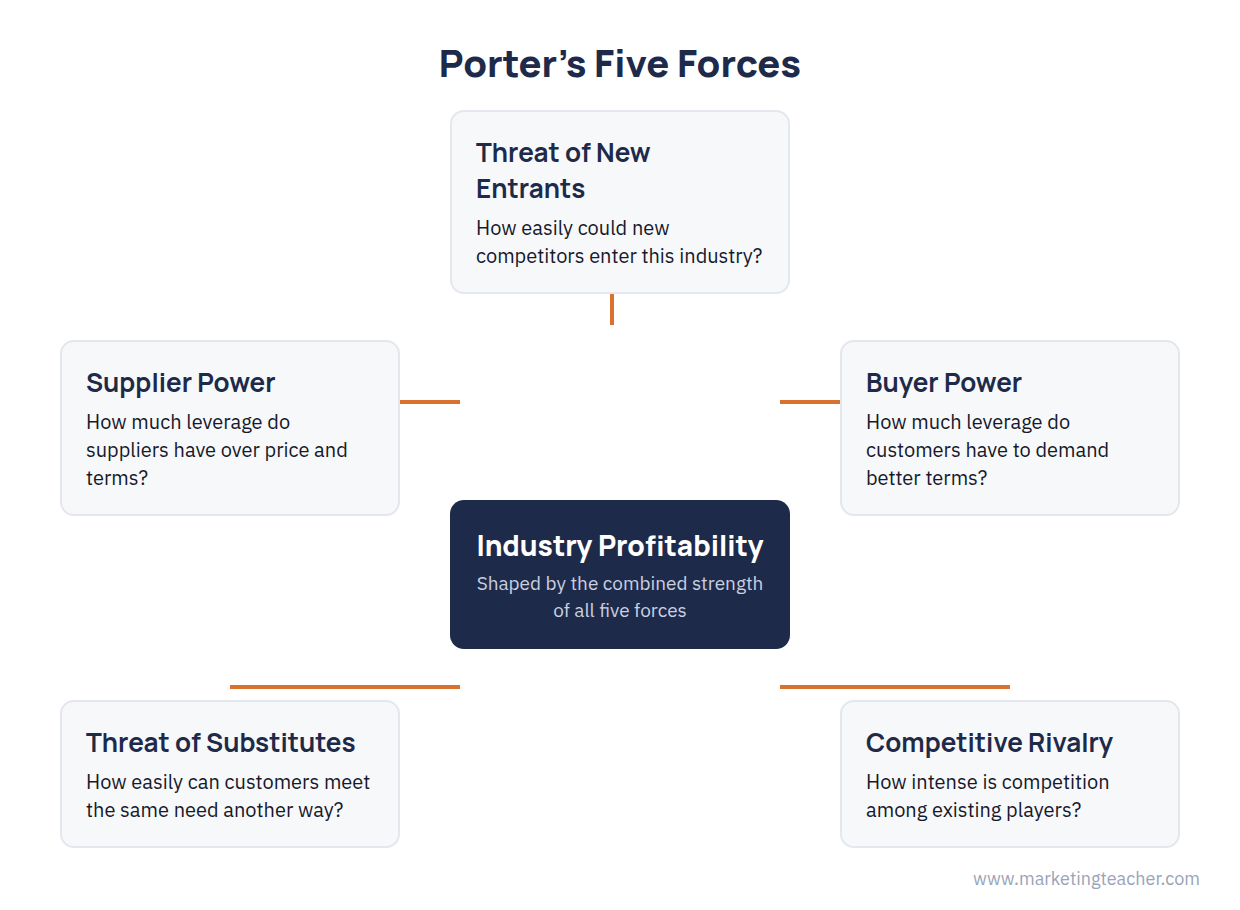
Five Forces Analysis is a framework for assessing how much competitive pressure an industry places on the businesses within it, and therefore how much of the value they create they are likely to keep as profit (Porter, 1980). It was developed by Michael Porter, who argued that industry profitability is shaped by five structural forces rather than by luck or product quality alone (Porter, 1979). The weaker these forces are, the more scope a business has to set its own prices and earn healthy margins; the stronger they are, the more that value gets competed or negotiated away.
The framework is used for external analysis at the industry level, complementing broader environmental scans such as PESTEL. Where PESTEL looks at the wider world a business operates in, Five Forces zooms in on the specific industry and asks a sharper question: is this a good industry to compete in, and why?
The Five Forces
Threat of new entrants. If it is easy for new competitors to enter an industry, existing businesses cannot raise prices too far without inviting fresh competition. Barriers such as high start-up costs, strong brand loyalty, or regulation keep this threat low; a low-cost, easy-to-copy business model keeps it high.
Bargaining power of suppliers. When there are few suppliers of a critical input, or switching supplier is costly, suppliers can push up prices or reduce quality without losing customers. An industry reliant on a single rare raw material has little room to negotiate.
Bargaining power of buyers. When customers are few, well-informed, or can easily switch to a competitor, they can demand lower prices or better terms. A supermarket selling to millions of individual shoppers has far less buyer power working against it than a component maker selling to three large car manufacturers.
Threat of substitutes. A substitute meets the same underlying need in a different way — video calling substitutes for business travel, and oat milk substitutes for dairy. The easier and cheaper it is to switch to a substitute, the harder it is for an industry to raise its prices.
Competitive rivalry. This sits at the centre of the model, since it is shaped by the other four forces. Rivalry is intense when there are many similar competitors, growth is slow, and products are hard to tell apart on anything but price — think of budget airlines on a shared route, all following each other’s fares down.
Using the Model Well
Five Forces Analysis works best as a structured discussion, not a box-ticking exercise. Each force should be rated in the context of the specific industry being studied, not marketing in general, and the analysis should lead somewhere: toward a view on where the industry’s profit is likely to go, and what a business can do about it. A common mistake is treating all five forces as equally important in every industry — in practice, one or two forces (often buyer power or the threat of substitutes) tend to dominate, and it is worth being explicit about which ones matter most for the industry being analysed.
The model also has limits worth knowing. It assumes a fairly stable industry structure and a zero-sum view of competition, which can undervalue opportunities to grow the whole market through collaboration or innovation rather than simply fighting existing rivals for a fixed pool of profit. It is best used alongside, not instead of, an internal capability review and a clear view of the business’s own competitive strategy.
Summary
Five Forces Analysis, developed by Michael Porter, is used to assess how attractive an industry is by examining the threat of new entrants, the bargaining power of suppliers and buyers, the threat of substitute products, and the intensity of competitive rivalry. Together these forces determine how much value a business in that industry can expect to keep as profit, and understanding them helps a business choose where and how to compete rather than simply reacting to whatever competitors do next.
The slides, worksheet, lesson plan and poster for this lesson are free to download and free to use in your course — no sign-up, no permission needed. See the teacher resources →
Assign this lesson to your class:
Using Canvas, Blackboard or Moodle? Copy the link and paste it into your course page or assignment. More ways to add lessons to your LMS.

