
Who Is Generation X?
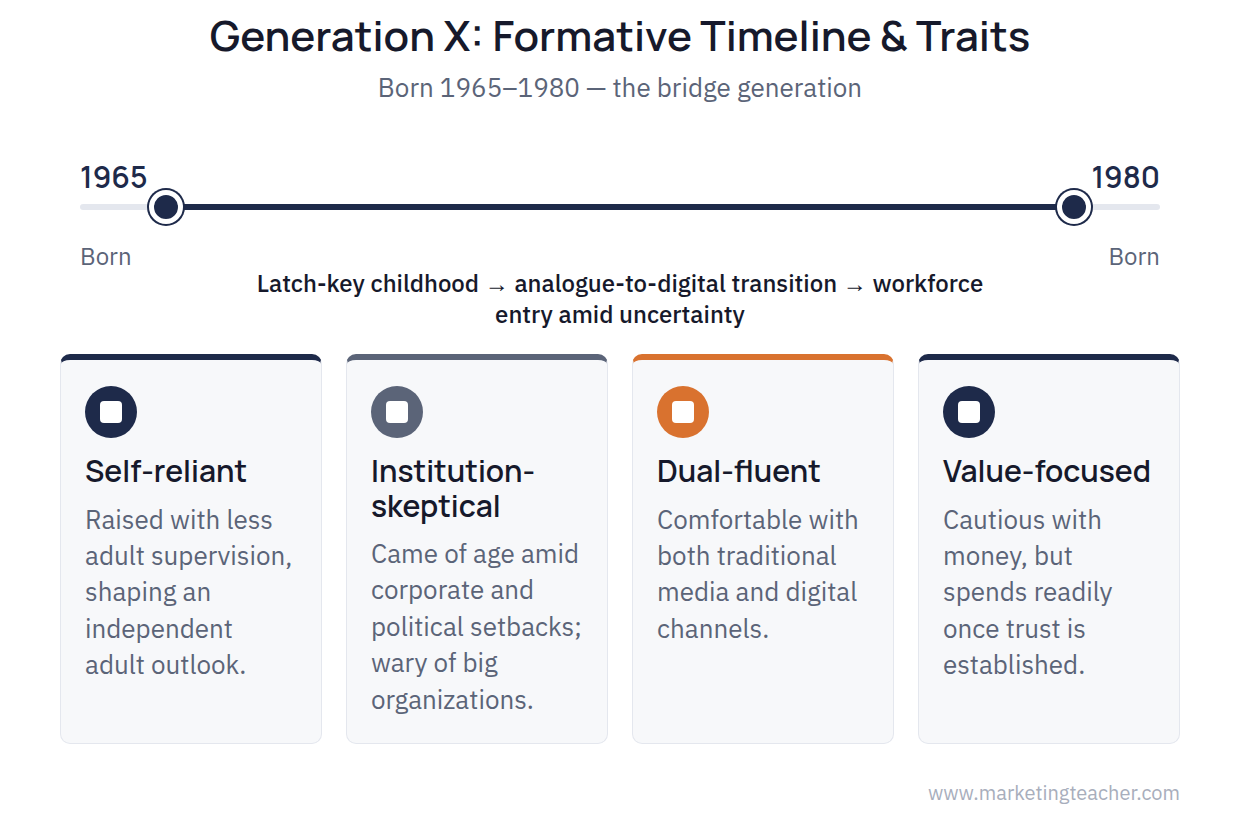
Generation X sits between the Baby Boomers and the Millennials, generally defined as Americans born between 1965 and 1980 (Dimock, 2019). It is a comparatively small generation, sandwiched between two much larger cohorts, which has shaped much of its self-image as the “forgotten middle child” of American generational marketing.
The Latch-Key Childhood
Many Gen Xers grew up as “latch-key kids,” a term describing children who let themselves into an empty house after school with a key worn around the neck, while both parents worked or a household went through divorce. Rising divorce rates and a growing number of dual-income households meant this generation often had less adult supervision growing up than the Boomers before them, which is widely credited with producing a more self-reliant and independent adult outlook.
Growing Up Between Two Worlds
Generation X was raised in the transition from paper-based knowledge to digital information: most remember schooling without computers, followed by their gradual introduction in middle or high school. That in-between position has made Gen X unusually comfortable adapting to new technology as adults, without having grown up as digital natives the way later generations did.
A More Skeptical Relationship With Institutions
Coming of age during a period of high-profile institutional setbacks, including corporate scandals and political disappointments, left many Gen Xers wary of large organizations and inclined toward individual self-reliance over loyalty to any single employer. This generation also averages a notably higher number of career changes across a working lifetime than the Boomers before them, reflecting a shift away from the assumption of a single, lifelong employer.
What This Means for Marketers
Because Gen X came of age skeptical of big institutions and advertising claims, marketing that leads with straightforward, verifiable information tends to perform better with this group than campaigns built primarily around brand aspiration or celebrity endorsement. Gen X consumers are also frequently the ones managing both children and ageing parents at once, a position sometimes called the “sandwich generation,” which makes convenience, reliability, and time-saving genuinely persuasive selling points rather than incidental ones.
A Generation That Rarely Sees Itself as One
Despite being a clearly identifiable cohort to researchers, Gen X members frequently report not feeling like a distinct generation in the way Boomers or Millennials often describe themselves. Strauss and Howe (1991) describe this kind of self-effacing cohort identity as itself a recognizable generational pattern, arising in “reactive” generations that come of age during a period of institutional decline and social fragmentation rather than collective purpose.
Financially Cautious, But Not Frugal
Having entered the workforce during a period of economic uncertainty, many Gen Xers developed a cautious approach to major financial commitments, favouring value and durability over impulse purchases, while still being willing to spend on brands and products they trust once that trust is established. This makes proof points, such as independent reviews, warranties and clear comparisons, unusually effective with this group, since the underlying instinct is not to avoid spending altogether but to avoid being caught out by a decision that turns out to be a poor one.
How Gen X Differs From the Generations Around It
Where Baby Boomers were shaped by a long period of post-war economic optimism, and Millennials came of age already immersed in the internet and social media, Gen X occupies a genuine middle ground: old enough to remember life before the internet, young enough to have adapted to it as a working adult rather than as a child. That dual fluency, comfortable with both traditional media and digital channels, makes Gen X a useful bridge audience for a business trying to reach both older and younger customers with a consistent message.
Reaching Gen X Without Stereotyping It
It is worth treating any generational profile as a starting point for research rather than a fixed rulebook, since individual variation within Gen X, by income, region, family situation and personal history, is far larger than the average differences between generations. A marketer who uses generational traits to inform tone and channel choice, while still testing messages against real customer data, gets more reliable results than one who treats “Gen X” as a single, uniform audience.
Summary
Generation X, born roughly between 1965 and 1980, grew up in the transition between analogue and digital life, often with more independence and less institutional trust than the generations on either side of it (Dimock, 2019). For marketers, that formative experience translates into a practical preference for clear, verifiable information over aspirational messaging, and a genuine sensitivity to convenience given how often this generation is managing responsibilities for both children and ageing parents at the same time.
The slides, worksheet, lesson plan and poster for this lesson are free to download and free to use in your course — no sign-up, no permission needed. See the teacher resources →
Assign this lesson to your class:
Using Canvas, Blackboard or Moodle? Copy the link and paste it into your course page or assignment. More ways to add lessons to your LMS.

