
Using Competitions as a Sales Promotion Tool
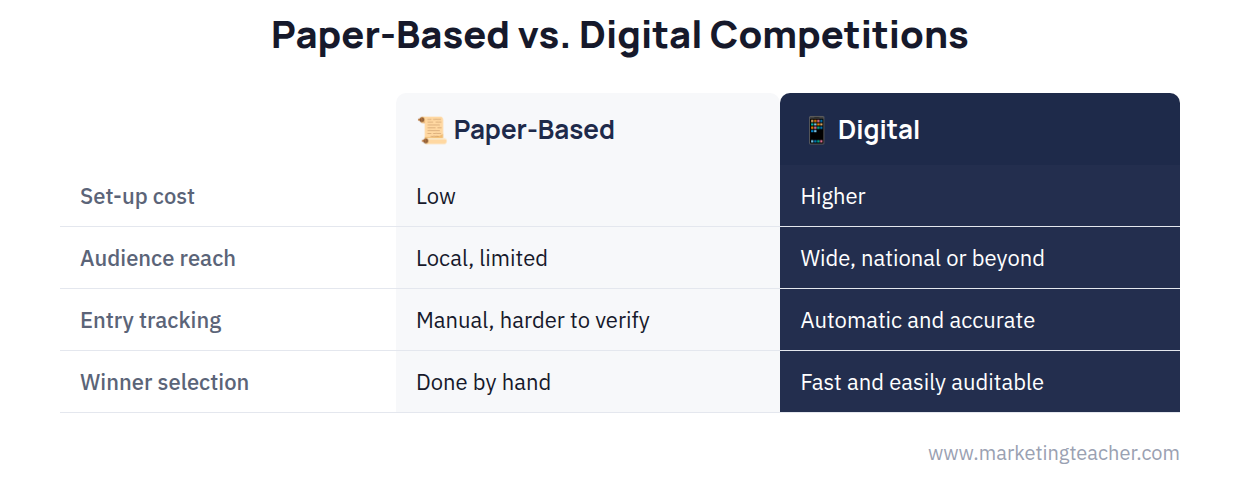
Games, draws and competitions are a category of price promotion, a form of sales promotion that offers customers a chance of winning something rather than a guaranteed discount. Belch and Belch (2012) group these alongside coupons and sampling as consumer sales promotion tools whose main appeal to a business is that the cost can usually be calculated fairly precisely in advance, a fixed prize budget and administration cost, rather than an open-ended discount that scales unpredictably with how many customers redeem it.
Games, Draws and Straightforward Competitions
The three formats work differently. A game is a structured activity, traditionally something like a bingo card or a printed crossword, and now often a short digital activity played online, that gives a customer an entertaining reason to keep engaging with a brand. A draw is a lottery-style promotion in which every entrant is given a ticket or a number, and winners are selected at random from among them. A competition, in the stricter sense, asks entrants to demonstrate some genuine skill, such as a photograph, a short piece of writing, or a creative idea, and judges entries against each other rather than drawing a name at random. This last distinction matters practically as well as semantically, since games of pure chance and genuine skill-based competitions are often treated differently under local promotional and gambling regulations, which is worth checking before launching either.
Paper-Based vs Digital: A Cost and Reach Trade-off
A simple paper-based competition, a printed entry form or a physical ticket, is almost always cheaper to run than its digital counterpart, which needs a website, an entry system, and often some ongoing technical support. Belch and Belch (2012) note that digital formats have become considerably more elaborate as marketing itself has moved online, and the trade-off a business faces is straightforward: paper costs less to set up but reaches a smaller, more local audience and is harder to verify and track, while a digital format costs more but reaches further, makes entries easier to count accurately, and simplifies picking and contacting a winner fairly.
What Makes a Competition Actually Work as Promotion
A competition only earns its cost back if it attracts the right entrants rather than just the largest number of them. A prize that is genuinely relevant to the business’s own target customer, such as its own products or a related experience, tends to attract people who are actually interested in the business, while a generic prize like cash or a popular gadget mostly attracts people chasing the prize itself, whether or not they have any interest in becoming a customer. Building a purchase or a genuine brand interaction into the entry requirement, as in the example above, keeps the promotion connected to actual sales rather than simply collecting email addresses.
Measuring Whether the Competition Paid Off
A competition’s cost is easy to calculate in advance, but its return needs measuring just as deliberately once it ends. Counting entries alone says little; comparing sales or new customer sign-ups during the competition period against a typical period, tracking how many entrants went on to make a repeat purchase, and noting how far the competition’s content, such as the winning photos, was shared afterward all give a fuller picture of whether it was worth repeating. A competition that generates a large number of entries but few actual customers is usually a sign the entry requirement was not closely enough tied to buying from the business.
Setting Clear, Fair Terms From the Start
Every competition needs plain, visible terms covering who can enter, how a winner is chosen, and by when, published before a single entry is accepted rather than decided informally afterward. Clear terms protect the business from disputes if a decision is challenged, and they protect entrants by making the promotion feel genuinely fair, which matters directly to whether people trust the brand enough to enter the next one.
Summary
Competitions, draws and games give a business a calculable-cost way to run a sales promotion, and Belch and Belch (2012) place them alongside coupons and sampling as standard consumer promotion tools. The choice between a paper-based and a digital format comes down to a genuine trade-off between lower cost and narrower reach versus higher cost and wider, more trackable reach, while the promotion’s actual success depends less on the format than on choosing a prize and entry requirement that attract real potential customers rather than prize hunters.
The slides, worksheet, lesson plan and poster for this lesson are free to download and free to use in your course — no sign-up, no permission needed. See the teacher resources →
Assign this lesson to your class:
Using Canvas, Blackboard or Moodle? Copy the link and paste it into your course page or assignment. More ways to add lessons to your LMS.

