
Advertising for Entrepreneurs
Why Entrepreneurs Need a Clear Advertising Objective
Advertising sends a single message to a large number of potential customers at once, which makes it powerful and, for a small business with a limited budget, genuinely risky if it is done without a clear purpose. Belch and Belch (2012) frame effective promotion as starting from a specific communication objective rather than a vague wish to “get noticed,” and for an entrepreneur that discipline matters even more, because a poorly targeted or overcomplicated campaign can absorb a start-up’s entire marketing budget with nothing to show for it. Two simple rules keep a campaign grounded: aim it at the specific potential customers you actually need to reach, and hold it to a standard of being genuinely cost effective for the size of the business running it.
Building a Simple Plan Before Spending Anything
It is easy to be drawn into an expensive, overcomplicated campaign that targets people who were never likely to buy in the first place. Before choosing a specific advertising channel, a new business benefits from a quick plan: who exactly the advertising needs to reach, what single objective it is meant to achieve, and what a realistic budget looks like given the size and stage of the business. That short planning step, done honestly, prevents most of the wasted spend that sinks a first-time advertiser’s budget.
You Won’t Always See an Immediate Increase in Sales
A new advertiser often expects a direct, immediate jump in sales from every pound spent, but advertising serves several distinct purposes, and not all of them show up on the till roll the same week. Understanding which objective a campaign is actually pursuing is what makes it possible to judge whether it worked at all.
The Five Objectives Advertising Can Pursue
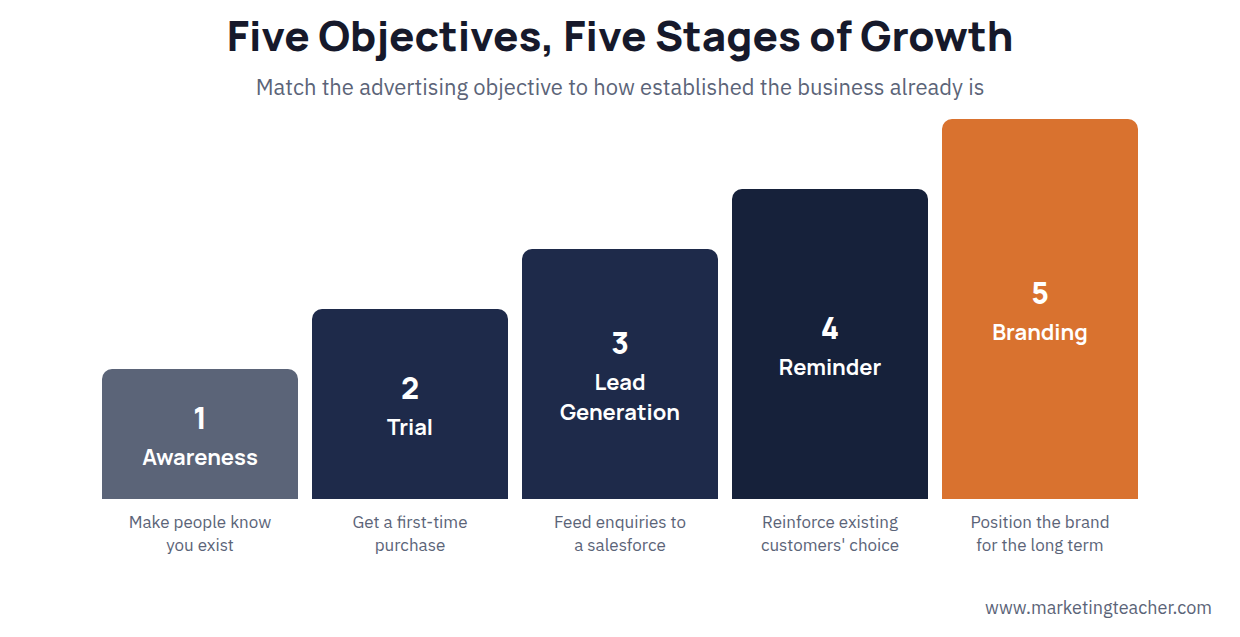
Awareness is the simplest objective: making potential customers aware that a product or service exists at all, which matters most in the earliest days of a new business. Trial follows naturally when the product or service is new to the market, and the advertising’s job is to persuade a potential customer to try it for the first time rather than to buy repeatedly. Lead generation supports a salesforce already in the field, using advertising to generate useful enquiries a salesperson can then follow up directly. Reminder advertising, often the least glamorous, simply reinforces an existing customer’s decision to keep buying, or nudges someone who was close to purchasing to actually go ahead. Branding, the most detailed and comprehensive objective, aims to position a product or service in a customer’s mind over the long term, though it is also the most expensive and time-consuming objective to pursue properly, so it needs to be approached with genuine caution by a business with limited resources.
Choosing the Right Objective for the Business’s Stage
A brand-new business rarely has the budget or the customer base to justify a full branding campaign, and is usually far better served by awareness or trial advertising aimed narrowly at the customers most likely to buy soon. As a business matures and repeat custom becomes more important than first-time trial, reminder advertising becomes more valuable, and only once a business has a track record and a stable customer base does investing in deliberate branding, such as a local endorsement, a demonstration of the product in use, or a clearly communicated price promotion, start to make sense.
Keeping the Message Consistent
Whichever objective a campaign pursues, it should be based on genuine research into what customers actually want to hear, gathered by talking to them directly rather than guessing. Every piece of advertising and promotion a business runs needs to stay consistent with the others, since mixed or contradictory messages confuse potential customers faster than a single clear, if narrower, message ever would.
Measuring Whether an Objective Was Actually Met
Each of the five objectives calls for a different measure of success, and confusing them is a common mistake for a first-time advertiser. Awareness is best judged by asking customers directly whether they have heard of the business, not by sales figures. Trial is judged by counting genuinely new customers rather than repeat ones, lead generation by the number and quality of enquiries a salesforce actually receives, reminder by repeat purchase rates among an existing customer base, and branding by longer-term shifts in how customers describe or recognise the business, which rarely shows up within the timeframe of a single campaign.
Summary
Advertising is powerful precisely because it reaches many potential customers at once, which is exactly why an entrepreneur needs a clear objective and a realistic budget before spending anything (Belch and Belch, 2012). A new business is usually best served by narrow awareness or trial advertising, while reminder and branding objectives become worthwhile only as the business matures, and keeping every piece of advertising and promotion consistent is what stops a limited budget from working against itself.
The slides, worksheet, lesson plan and poster for this lesson are free to download and free to use in your course — no sign-up, no permission needed.

