
Using Giveaways and Premiums in Marketing
Using Giveaways and Premiums in Marketing
A giveaway, also called a premium, is a product or service offered free or at a reduced price to give customers an extra incentive to buy. Belch and Belch (2012) group premiums alongside coupons, rebates and sampling as standard consumer sales promotion tools, each suited to a slightly different marketing goal, whether that is encouraging a first trial purchase, rewarding an existing customer, or simply adding perceived value to a purchase a customer was already going to make.
The Main Types of Giveaway
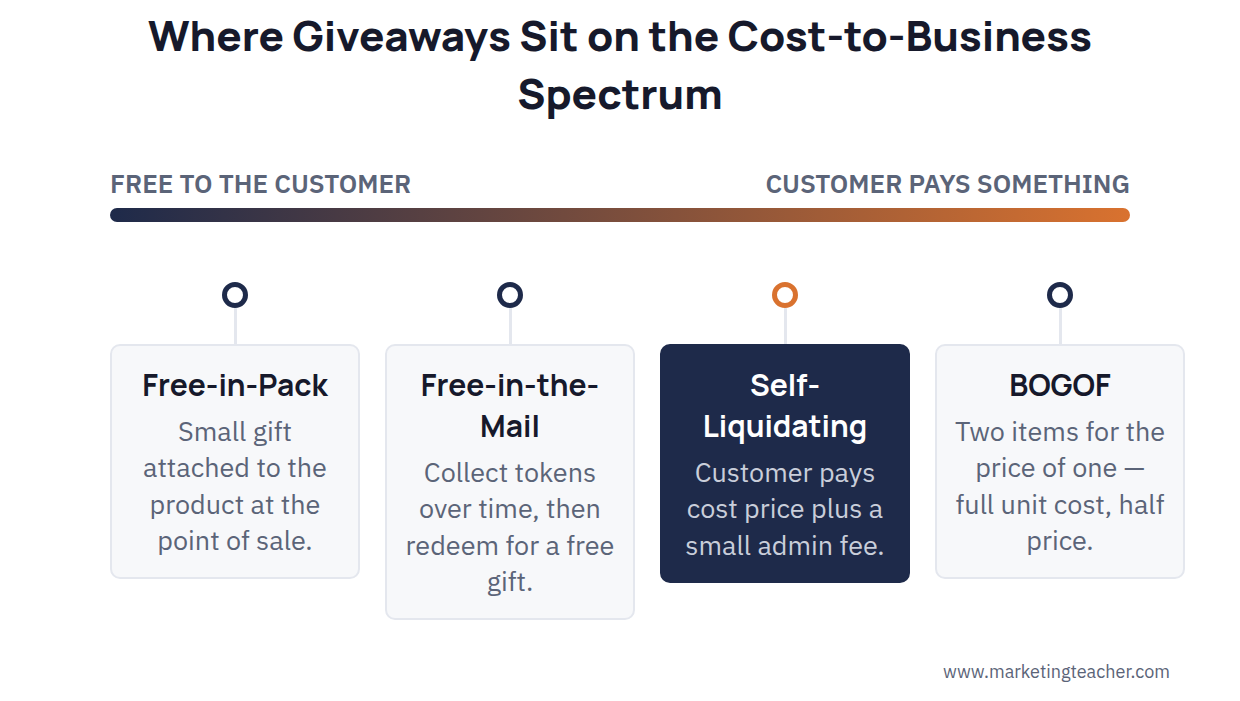
A free-in-pack or on-pack gift is a small item attached to or included with the product as it is sold, giving an immediate, visible bonus at the point of purchase. A free-in-the-mail giveaway asks the customer to collect tokens, proofs of purchase or packaging and post them off to redeem a free gift later, which spreads the cost over a longer campaign and rewards repeat purchases rather than a single sale. A buy-one-get-one-free offer, usually shortened to BOGOF, gives the customer two items for the price of one; from the customer’s point of view this feels like a straightforward half-price deal, though the business is really just doubling its unit cost of goods against a single sale price.
Why a Self-Liquidating Offer Is Different From a Free Gift
Not every giveaway is genuinely free to the customer. A self-liquidating offer lets a customer buy an item at a price that covers the business’s own cost plus a small administration fee, so the promotion pays for itself rather than being subsidised out of margin. The customer still benefits, since the price is well below what the item would cost at retail, and the business benefits from buying the gifts in bulk at a lower unit cost than the price it charges. The main risk is being left holding unsold stock, so the offer needs a firm redemption deadline and a bulk order sized to realistic demand rather than a hopeful guess.
The Risk of Devaluing Your Product
A giveaway that runs too often, or that becomes something customers expect as standard, stops feeling like a bonus and starts feeling like part of the product they are already paying for. This matters most for a business trying to build a premium or high-quality image, since a constant stream of free extras can quietly signal that the core product alone is not worth the full price. A giveaway used sparingly, and tied to a specific goal such as a new product launch or a slow sales period, keeps its impact as a genuine incentive rather than becoming an expected discount in disguise.
Choosing the Right Giveaway for Your Goal
The right format depends on what the promotion is actually meant to achieve. A free-in-pack gift suits driving an immediate first purchase, since the reward is visible on the shelf at the moment of decision. A free-in-the-mail offer suits building loyalty over several purchases, since the customer has to keep buying to collect enough proofs of purchase. A self-liquidating offer suits adding perceived value without touching margin at all, which makes it a reasonable choice even for a business that cannot afford to give anything away outright. Matching the format to the goal, rather than picking whichever seems easiest to run, is what keeps a giveaway working as a genuine sales promotion tool.
Measuring Whether a Giveaway Actually Worked
A giveaway’s redemption rate on its own says little about whether it paid off. Comparing sales of the promoted product against a normal period, tracking how many redeemers went on to buy again without a gift attached, and checking whether the promotion drew genuinely new customers rather than simply rewarding people who were already loyal all give a clearer picture. A free-in-the-mail offer with a low redemption rate is not automatically a failure either, since a business only pays out on the gifts that are actually claimed, which is part of why the format appeals to businesses wary of an open-ended cost.
Summary
Giveaways and premiums, one of the standard consumer sales promotion tools identified by Belch and Belch (2012), give a business several distinct ways to add incentive to a purchase, from a free-in-pack gift through to a self-liquidating offer that covers its own cost. Choosing the right type for the actual marketing goal, and using it sparingly enough that it stays a genuine bonus rather than an expected discount, is what separates an effective giveaway from one that simply erodes margin or product perception over time.
The slides, worksheet, lesson plan and poster for this lesson are free to download and free to use in your course — no sign-up, no permission needed.

