
Money-Off Deals and Discounting as a Sales Promotion Tool
Money-Off Deals and Discounting as a Sales Promotion Tool
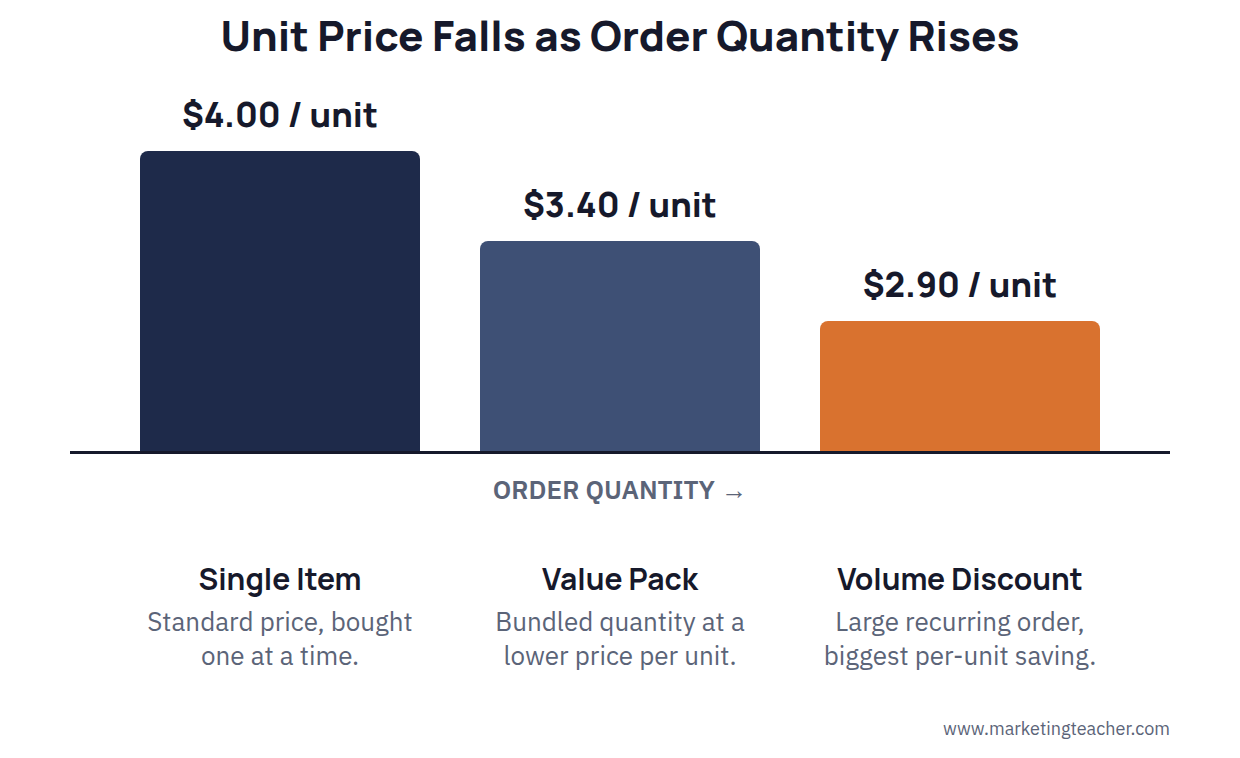
A money-off deal offers a customer a straightforward reduction on the usual price, giving an immediate, easily understood increase in value for whatever they pay. Belch and Belch (2012) place price-based promotions like this alongside premiums, coupons and rebates as standard consumer sales promotion tools, and note that their main strength is speed: a money-off deal is one of the fastest ways to prompt a hesitant customer to try a product or to lift sales during a slow period.
Value Packs and Volume Discounting
A money-off deal does not have to be a simple percentage cut. A value pack sells a larger quantity of the product for a lower price per unit than buying single items separately, which rewards a customer for buying more in one transaction without cutting the headline price of a single item. Volume discounting works on a similar principle at a bigger scale, usually in business-to-business selling, where a customer earns a lower unit price by committing to a larger order, and the business benefits from a bigger single sale and lower per-unit handling costs even after the discount.
Working Out Your Costing Before You Discount
A discount that looks generous to a customer can quietly erase a business’s margin if the costing was not worked out properly beforehand. Before agreeing to any money-off deal or volume discount, a business needs to know its true unit cost, including the cost of handling a bigger single order, so that the discounted price still covers costs and leaves a worthwhile margin. Working out a discount structure in advance, before a customer asks for one in a negotiation, keeps a business from agreeing to a number on the spot that it later regrets, and it also means every customer negotiating a similar order size is offered a broadly consistent deal rather than whatever figure feels reasonable in the moment.
The Risk to a Premium or High-Quality Image
Discounting sends a signal about a product’s value, and that signal can work against a business that wants to be seen as premium or high quality. A product discounted too often, or too deeply, risks teaching customers to wait for the next deal rather than buying at full price, and can make the product feel like it was never really worth its original price in the first place. A business protecting a premium image is usually better served by a value pack, which rewards volume without cutting the per-unit price customers see advertised, than by a straightforward price cut applied across the board.
Deciding When a Money-Off Deal Makes Sense
A money-off deal earns its cost back fastest when it is used for a clear, time-limited purpose: clearing ageing stock, encouraging trial of a new product, or lifting sales during a predictably slow period. Used constantly, without a specific reason attached, the same deal stops feeling like a promotion and starts feeling like the product’s real price, which removes the very incentive effect the discount was meant to create in the first place.
Checking a Discount Actually Paid for Itself
A money-off deal’s real cost is not just the reduction on the sticker price, but that reduction multiplied across every unit sold at the discounted rate, including customers who would have bought at full price anyway. Comparing total revenue and margin during the promotion against a comparable normal period, not just counting units sold, is what shows whether the extra volume genuinely made up for the lower price per unit. A deal that moves a large amount of stock but at a margin too thin to cover fixed costs has not really paid for itself, however impressive the sales figures look on their own.
Summary
Money-off deals are among the fastest sales promotion tools for prompting a purchase, and Belch and Belch (2012) group them with premiums, coupons and rebates as standard consumer promotion techniques. Value packs and volume discounts extend the same basic idea to reward bigger orders without cutting a headline price, but every version of discounting needs careful costing beforehand and a clear time-limited reason, since discounting used too often can quietly damage a product’s perceived value rather than simply boosting short-term sales.
The slides, worksheet, lesson plan and poster for this lesson are free to download and free to use in your course — no sign-up, no permission needed.

