
What Is Guerrilla Marketing?
What Is Guerrilla Marketing?
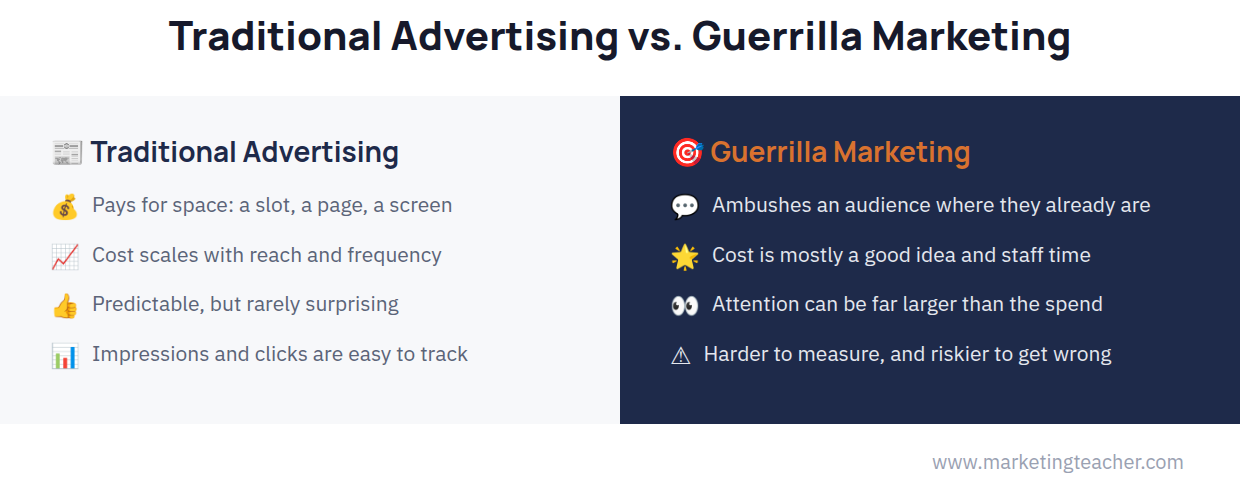
Guerrilla marketing is the use of unconventional, low-cost tactics that surprise an audience in an unexpected place, rather than paying for advertising space through the usual channels. Jay Conrad Levinson coined the term in his 1984 book Guerrilla Marketing, aimed specifically at small businesses looking to compete with larger advertisers on ideas rather than budget. Hutter and Hoffmann (2011) describe the concept more formally as surprise-based tactics that aim for attention and word-of-mouth diffusion out of proportion to what was actually spent on them.
Ambushing an Audience, Rather Than Buying Their Attention
Where traditional advertising pays for a slot, a page, or a screen, guerrilla marketing tries to intercept an audience somewhere they are not expecting to be marketed to. A celebrity or sports team visiting a town, a trade show organised by an industry association, or simply a busy high street can all become the setting: a branded T-shirt worn at exactly the right event, a banner displayed where a crowd is already gathered, or a projection of a logo onto a prominent local building are all classic examples that cost little beyond the idea and the effort of carrying it out.
Why It Suits a Small Business Specifically
Cost is the main reason guerrilla marketing appeals to a small business: a good idea, some staff time, and a small amount of materials can replace a marketing spend a larger competitor would need for the same reach. This fits directly into the budget step of a small business advertising plan, since a guerrilla tactic can often deliver attention a modest budget could never buy through paid media alone. Hutter and Hoffmann (2011) point to exactly this kind of outsized attention relative to spend as the concept’s central appeal, though they are also careful to note that solid, independent evidence of how well guerrilla tactics actually perform is still fairly limited.
The Real Risks Worth Weighing Before You Try It
A stunt that surprises people can also annoy or offend them if it is judged badly, and a business needs to think honestly about how its idea will land with people who did not choose to be marketed to at that moment. Practical risks matter just as much: using public property, referencing a trademark, or gathering a crowd can all raise permission and safety questions that a business should check before going ahead, and a guerrilla tactic’s informal nature makes its results harder to measure reliably than a tracked digital campaign.
Judging Whether a Stunt Actually Worked
Because a guerrilla tactic rarely comes with a click-through rate or an impression count, a business needs to decide in advance how it will judge success. Counting social media mentions and shares, watching for a spike in foot traffic or website visits around the time of the stunt, and simply asking new customers how they heard about the business are all workable substitutes for the kind of precise tracking a digital advert offers. Word of mouth is often the real goal of a guerrilla tactic in the first place, since a stunt that gets people talking and sharing photos of it can reach a far larger audience than the people who witnessed it directly, but that spread has to be actively watched for rather than assumed.
A Few Practical Tactics to Start With
A business new to guerrilla marketing does not need anything elaborate to begin: branded clothing worn at an industry event, temporary chalk art on a public pavement outside a shop, a flash offer tied to a local event happening nearby, or a projection display arranged with the building owner’s permission are all accessible starting points. The common thread across all of them is finding a moment and a place where the target audience already is, rather than paying to bring an audience to the business’s own message.
Summary
Guerrilla marketing, a term coined by Levinson in 1984, uses unconventional, low-cost tactics to surprise an audience rather than buying conventional advertising space, and Hutter and Hoffmann (2011) frame its appeal as attention gained out of proportion to what was spent. It suits a small business’s constrained budget particularly well, but a business still needs to weigh reputational, permission and measurement risks carefully before committing to a stunt, since a guerrilla tactic that misjudges its audience can damage a brand as easily as a well-judged one can build it.
The slides, worksheet, lesson plan and poster for this lesson are free to download and free to use in your course — no sign-up, no permission needed.

