
How to Write a Small Business Advertising Plan
Why Bother Planning Before You Advertise?
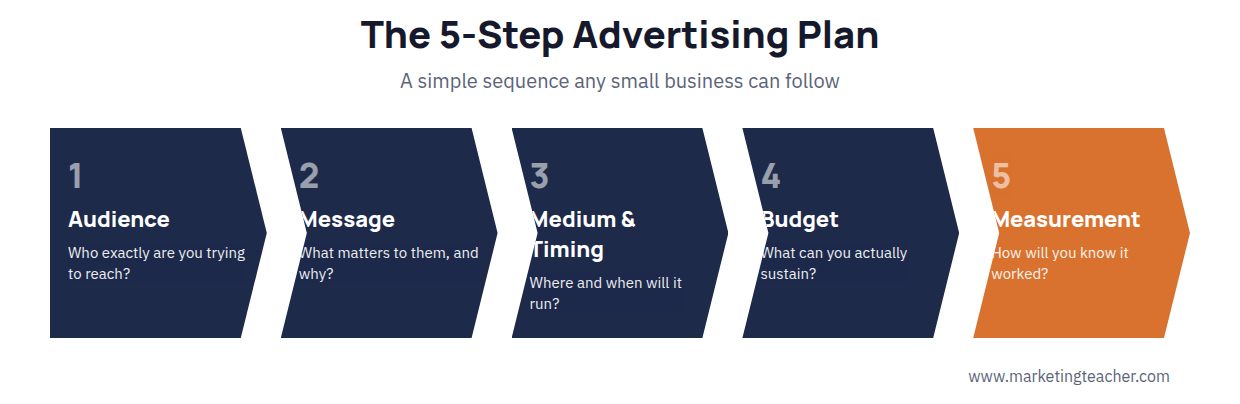
It is tempting for a small business owner to jump straight to booking a newspaper advert or a radio slot without first working out what the advertising actually needs to achieve. Belch and Belch’s (2012) treatment of advertising and promotion planning sets out a structured sequence, moving from audience and message through to media choice, budget and evaluation, that applies just as much to a modest local campaign as to a national one. A short written plan, even a single page, protects a small business from being sold more advertising than it needs and gives it a clear basis for judging afterward whether the money was well spent.
Step One: Who Are You Actually Talking To?
Every advertising plan starts with the target audience: the specific group of potential customers the advertising is meant to reach, described in as much practical detail as possible rather than as “everyone.” A small bakery’s target audience might be households within a short walk of the shop, while a niche online retailer’s audience might be defined by interest rather than location. Getting this step right shapes every decision that follows, since the right message and the right medium both depend on knowing exactly who the advertising is trying to reach.
Step Two: What Do You Need to Say, and Why Does It Matter to Them?
Once the audience is clear, the plan needs a message: what the business wants to communicate, and why that matters to the audience rather than to the business itself. This usually means describing the product or service’s benefits in terms the customer cares about, such as convenience, price or quality, rather than simply listing features, and explaining why the business is a better choice than the competition. A consistent message across every advert also builds a recognisable brand over time, rather than each advert feeling disconnected from the last.
Step Three: Choosing the Right Medium and Timing
With the audience and message settled, the plan turns to which type of advertising will actually reach that audience, and whether the business will use one medium or blend several, such as a local newspaper alongside social media. Whatever the mix, the message needs to stay consistent across every medium used. Timing matters just as much as the choice of medium: a seasonal product benefits from advertising that builds up before its peak period, while a service business might time a campaign to a traditionally quiet period it wants to fill.
Step Four: Setting a Budget You Can Actually Commit To
Every advertising plan needs a budget, and setting one honestly, based on what the business can afford to commit for the length of the campaign, is more useful than an ambitious figure that gets abandoned halfway through. Carson, Cromie, McGowan and Hill’s (1995) research on entrepreneurial marketing points to exactly this kind of resource-constrained decision-making as typical of how smaller firms actually plan: the right budget is the one a small business can sustain long enough to give the advertising a fair chance to work, not the largest figure it can theoretically stretch to.
Step Five: Deciding How You Will Measure Success
The final step, often skipped by small businesses in a hurry to get an advert out, is deciding in advance how success will be measured. Sales are the most direct measure, but footfall, a returned voucher, or simply asking new customers how they heard about the business are all workable substitutes when a direct sales link is hard to trace. Deciding on the measurement method before the campaign runs, rather than trying to reconstruct one afterward, is what turns advertising from a hopeful expense into something a small business can actually evaluate and improve on next time.
Summary
A small business does not need a lengthy formal document to plan its advertising, but working through the same sequence a larger advertiser would use, target audience, message, medium and timing, budget, and measurement, protects it from wasted spend and gives it a genuine basis for judging results. Belch and Belch (2012) set out this planning logic in detail, while Carson, Cromie, McGowan and Hill’s (1995) work on entrepreneurial marketing is a reminder that the right budget and campaign length for a small business are the ones it can actually sustain, not the most ambitious ones on paper.
The slides, worksheet, lesson plan and poster for this lesson are free to download and free to use in your course — no sign-up, no permission needed.

