
Why Measurement Starts Before the Campaign Launches
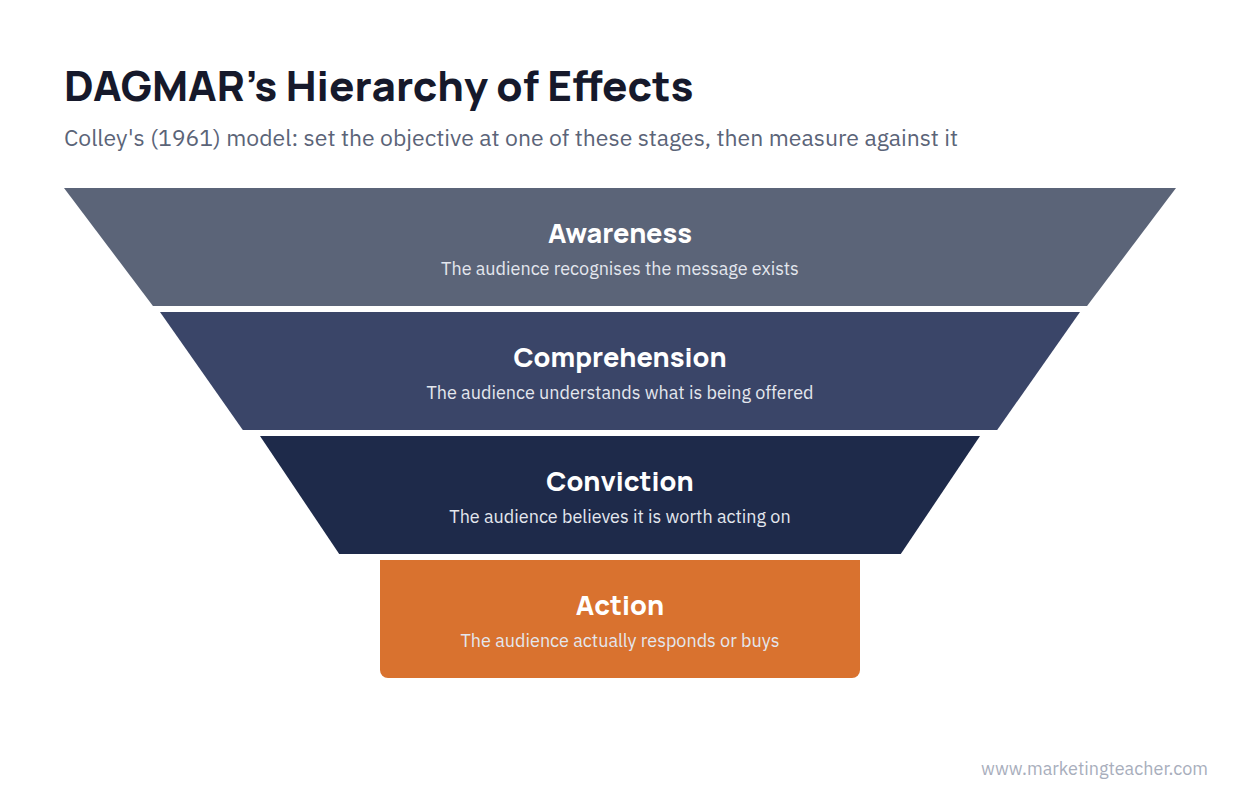
A campaign cannot be judged a success or failure without first knowing what it was trying to achieve. Colley’s (1961) DAGMAR model (Defining Advertising Goals for Measured Advertising Results) argues that a campaign should set a specific, measurable communication objective in advance, tracked through a hierarchy of effects: moving a target audience from awareness of a message, to comprehension of what it means, to conviction that it is worth acting on, and finally to action itself. Without a pre-set objective at one of these stages, such as “raise awareness among 30% of the target audience” or “generate 200 qualified enquiries,” there is no benchmark to measure the campaign against once it ends, only a pile of activity data with no clear verdict attached to it.
Outputs, Outcomes and the AVE Trap
Once a campaign is running, it is tempting to measure whatever is easiest to count, but the AMEC Barcelona Principles (2010), an internationally adopted framework for communication measurement, draw a sharp line between outputs and outcomes. Outputs are simple activity counts, such as the number of press mentions, social posts, or coupons handed out. Outcomes measure whether that activity actually changed something that matters, such as a shift in awareness, attitude, enquiries or sales. The Barcelona Principles explicitly reject Advertising Value Equivalents (AVEs), a once-common practice of converting press coverage into a notional advertising-spend value, as a meaningless measure of communication’s real worth, since a large volume of low-quality or irrelevant coverage is not the same as a small amount of coverage that actually reaches and moves the target audience.
Practical Ways to Capture the Data
Turning this into a working measurement system does not require expensive tools. Sales and enquiry records, kept consistently before, during and after a campaign, show whether purchasing actually increased during the promotional period. A clear call to action, such as a dedicated phone number, email address or discount code used only in that campaign, makes it possible to trace a response back to the specific activity that generated it. Coupons, loyalty cards and competition entries all work the same way: each redemption or entry is a data point that can be tied to a source. Simply asking a new customer how they heard about the business, and recording the answer consistently, remains one of the cheapest and most reliable ways to attribute a sale to a specific channel, whether that is PR coverage, an advert, or a personal recommendation.
Choosing the Right Metric for the Objective
Not every campaign should be measured the same way, because not every campaign is trying to move a target audience to the same stage of Colley’s (1961) hierarchy. A brand-awareness campaign is better judged through a recall or recognition survey than through a sales figure, since its objective sits earlier in the hierarchy and a direct sales lift may not appear for months. A direct-response campaign, such as a coupon-led promotion or a PPC advert, sits much further along the hierarchy, closer to action, so tracking redemptions, clicks and conversions is the appropriate measure. Applying a conversion-rate metric to an awareness campaign, or a recall survey to a direct-response promotion, produces a misleading verdict simply because the metric was never designed to capture that stage of the customer’s response.
Turning Data Into a Verdict
Once the data is in, it needs to be compared against the objective set at the start, not against a vague sense of whether the campaign “felt” successful. If the pre-set goal was 200 qualified enquiries and the campaign generated 340, that is a clear result; if it generated 90, that is also a clear result, and one worth investigating rather than ignoring. Calculating the return on investment of the campaign, by weighing the value generated against what the campaign cost to run, turns a simple pass or fail into a genuine business decision about whether to repeat, scale up or drop that approach next time.
Summary
Effective campaign measurement starts with a specific, pre-set objective, ideally mapped to a stage in a hierarchy of effects such as Colley’s (1961) DAGMAR model, rather than being decided after the fact. The Barcelona Principles (AMEC, 2010) show why outcomes, not output volume or discredited measures such as Advertising Value Equivalents, are what a campaign should actually be judged on. Consistent, simple data capture, from a unique call to action to a straightforward “how did you hear about us” question, is what makes that comparison against the original objective possible at all.
The slides, worksheet, lesson plan and poster for this lesson are free to download and free to use in your course — no sign-up, no permission needed.

