
Why Consumer Behavior Is Largely Learned
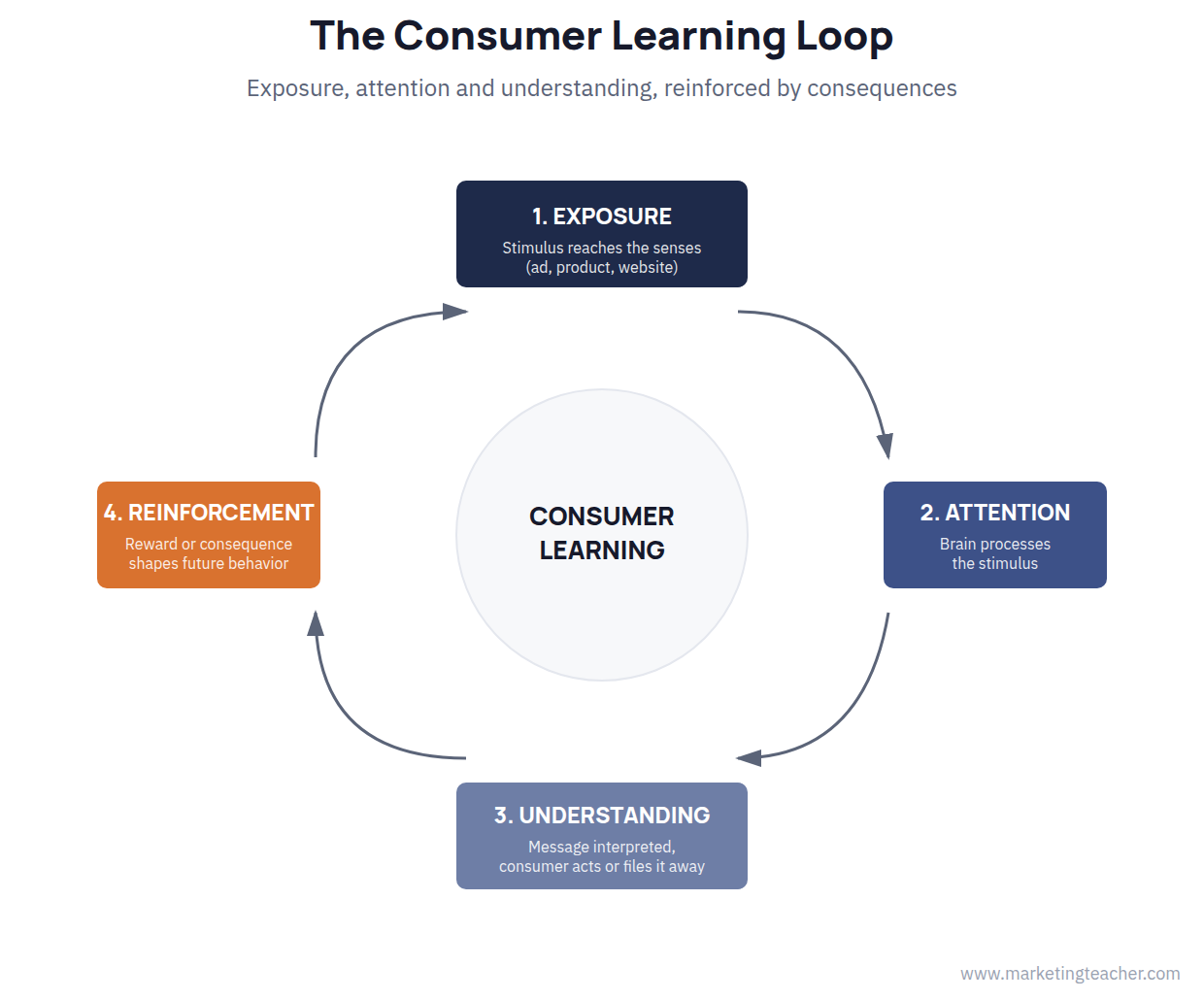
Most of what a consumer believes, values and prefers is not fixed from birth, it is learned through experience. Learning is any relatively permanent change in behavior that results from a person’s interaction with their environment. A shopper who tries a new brand of coffee and dislikes it learns to avoid that brand on future trips, while one who has a pleasant experience with a retailer’s customer service learns to return there first. Two long-standing psychological theories explain much of how this learning happens.
Classical Conditioning
Classical conditioning, first described by Pavlov (1927) in his well-known experiments with dogs, occurs when a neutral stimulus becomes associated with a stimulus that already produces a response, until the neutral stimulus alone can trigger a similar response. In marketing, a brand can become associated with pleasant music, an appealing setting or a likeable spokesperson, until the brand name itself starts to trigger a positive feeling independent of the product’s actual features. This is one reason brands invest heavily in the tone and imagery of their advertising even when the underlying product has not changed.
Operant Conditioning
Operant conditioning, described by Skinner (1938), occurs when behavior is shaped by its consequences: a behavior followed by a reward is more likely to be repeated, while a behavior followed by a negative outcome is less likely to be repeated. Loyalty programmes, discounts on repeat purchases and satisfying product experiences all function as reinforcement, making a consumer more likely to buy the same brand again. A late delivery, a rude customer service interaction or a product that fails to perform functions as a mild punishment, making a consumer less likely to return, even if they never consciously connect the two events.
The Consumer Learning Process: Exposure, Attention, Understanding
Beyond conditioning, consumer behavior textbooks commonly describe learning as unfolding across three practical stages once a message reaches a consumer. Exposure occurs when a stimulus, an advertisement, a product on a shelf, a website, comes within range of at least one of the consumer’s senses. Attention occurs when the consumer actually processes that stimulus rather than filtering it out, which is far from guaranteed given how many messages compete for attention on any given day. Understanding occurs when the consumer interprets the information and acts on it, whether that means buying the product, dismissing the message, searching for more information, or simply filing it away for a future purchase decision. A message that fails at any one of these three stages, never seen, seen but ignored, or seen but misunderstood, cannot teach the consumer anything at all.
Stimulus Generalization and Discrimination
Two related concepts help explain how learned associations spread, or fail to spread, across products. Stimulus generalization occurs when a consumer responds to a new stimulus in the same way they respond to an original one because the two seem similar, which is why a trusted brand can often extend successfully into a new product category, since consumers transfer their existing positive association to the new item bearing the same name. Stimulus discrimination is the opposite: consumers learn to tell two similar stimuli apart and respond to them differently, which is why a store-brand product in near-identical packaging to a market leader does not automatically inherit that leader’s reputation once shoppers learn to recognise the difference. Marketers rely on generalization when launching brand extensions, and work to encourage discrimination when trying to differentiate their own product from a close competitor’s.
Learning and Brand Loyalty
Repetition plays a central role in both classical and operant conditioning, and it is one reason consistent, repeated exposure to a brand’s message tends to be more effective than a single, more expensive burst of advertising. Companies that help customers learn about their products clearly, and that consistently pair their brand with a positive experience, build a genuine competitive advantage over time. This is also why a single bad experience can undo a long history of positive reinforcement, since the negative consequence can outweigh many smaller positive ones in shaping future behavior. Social influences reinforce this learning too: watching other people be rewarded or penalised for a purchase decision, whether through a friend’s recommendation or a public review, can teach a consumer a lesson they never directly experienced themselves.
Summary
Consumer learning draws on two classic psychological mechanisms, classical conditioning through association (Pavlov, 1927) and operant conditioning through consequences (Skinner, 1938), as well as a practical three-stage process of exposure, attention and understanding by which a specific message actually changes what a consumer believes or does. Marketers who understand which mechanism is at work, association, reinforcement, or straightforward information processing, can design messages, rewards and experiences that build the kind of repeated, positive learning that turns a first-time buyer into a loyal customer.
The slides, worksheet, lesson plan and poster for this lesson are free to download and free to use in your course — no sign-up, no permission needed. See the teacher resources →
Assign this lesson to your class:
Using Canvas, Blackboard or Moodle? Copy the link and paste it into your course page or assignment. More ways to add lessons to your LMS.

