
How Do Lifestyle and Attitude Shape Consumer Behavior?
Lifestyle and attitude are two closely related internal influences that help marketers understand not just what a consumer buys, but why a particular message will or will not land with them. Lifestyle describes the pattern of how a person spends their time and money, while attitude describes how they evaluate a specific product, brand or issue. Together they help explain why two consumers with similar demographics can respond completely differently to the same advertisement.
Lifestyle Segmentation: The AIO Framework
Wells and Tigert (1971) propose that lifestyle can be measured and segmented using three categories: activities, interests and opinions, often shortened to the AIO framework. Activities cover how consumers spend their time, things like running, cooking, travelling or attending sporting events. Interests cover what consumers care about, such as family, fashion or community involvement. Opinions cover how consumers view themselves and the wider world, including their views on social issues, politics or their own achievements. Marketers use AIO surveys to group consumers into lifestyle segments that cut across traditional demographic categories, since two people of the same age and income can have very different activities, interests and opinions.
The Three Components of Attitude
Rosenberg and Hovland (1960) describe attitude as made up of three components: affect (feelings toward the object), behavior (actions or intentions toward it) and cognition (beliefs about it), sometimes shortened to the ABC model. These three components do not always form in the same order. In a high-involvement purchase such as a car, a consumer typically forms beliefs first, then feelings, then acts, a belief-affect-behavior sequence. In a low-involvement purchase, a consumer may act on habit before forming a strong feeling, a belief-behavior-affect sequence. In an experiential purchase, such as a spontaneous restaurant visit, feelings often come first, an affect-behavior-belief sequence. In a purely behavioral-influence situation, such as a impulse buy at a checkout, action can come before any belief or feeling has formed at all, a behavior-belief-affect sequence. Recognising which sequence applies to a given purchase helps a marketer decide whether a message should lead with facts, with feelings, or simply make the product easy to try.
How Attitudes Change: The Elaboration Likelihood Model
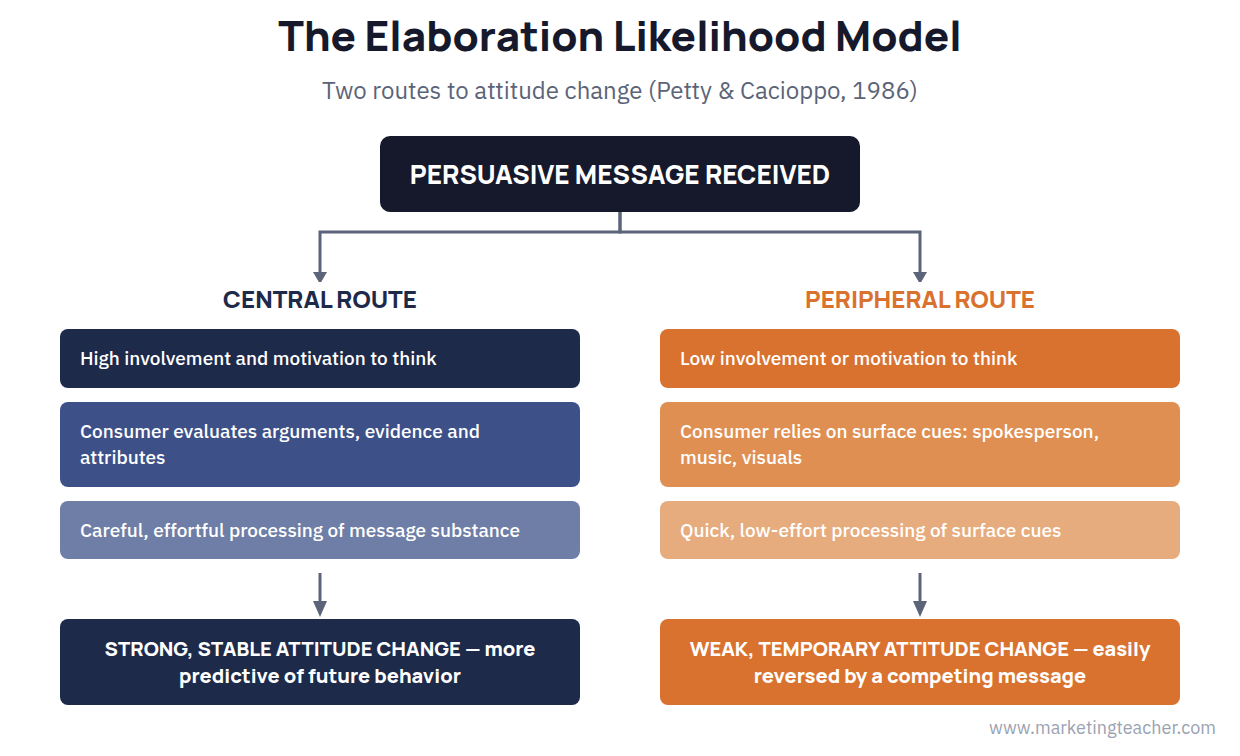
Petty and Cacioppo (1986) propose the Elaboration Likelihood Model (ELM) to explain how consumers process persuasive messages and change their attitudes. When a consumer is highly involved and motivated to think about a purchase, they follow the central route, carefully evaluating the actual arguments, evidence and product attributes in a message. When a consumer is not highly involved, or lacks the motivation or ability to process detailed information, they follow the peripheral route instead, relying on surface cues such as an attractive spokesperson, appealing music or an eye-catching visual rather than the substance of the message. Attitude change formed through the central route tends to be more stable and predictive of future behavior, while attitude change formed through the peripheral route is often weaker and more easily reversed by a competing message.
Social Judgment Theory
Sherif, Sherif and Nebergall (1965) offer a related explanation for how consumers evaluate incoming messages against their existing views. According to Social Judgment Theory, a consumer compares a new message to their current attitude and sorts it into a latitude of acceptance, a latitude of rejection, or a latitude of noncommitment. A message that falls within a consumer’s latitude of acceptance is judged favourably and can shift their attitude gradually, while a message that falls too far into their latitude of rejection is dismissed outright, and can sometimes make the original attitude even stronger. This is one reason marketers often make small, incremental claims rather than dramatic ones when trying to shift an already sceptical audience.
Aspirational Lifestyle Marketing
Many consumers hold two lifestyles in mind at once, the one they currently live and the one they would like to live, which is almost always presented as somehow better. Marketers frequently showcase people living this aspirational lifestyle in their advertising, rather than the consumer’s actual day-to-day reality, on the theory that consumers are drawn toward products associated with the life they want rather than the life they have. This is why advertising aimed at a given age group often features people who are slightly older, more accomplished or more adventurous than the target audience currently is, inviting the viewer to imagine themselves a step further along.
Summary
Lifestyle, measured through the AIO framework of activities, interests and opinions (Wells and Tigert, 1971), segments consumers by how they spend their time and what they value, while attitude is built from affect, behavior and cognition (Rosenberg and Hovland, 1960) in an order that depends on how involved the consumer is in the purchase. The Elaboration Likelihood Model (Petty and Cacioppo, 1986) and Social Judgment Theory (Sherif, Sherif and Nebergall, 1965) both help explain how and why a consumer’s attitude shifts, or fails to shift, in response to a marketing message. Together these frameworks help marketers decide not just what to say, but how to say it to a specific audience.
The slides, worksheet, lesson plan and poster for this lesson are free to download and free to use in your course — no sign-up, no permission needed. See the teacher resources →
Assign this lesson to your class:
Using Canvas, Blackboard or Moodle? Copy the link and paste it into your course page or assignment. More ways to add lessons to your LMS.

