
What Drives Consumers to Buy?
Motivation is an internal state that energizes and directs behavior toward satisfying a need. Once a consumer recognizes an unmet need, a state of tension exists that pushes them toward reducing that tension, and a purchase is often the route chosen to resolve it. Because only unmet needs actually motivate behavior, a marketer’s first task is identifying which genuine need a product satisfies, rather than assuming a want exists simply because a product is available.
Maslow’s Hierarchy of Needs Applied to Consumption
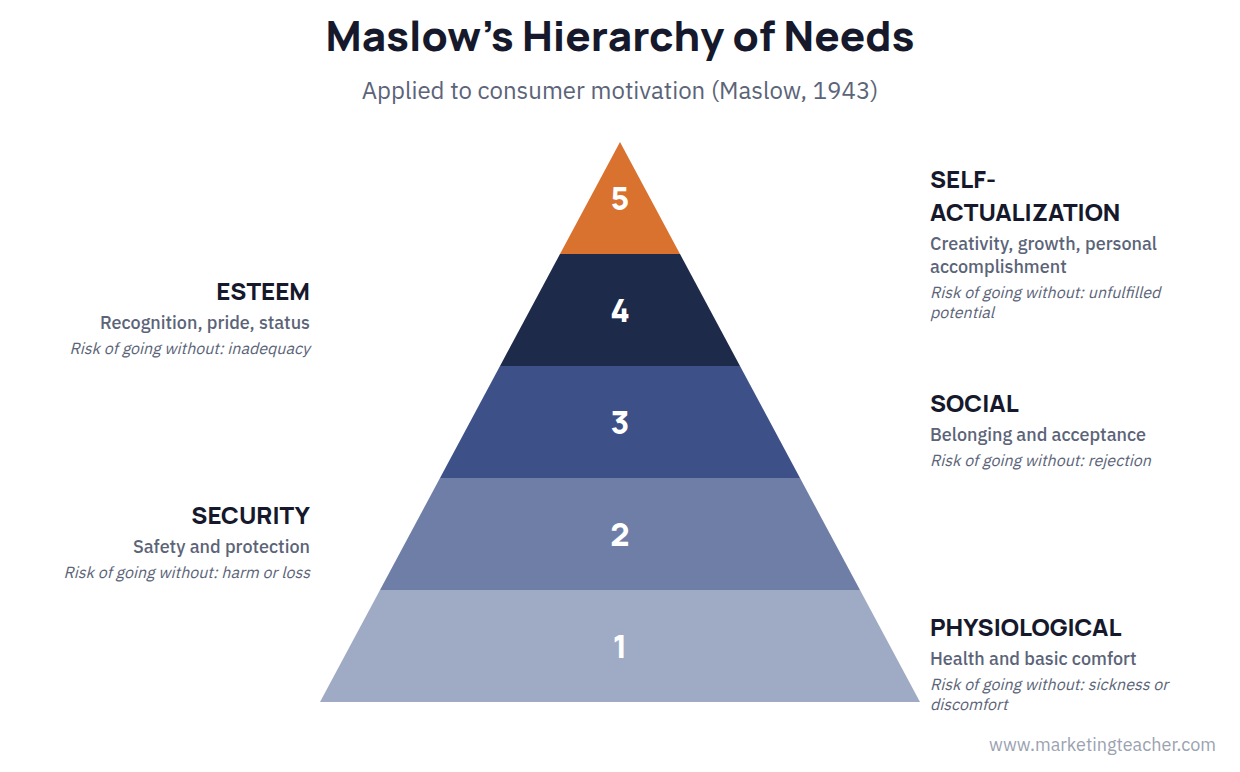
Maslow (1943) proposes that human needs fall into a hierarchy, with more basic needs generally taking priority over higher-level ones. Physiological needs, such as health and comfort, sit at the base, and products that satisfy them help consumers avoid sickness or discomfort. Security needs cover safety and protection, driving purchases such as insurance or protective equipment, with the fear of loss or harm as the consequence of going without. Social needs cover acceptance and belonging, motivating purchases that signal group membership, with rejection as the risk of not participating. Esteem needs cover pride, recognition and status, motivating purchases that build a consumer’s reputation, with failure or inadequacy as the underlying fear. Self-actualization sits at the top, covering creativity and personal accomplishment, motivating purchases that support a consumer’s growth or self-expression, with unfulfilled potential as the cost of neglecting it. A single product can sometimes address more than one level at once, which is part of why the hierarchy is a useful lens rather than a rigid checklist.
McGuire’s Psychological Motives
McGuire (1974) proposes a broader typology of psychological motives that explain why consumers behave the way they do, beyond Maslow’s needs-based structure. The need for consistency describes a desire to keep one’s purchases aligned with one’s existing identity and other choices. The need for affiliation describes a drive to build and maintain relationships, motivating purchases made to fit in with, or provide for, a social group. The need for novelty describes variety-seeking behavior, which can drive brand switching or impulse purchases, particularly among consumers whose lives otherwise feel stable and predictable. The need for assertion describes a drive to build self-esteem, both one’s own and in the eyes of others, motivating purchases that make a visible personal statement. The need for categorization describes a preference for sorting products into clear groups to make choices faster, which is part of why product categories and clearly labelled variants make shopping easier. The need for ego-defense describes a drive to protect one’s self-image, which can push more insecure consumers toward well-known, socially safe brand names rather than less familiar alternatives. McGuire’s full typology covers a wider range of similar motives, but even this shortlist illustrates how differently two consumers can be motivated to buy the same product, one for consistency with their existing identity, another purely for the sake of variety.
Why Motivation Research Matters
Understanding which need or motive genuinely drives a purchase changes how a product should be marketed. Selling a security-driven product on status grounds, or a status-driven product purely on functional merit, tends to under-perform because the message misses the need that is actually creating the tension the consumer wants resolved. Good motivation research, through interviews, surveys or observing actual purchase behavior, helps a marketer identify which needs or motives are really in play for a given audience, rather than assuming every customer buys a product for the same reason. It is also worth remembering that motivation can shift over time for the same customer, a product bought once purely out of security-driven necessity might later be repurchased for status or self-expression reasons once the basic need has been comfortably met, so motivation research is rarely a one-off exercise.
Summary
Motivation is the internal tension created by an unmet need, and Maslow’s (1943) hierarchy of needs offers one widely used framework for understanding which level of need, from physiological survival through to self-actualization, a purchase is intended to satisfy. McGuire’s (1974) broader typology of psychological motives, including needs for consistency, affiliation, novelty and assertion, explains additional, more specific reasons consumers buy. Because the same product can satisfy different needs for different people, effective marketing depends on identifying which need or motive is genuinely driving a given customer’s decision.
The slides, worksheet, lesson plan and poster for this lesson are free to download and free to use in your course — no sign-up, no permission needed. See the teacher resources →
Assign this lesson to your class:
Using Canvas, Blackboard or Moodle? Copy the link and paste it into your course page or assignment. More ways to add lessons to your LMS.

