
What Is Personality, and Why Does It Matter to Marketers?
Personality is the relatively stable pattern of thoughts, emotions and behaviors a person expresses as they move through the world. It is unique to each individual, but marketers often generalize personality traits across groups of similar consumers in order to understand and predict purchasing behavior. Through interviews, surveys and focus groups, marketers try to work out which traits are common among their target customers, and how those traits connect to the products and messaging that resonate with them.
The Five Factor Model
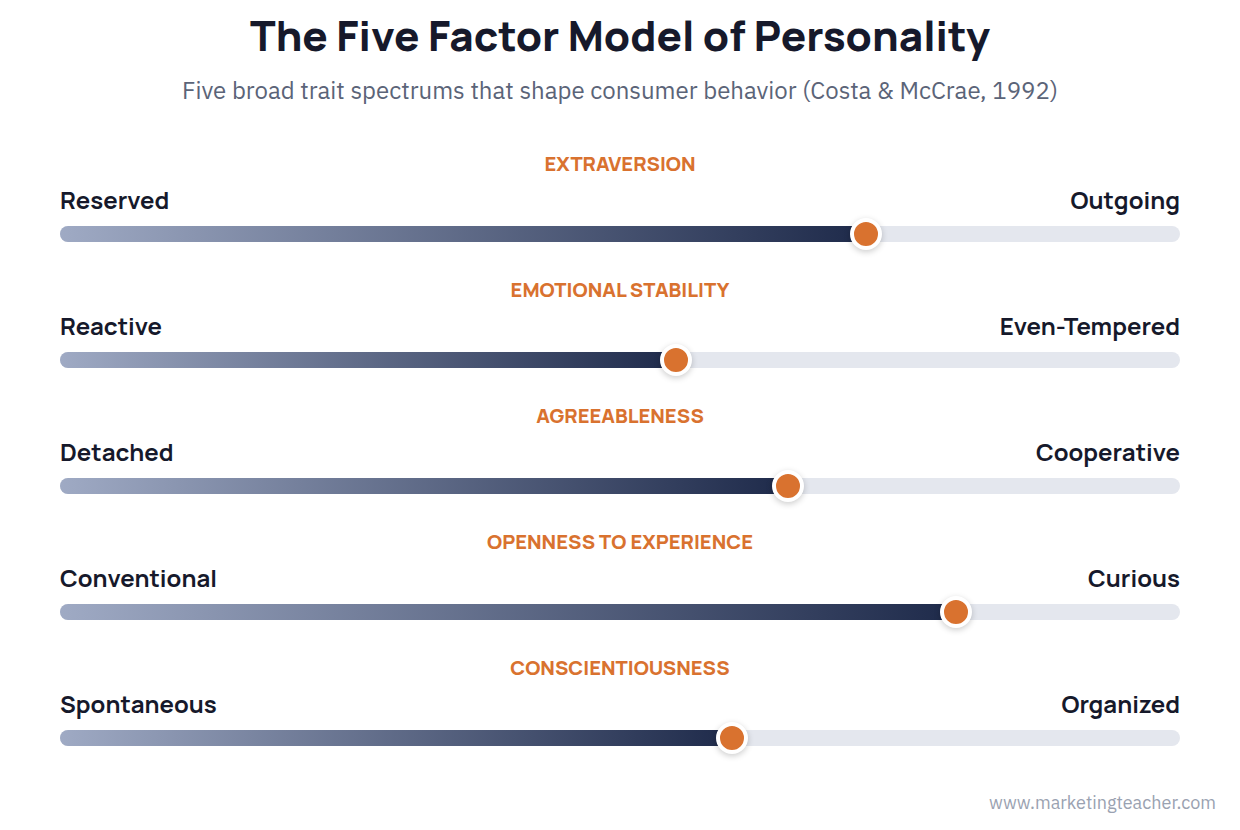
Costa and McCrae (1992) describe five broad dimensions of personality that together make up what is widely known as the Five Factor Model, sometimes called the Big Five (Goldberg, 1990). Extraversion describes how much a person seeks stimulation and enjoys the company of others, and tends to correlate with an interest in social experiences and shared activities. Emotional stability describes how evenly a person handles stress, ranging from calm and even-tempered to more reactive and anxious. Agreeableness reflects warmth, cooperation and concern for others, often showing up in a preference for ethically produced or socially responsible products. Openness to experience captures imagination and curiosity, and tends to correlate with interest in novel, creative or artistic offerings. Conscientiousness reflects carefulness, organization and self-discipline, often reflected in a preference for reliable, practical products that get the job done without fuss.
Trait-Based Consumer Behaviors
Beyond the five broad dimensions, marketers also talk about narrower, purchase-specific traits that draw on the same underlying personality structure. Frugality describes consumers who think carefully about spending and actively restrain impulse purchases. Impulsiveness describes the opposite pattern, buying with little forethought. Anxiety-prone consumers are more likely to experience post-purchase dissonance, a nagging doubt about whether a purchase was the right choice. Vanity relates to pride in appearance and achievement, and often drives interest in premium or status-signalling products. Sophistication describes a preference for glamorous, prestigious offerings, while ruggedness describes an attraction to products marketed as tough and durable. None of these traits determines behavior on its own, but together they help explain why two consumers with similar needs can respond very differently to the same product. A consumer high in both anxiety and vanity, for example, might research a purchase extensively, lean toward well-known brand names to reduce the risk of an embarrassing mistake, and still feel some regret after buying, three separate traits combining to shape one purchase journey.
Using Personality in Marketing Strategy
Marketers use personality insight to shape everything from product design to advertising tone, matching a brand’s own personality to the traits of its target audience. A brand aimed at highly extraverted, novelty-seeking consumers might lean into bold colours, social proof and limited-edition drops, while a brand aimed at conscientious, security-minded consumers might emphasise reliability, warranties and clear instructions. The risk is treating personality as a rigid label rather than one influence among several, real consumers combine personality with their culture, income, lifestyle and immediate situation, so personality works best as one lens in a broader segmentation strategy rather than the only one.
Measuring Personality in Marketing Research
Marketers rarely ask consumers to complete a full academic personality inventory before buying a product, but shorter, purpose-built versions of the Five Factor Model are widely used in market research to segment audiences and pre-test advertising concepts. A furniture retailer might survey customers on a handful of items tied to conscientiousness and openness to experience to work out whether a new product line should emphasise practicality or design flair. Brands also sometimes describe themselves in personality terms, a practice usually called brand personality, giving a product human-like traits such as ruggedness, sophistication or sincerity so that consumers whose own personality matches the brand’s feel a stronger sense of fit. This matching effect is one reason the same functional product, a wristwatch, a car, a coffee blend, can be marketed in noticeably different ways depending on which personality traits a brand wants to signal to its audience.
Summary
Personality is a stable pattern of thoughts, emotions and behavior that shapes how consumers respond to products and marketing messages. The Five Factor Model (Costa and McCrae, 1992; Goldberg, 1990) organizes personality into five broad dimensions, extraversion, emotional stability, agreeableness, openness to experience and conscientiousness, that marketers can use alongside narrower traits like frugality or vanity to understand purchase behavior. Used well, personality insight helps a brand speak more precisely to its target audience, provided it is treated as one influence among several rather than the whole picture.
The slides, worksheet, lesson plan and poster for this lesson are free to download and free to use in your course — no sign-up, no permission needed. See the teacher resources →
Assign this lesson to your class:
Using Canvas, Blackboard or Moodle? Copy the link and paste it into your course page or assignment. More ways to add lessons to your LMS.

