
Why Memory Matters in Marketing
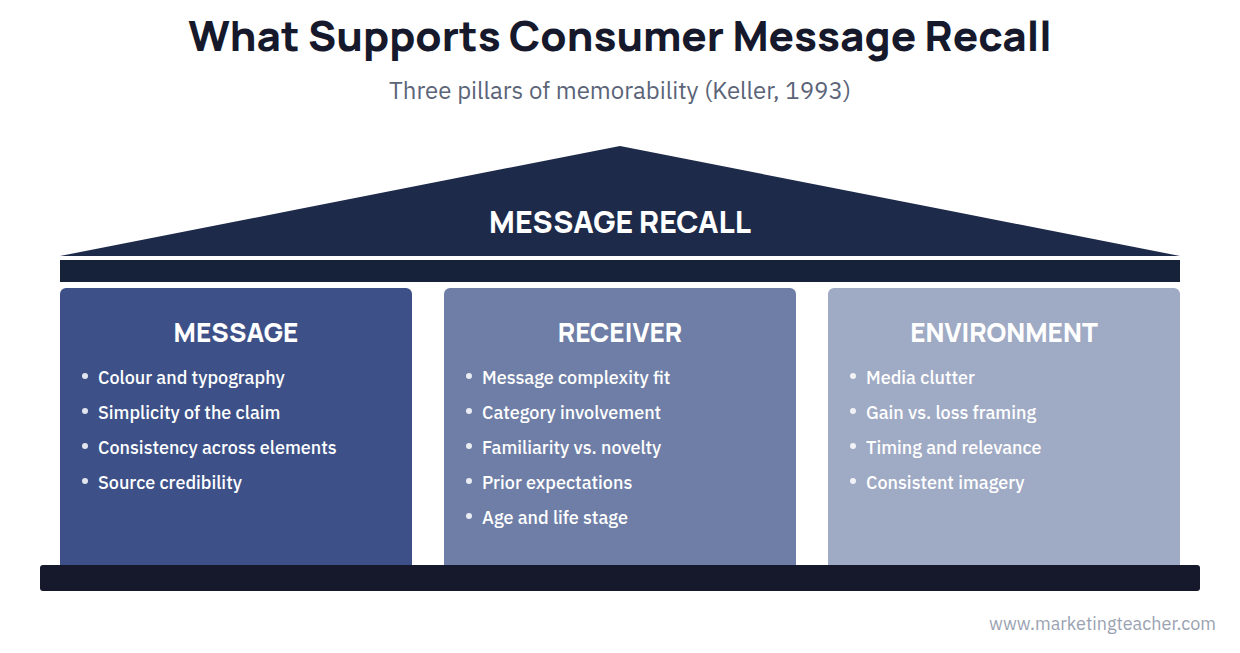
A marketing message can only work if a consumer understands it and remembers it when it matters, at the point of purchase. Keller (1993) describes brand knowledge as a network of associations stored in memory, built up gradually every time a consumer is exposed to a brand’s messaging, packaging or experience. The stronger and more consistent these associations are, the more easily a consumer can recall the brand, and the more favourably they tend to evaluate it, when a relevant buying decision comes up. Value and meaning, in this sense, are always assigned together: a consumer does not just recall that a brand exists, they recall what it means to them personally, which is why the same advertisement can land completely differently with two consumers who have different prior experiences of the product category.
Message Characteristics That Aid Recall
Several qualities of a message itself affect how well it is encoded into memory. Colour has a strong, largely subconscious effect on how a message is received, and its meaning can vary sharply between cultures, so a colour scheme that works well in one market may need rethinking in another. Typography contributes too, a bold, angular font conveys a different personality than a soft, flowing script, even when the words are identical. Simplicity helps: a short, easily understood phrase is generally recalled better than a long, complex one. Consistency matters just as much, every element of a message, colour, tone, imagery, music, needs to reinforce the same overall impression rather than pulling in different directions. Finally, the credibility of the message’s source, whether a spokesperson, a character or an expert endorsement, strongly affects whether consumers bother to encode the message at all.
Consumer Characteristics That Affect Recall
How a message is received also depends heavily on the person receiving it. Messages pitched at an appropriate level of complexity for the target audience are recalled better than those which are either patronisingly simple or needlessly technical. Consumers with higher involvement in a product category, meaning they care more and pay closer attention, tend to recall more detail than less-engaged consumers, which is one reason interactive content and deeper product information can boost recall among genuinely interested customers. Familiarity generally helps recall too, but too much of it can backfire: consumers who become overly familiar with a brand can grow bored and start seeking novelty elsewhere, so even well-established brands need occasional fresh execution to stay memorable. Clear expectations also matter, a consumer who understands what a product or brand stands for is more likely to notice and correctly interpret a new message from it. Physical or sensory limitations, such as visual or hearing impairments, are a further practical consideration when designing a message meant to reach the widest possible audience. Age and life stage can shape recall too, a message aimed at a younger, digitally native audience often needs a different pace and format from one aimed at an older audience more accustomed to traditional media, even when the underlying product benefit is identical.
Environmental Characteristics
The surrounding environment in which a message is encountered also shapes how well it is remembered. In a media environment cluttered with competing messages, consumers are far more likely to ignore or fail to fully process any single advertisement, which is part of why marketers increasingly rely on product placement and other less avoidable formats to reach audiences who actively skip traditional advertising. Framing, whether a message is presented in terms of a gain to be had or a loss to be avoided, changes how consumers respond even when the underlying facts are identical, as the Solace Sunscreen example shows. Timing matters too, a message seen at a moment of genuine relevance, such as a coffee advertisement encountered during a morning commute, is more likely to be acted on than the same message encountered at an irrelevant time. Imagery plays a similar reinforcing role: when a brand name, visual style and slogan work consistently together across every touchpoint, they build a single, coherent mental picture that is far easier for a consumer to retrieve later than a set of loosely related, inconsistent impressions.
Summary
Marketing messages only work if consumers understand and remember them, and Keller’s (1993) view of brand knowledge as a network of memory associations explains why consistent, repeated exposure builds stronger recall over time. Message characteristics such as colour, typography, simplicity and source credibility, consumer characteristics such as involvement and familiarity, and environmental characteristics such as clutter, framing and timing all interact to determine whether a given message is actually remembered when a purchase decision is made.
The slides, worksheet, lesson plan and poster for this lesson are free to download and free to use in your course — no sign-up, no permission needed. See the teacher resources →
Assign this lesson to your class:
Using Canvas, Blackboard or Moodle? Copy the link and paste it into your course page or assignment. More ways to add lessons to your LMS.

