
What Is Internal Marketing?
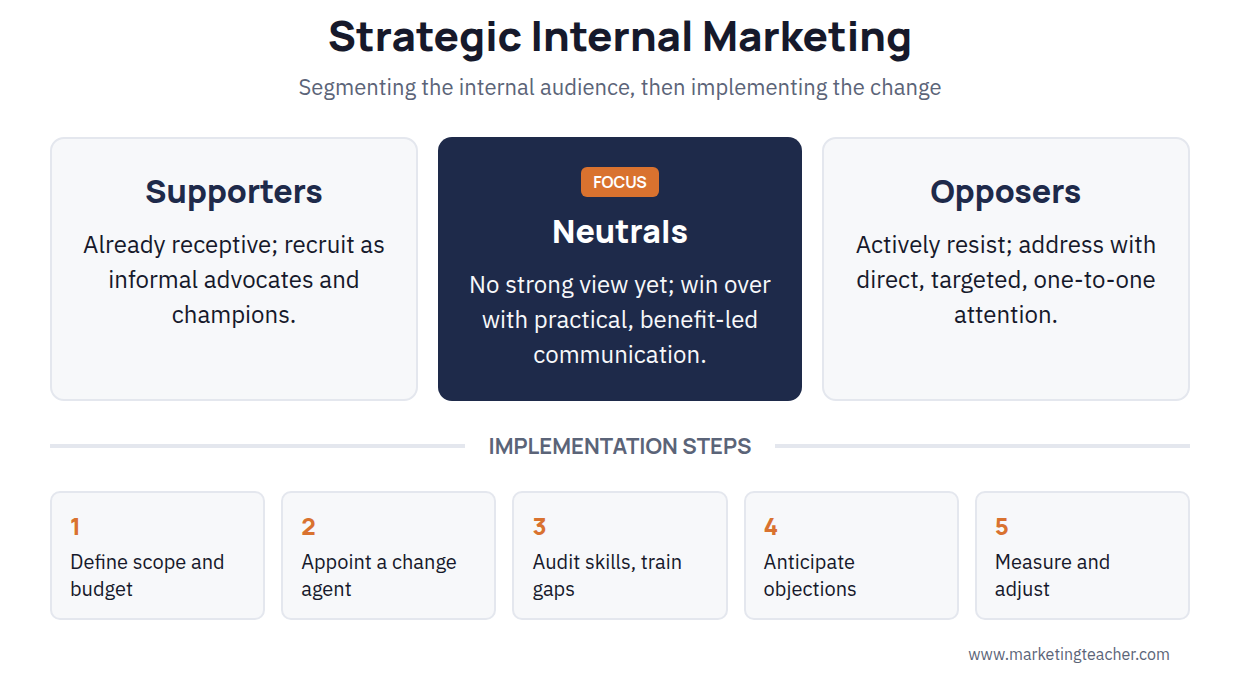
Internal marketing applies ordinary marketing thinking to an organisation’s own staff rather than to its external customers (Jobber, 2009). Where external marketing persuades customers to buy a product, internal marketing persuades employees to understand, accept and actively support a new initiative or strategy, treating staff as an internal audience with its own needs, concerns and buying behaviour rather than simply issuing an instruction from above. It is, in effect, a change-management tool built on marketing principles the organisation likely already uses externally.
Segmenting the Internal Audience
Just as external customers can be segmented by how they are likely to respond to an offer, internal stakeholders can be segmented by how they are likely to respond to a proposed change (Jobber, 2009). A useful three-way split is supporters, who are already receptive and can act as informal advocates; neutrals, who have not yet formed a strong view and can be persuaded either way depending on how the change is communicated; and opposers, who actively resist and need the most direct, targeted communication to bring round, or at minimum to prevent from undermining the change among others. Treating all three groups identically wastes effort: a message crafted to reassure opposers can feel patronising to supporters who were already on board, while a message aimed only at supporters can leave real resistance unaddressed.
Implementing a Change Programme
Beyond segmenting the audience, a strategic internal marketing programme needs a number of practical steps handled in sequence (Jobber, 2009). The change itself needs clear boundaries and a realistic, agreed budget, since an open-ended or under-resourced change programme quickly loses credibility. Appointing a change agent or champion, someone with genuine standing among staff rather than simply the most senior person available, gives the change a visible, trusted advocate rather than leaving it to feel imposed purely from senior management. Auditing the skills and capabilities of the team early identifies training gaps before they become a source of resistance, and anticipating the arguments likely to be raised against the change, then preparing a considered response to each, is far more effective than reacting to objections as they arise unplanned and without a ready answer.
Building the Right Climate for Change
None of these steps works well without first creating a cultural climate genuinely willing to accept change, since even a well-planned programme run inside a resistant culture tends to stall. This means being honest about why the change is needed, giving staff a genuine channel to raise concerns rather than a token consultation, and being visibly consistent between what leadership says about the change and what leadership then does. Internal marketing succeeds or fails less on the quality of any single communication and more on whether staff trust that the process as a whole is being run fairly and openly. Measuring how the change is actually landing, through short surveys, informal check-ins with the change agent, or simply tracking how many opposers have moved toward the neutral or supporter segments over time, lets the programme adjust its approach mid-course rather than only finding out it failed once the change is already fully rolled out.
Internal and External Marketing Compared
Internal marketing follows broadly the same structure as external marketing: understand the audience, segment it meaningfully, tailor the message to each segment, and measure whether the message actually landed. The key difference is simply who the customer is. Because internal stakeholders already work for the organisation and will keep doing so after the change lands, poorly handled internal marketing carries an ongoing cost external marketing rarely does: a workforce that feels marketed at rather than genuinely consulted can carry that resentment into the next change programme, making each subsequent initiative harder to land than the last, which is why the trust built or lost during one change programme tends to carry forward into the next.
Summary
Internal marketing (Jobber, 2009) applies familiar marketing principles, audience understanding, segmentation and tailored communication, to an organisation’s own staff during a change programme. Segmenting stakeholders into supporters, neutrals and opposers allows each group to be addressed appropriately, while a clear change agent, a defined budget and scope, and an honest, consistent culture around the change are what actually determine whether a well-designed internal marketing plan succeeds in practice.
The slides, worksheet, lesson plan and poster for this lesson are free to download and free to use in your course — no sign-up, no permission needed. See the teacher resources →
Assign this lesson to your class:
Using Canvas, Blackboard or Moodle? Copy the link and paste it into your course page or assignment. More ways to add lessons to your LMS.

