
How Coupons Work as a Sales Promotion Tool
How Coupons Work as a Sales Promotion Tool
A coupon is a certificate, paper or digital, that a customer redeems for a saving on a specific product or service. Belch and Belch (2012) list coupons alongside premiums, rebates and price-off deals as one of the standard consumer sales promotion tools, and note that unlike many of the others, a coupon can double as a record of exactly who redeemed it and when, which makes it unusually useful for tracking a promotion’s actual reach.
From Newspaper Clippings to Digital Codes
Coupons were traditionally distributed through newspapers, magazines or a printed leaflet drop, and their reach was whatever that print run’s circulation happened to be. Digital coupons, delivered by email, text message, or through a retailer’s own app, keep the same basic mechanic but add something the paper version never had: the ability to tailor which offer a specific customer sees, based on what a business already knows about their past purchases or browsing behaviour. This is part of why couponing, unlike some older sales promotion formats, has genuinely benefited from newer technology rather than simply moving online unchanged.
Two Different Jobs a Coupon Can Do
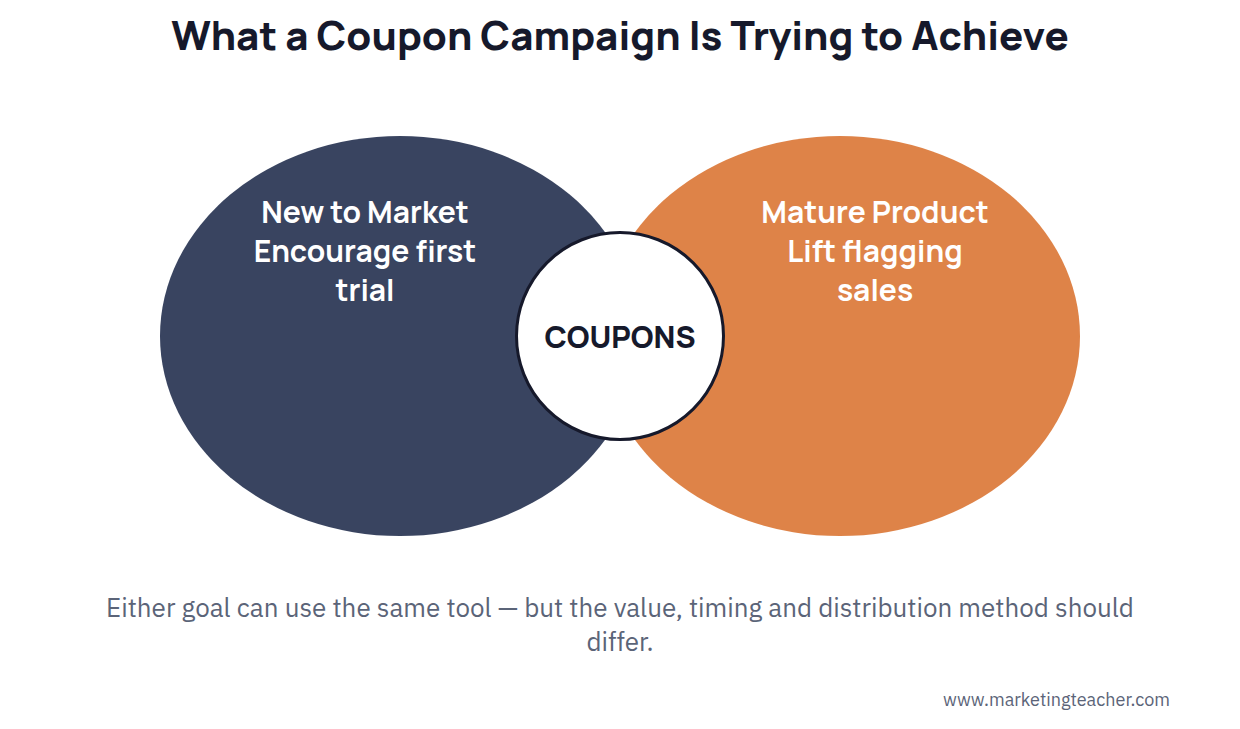
Coupons are useful for two quite different marketing goals, and it helps to be clear which one a specific campaign is chasing. A business new to a market, or launching a genuinely new product, can use a coupon to lower the risk of trying something unfamiliar, encouraging exactly the trial purchase a business needs to build early sales. A business with a mature, well-established product facing flattening sales can use the same tool differently, as a short, deliberate nudge to lift volume during a specific period, without permanently repositioning the product as a discount item.
Choosing a Distribution Method That Suits the Goal
Redeeming a coupon on a business’s own website, or texting a code directly to a customer’s phone, gives a business tighter control over who receives an offer and how quickly it can be tracked and analysed than a broad newspaper insert ever could. A wider third-party deal platform can put an offer in front of a large, geographically local audience quickly, which suits a business chasing rapid volume in one area, but the same reach can work against a business with a niche or higher-value product aimed at a smaller, more specific audience that a mass platform is not built to target.
Avoiding the Discount-Dependency Trap
A coupon used too often on the same product risks the same problem as any other repeated discount: customers start waiting for the next one rather than buying at full price. Setting a coupon’s value, timing and eligibility deliberately, tied to a specific goal like a launch or a slow period rather than running continuously, keeps it working as a genuine promotional tool rather than becoming an expected part of the product’s real price.
Tracking Whether a Coupon Campaign Worked
Because a coupon, digital or paper, carries a code or a redemption record, it is one of the easier sales promotion tools to measure precisely. Comparing the redemption rate against how many coupons were actually distributed, tracking whether redeemers went on to buy again at full price, and checking whether a campaign reached genuinely new customers rather than existing ones who would have bought anyway all give a clearer picture of whether the campaign earned back its cost.
Setting the Right Coupon Value
A coupon’s value needs to be large enough to genuinely change a customer’s decision, but not so large that it erodes margin on a purchase many customers would have made anyway. A useful starting point is working backward from the actual goal: a trial-focused coupon for a new, unfamiliar product can usually justify a deeper saving, since the business is trying to overcome real hesitation, while a coupon aimed at a mature product only needs to be large enough to prompt a repeat purchase or a slightly bigger basket, not to compete with the product’s everyday price.
Summary
Coupons remain one of the standard consumer sales promotion tools identified by Belch and Belch (2012), valued because they double as a trackable record of exactly who used an offer. Digital distribution has extended what a coupon can do, letting a business target a specific customer segment and measure results precisely, but the underlying choice of goal, whether encouraging trial of something new or lifting a mature product’s flagging sales, still needs to be clear before choosing how and where to distribute the offer.
The slides, worksheet, lesson plan and poster for this lesson are free to download and free to use in your course — no sign-up, no permission needed.

