
What Is a Rebate in Marketing?
What Is a Rebate in Marketing?
A rebate is a cash refund paid back to a customer after a purchase has already been made, rather than a reduction applied at the point of sale. Belch and Belch (2012) list rebates and refunds alongside coupons and premiums as standard consumer sales promotion tools, but draw a clear line between them: a coupon is redeemed at the till as part of the transaction, while a rebate is claimed afterward, once the customer has already paid the full price and can show proof of purchase.
Why the Timing of a Rebate Matters
Because a rebate is claimed after the sale, the business collects full payment upfront and only pays out to customers who actually go through the claims process, which is typically a smaller share of buyers than the number who would use an instant discount. This makes a rebate a comparatively low-risk way to advertise a lower effective price without cutting the shelf price everyone pays, though it also means some genuinely interested customers are put off by the extra effort of claiming, a trade-off worth weighing against a simpler money-off deal for a business chasing volume rather than a specific, measurable spending outcome.
Using a Rebate to Reward Cumulative Spending
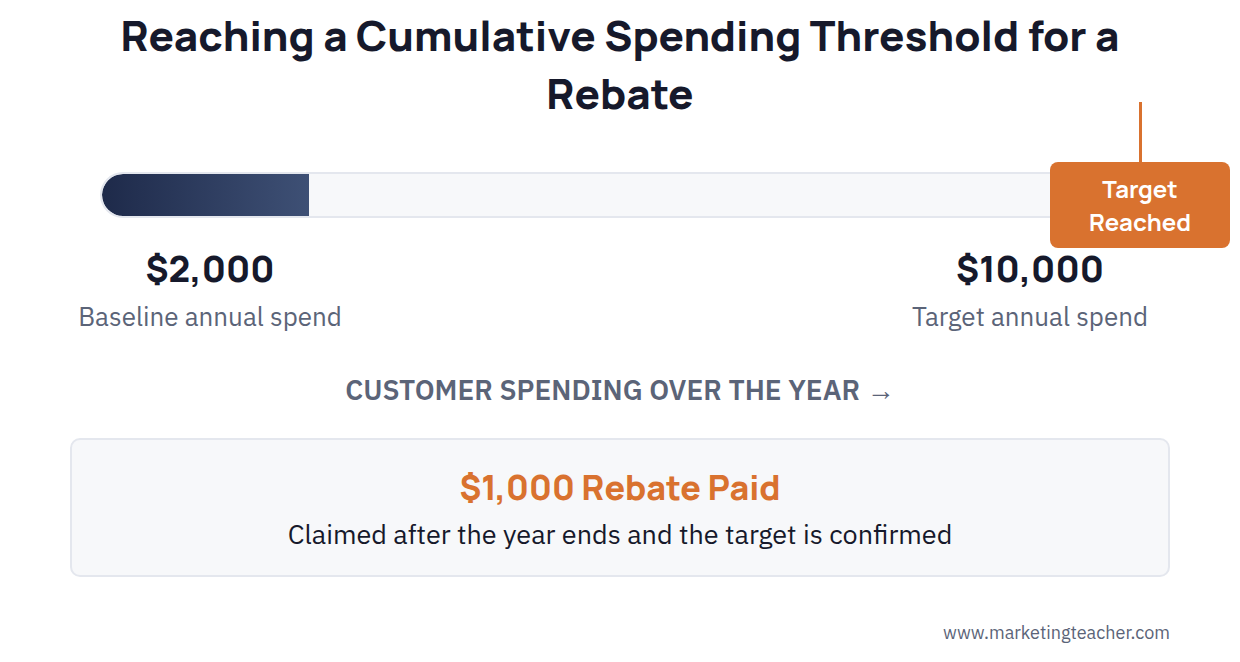
A rebate structure like the one above is particularly well suited to business-to-business selling, where a supplier wants to reward a customer’s total spending over a full year rather than any single order. Setting the target as a jump from a defined baseline, rather than as a flat percentage of whatever the customer happens to buy, gives the customer a specific, motivating number to aim for, and gives the business a predictable, budgetable cost tied directly to genuinely increased revenue rather than an open-ended ongoing discount.
Costing a Rebate Programme Carefully
A rebate should always be set as a percentage of the extra revenue it is designed to generate, not as a round number that feels generous in isolation. Working backward from the margin on the additional sales a customer needs to make to hit the target ensures the rebate paid out is comfortably smaller than the extra profit it produced, so the programme is a genuine net gain rather than an expensive way of buying loyalty that was arguably already there.
Rebates Compared With a Simple Discount
Where a straightforward money-off deal changes the price every buyer sees immediately, a rebate keeps the advertised price unchanged and rewards a smaller group of customers after the fact, based on genuine purchasing behaviour rather than simply showing up to buy. This makes a rebate a better tool for building a specific, measurable outcome, like a defined spending increase, than for the immediate volume boost a straightforward discount is better suited to producing.
Verifying Claims Before Paying Out
A rebate programme only protects a business’s margin if claims are checked properly before payment. Proof of purchase, whether that is invoices, receipts, or an internal sales record for an existing business-to-business account, needs to be verified against the actual target agreed at the start, not simply taken on trust from the customer’s own tally. Setting this verification process out clearly when the rebate is first offered, rather than improvising it once claims start arriving, avoids disputes over whether a target was genuinely met and keeps the administrative cost of running the programme predictable.
Setting a Realistic and Motivating Target
A rebate target pitched too low rewards spending a customer was going to reach anyway, while one pitched too high never feels achievable enough to change behaviour at all. Looking at a customer’s actual purchase history before setting the baseline and the target, rather than applying the same jump to every account regardless of its starting point, keeps the goal realistic for that specific customer while still asking for genuine growth rather than business as usual.
Summary
Rebates give a business a way to reward customers for reaching a spending target after the purchase has already happened, distinguishing them from coupons and simple discounts applied at the till, a distinction Belch and Belch (2012) draw clearly among standard consumer sales promotion tools. Used well, particularly in business-to-business selling, a carefully costed rebate structure can grow revenue from existing customers at a cost that stays comfortably smaller than the extra profit it produces.
The slides, worksheet, lesson plan and poster for this lesson are free to download and free to use in your course — no sign-up, no permission needed.

