
Using Product Samples to Market a Small Business
Why Give Something Away for Free?
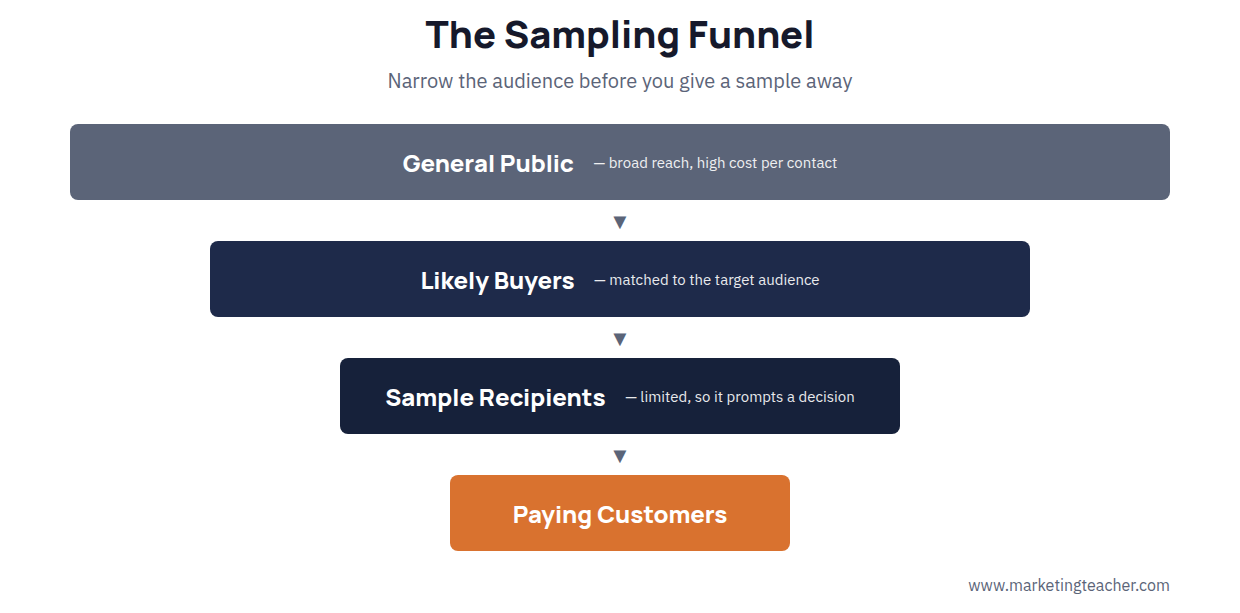
There is nothing quite like actually trying a product or service for yourself: once a potential customer has experienced it directly, buying it becomes a far smaller decision than buying something they have only read about. Belch and Belch’s (2012) treatment of sales promotion places sampling alongside coupons and trial offers as one of the most effective ways to convert a hesitant prospect, precisely because it removes the risk of an untried purchase. A small business can give a sample away entirely free, or charge a small amount that simply offsets the cost of producing it, depending on how expensive the product is to make.
Targeting the Sample at the Right People
The most cost-effective way to use sampling is to make sure the sample reaches people or businesses who are actually likely to buy the full product or service, rather than handing it out indiscriminately. Some methods, such as door-to-door delivery, in-store handouts, or samples sent by mail, are relatively low-cost per person reached, while others, such as giving samples away at a trade fair or exhibition, can be considerably more expensive once staff time and event costs are included. Whatever the method, the underlying rule stays the same: only give a sample to someone with a genuine chance of becoming a paying customer, or the cost of the sample is simply wasted.
Giving Away a Service, Not Just a Product
A business that sells a service rather than a physical product can use the same principle by offering all or part of the service free as a trial, such as a single free session, a short trial subscription, or a free initial consultation. One way to make a sample or trial more compelling, whether it is a product or a service, is to limit how many are available or how long the offer lasts, since a genuine limit encourages a potential customer to act rather than putting the decision off indefinitely. Left open-ended, a trial or sample offer loses much of its power to prompt an actual decision.
Weighing the Cost Against a Limited Budget
Sampling is rarely free to the business giving it away, since it involves producing, packaging and distributing the product or arranging staff time for a service trial, so a small business needs to weigh that cost carefully against its likely return. Carson, Cromie, McGowan and Hill’s (1995) research on entrepreneurial marketing highlights exactly this kind of trade-off as typical of smaller firms, which rarely have the budget for large-scale sampling campaigns and instead need to find the smallest, most targeted version of a sample programme that still gets the product in front of genuinely interested people. Bundling a sample into an existing order, as in the coffee example above, is one of the lowest-cost ways to do this, since it adds no separate distribution cost of its own.
Choosing Where to Give the Sample Away
Beyond who receives a sample, where it is given away shapes both its cost and how well it targets the right audience. A sample handed out at a general public event reaches a broad, mostly untargeted crowd at a relatively high cost per contact, whereas one attached to an existing customer’s order, offered at a niche trade event for the right industry, or distributed through a partner business whose customers already overlap with the target audience tends to reach a much higher proportion of genuinely interested people for the same spend. A small business with a tight budget is usually better served by picking one well-matched distribution point and doing it properly than spreading a limited number of samples thinly across several loosely related ones.
Measuring Whether Sampling Actually Worked
Because a sample rarely produces an immediate sale on the spot, a small business needs to build measurement into the sample itself, such as a unique discount code, a short follow-up email, or simply asking new customers whether they tried a sample first. Comparing the conversion rate from a sampling campaign against other promotional tools the business has tried helps it decide whether sampling is worth repeating, and at what scale, the next time it wants to introduce a new product or reach a new group of customers.
Summary
Giving away a free or reduced-cost sample lets a potential customer experience a product or service before committing to buy it, and Belch and Belch (2012) frame this as one of the more effective sales promotion tools precisely because it removes purchase risk. For a small business, the real skill is in targeting samples narrowly, limiting the offer to prompt a decision, and measuring the result, since Carson, Cromie, McGowan and Hill’s (1995) view of entrepreneurial marketing is a reminder that a small business rarely has the budget to sample broadly and needs every sample to count.
The slides, worksheet, lesson plan and poster for this lesson are free to download and free to use in your course — no sign-up, no permission needed.

