
What Is Digital Marketing?
Digital marketing is best understood as one part of marketing as a whole, not a separate discipline with its own goals. The American Marketing Association (2004) defines marketing itself as “an organizational function and a set of processes for creating, communicating and delivering value to customers and for managing customer relationships in ways that benefit the organization and its stakeholders.” Digital marketing, in turn, is Chaffey and Ellis-Chadwick’s (2019) narrower idea of “achieving marketing objectives through applying digital technologies and media” — so it inherits marketing’s underlying goals but pursues them through a specific set of digital channels and tools rather than through advertising, selling, or distribution alone. This distinction also separates digital marketing from e-commerce: e-commerce is about the transaction itself, buying and selling online, while digital marketing is about everything that leads a customer toward that transaction and keeps them coming back afterward.
How Marketers Plan for Digital Marketing: The AOSTC Framework
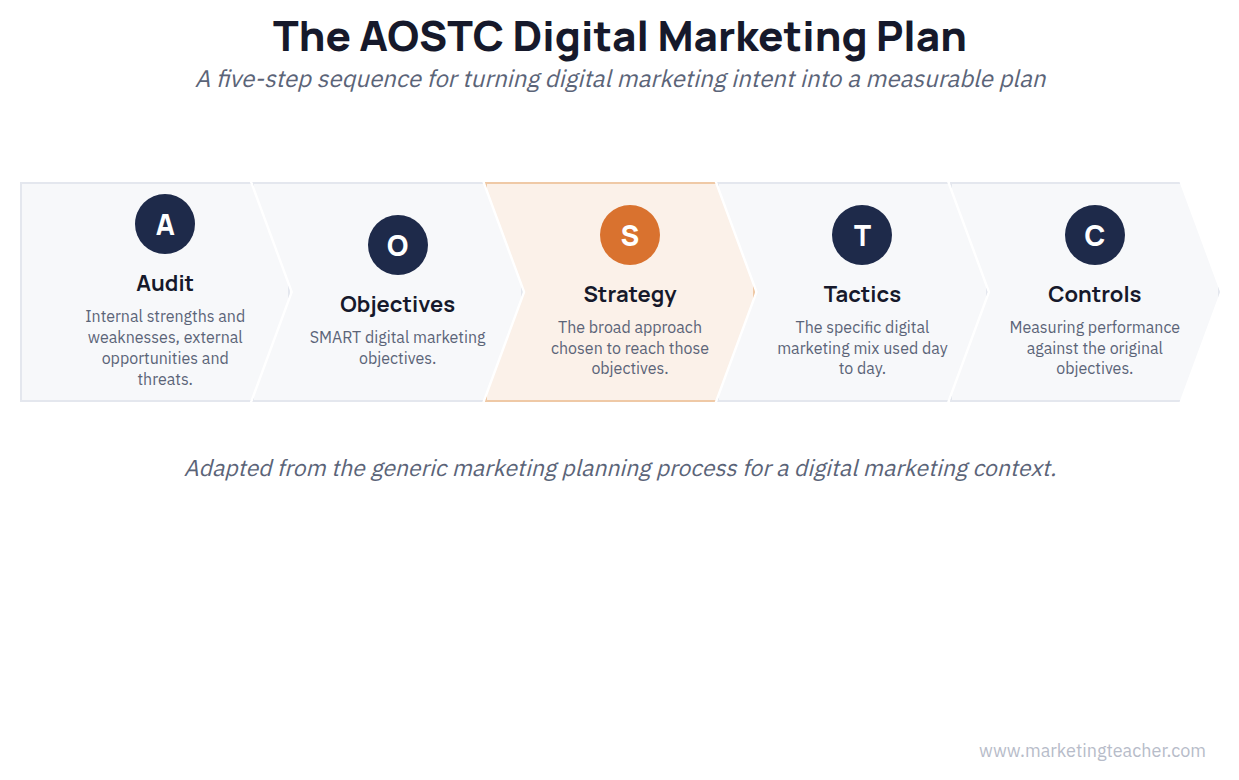
Whether a business is an existing organisation adding digital marketing to its wider marketing plan, or a business that trades solely online and so plans digital marketing as its entire marketing plan, the next step is the same: turning a general commitment to digital marketing into a structured plan. Marketing Teacher’s generic marketing planning lesson sets out that structure for marketing as a whole; this lesson adapts it into the acronym AOSTC specifically for a digital marketing context, so a digital plan follows the same underlying logic as any other marketing plan rather than reinventing the process from scratch. Audit means assessing internal strengths and weaknesses alongside external opportunities and threats, specifically as they relate to the business’s digital presence and capability. Objectives means setting SMART digital marketing objectives, specific, measurable, achievable, relevant, and time-bound targets rather than vague ambitions. Strategy means choosing the broad digital marketing strategies that will achieve those objectives, such as which markets or customer segments to prioritise online. Tactics means deciding the digital marketing mix, the specific combination of tools and channels that will carry out the strategy day to day. Controls means measuring the performance of the digital marketing activity against the original objectives, so the plan can be adjusted rather than run blind.
The Digital Marketing Toolkit
Once a strategy and tactics are set, digital marketing offers a specific toolkit to carry them out. A business can distribute products directly online, cutting out a traditional physical retail step entirely. It can use digital channels to build and maintain an ongoing customer relationship rather than a one-off sale, through email, apps, or a loyalty programme. Payment and billing can themselves move online, removing a manual step from an existing transaction. Digital tools can generate leads by attracting potential customers into a low-commitment first step, such as a free trial or a short sign-up, before asking for a longer-term commitment. Paid search and social advertising let a business target people actively searching for or interested in what it sells, rather than advertising to an undifferentiated mass audience. Finally, the same digital channels can be used to collect direct responses and feedback from customers, turning marketing into a two-way conversation rather than a one-way broadcast.
Summary
Digital marketing is one part of marketing as a whole: it shares marketing’s goal of creating and delivering value to customers, but pursues that goal specifically through digital technologies and media. The AOSTC framework, Audit, Objectives, Strategy, Tactics, and Controls, structures the planning process for any business, whether digital marketing is one part of a wider marketing plan or the whole of it. A practical digital marketing toolkit, spanning direct distribution, relationship-building, online payment, lead generation, targeted advertising, and feedback collection, gives that plan the specific tools it needs to succeed.
The slides, worksheet, lesson plan and poster for this lesson are free to download and free to use in your course — no sign-up, no permission needed. See the teacher resources →
Assign this lesson to your class:
Using Canvas, Blackboard or Moodle? Copy the link and paste it into your course page or assignment. More ways to add lessons to your LMS.

