
Choosing the Right Promotional Mix for Your Start-Up
Thinking of Promotion as a Mix
A start-up has many tools available for communicating with the outside world, and Belch and Belch (2012) describe these collectively as the promotional mix: personal selling, sales promotion, advertising, public relations, and additional tools such as trade fairs and sponsorship. No single tool works alone, and a start-up will typically balance and blend several of them to suit its particular business rather than relying on just one. The starting question is always the same: why is the business trying to communicate with its customers, and what is it actually trying to say?
The Real Purpose Behind Promotion
The purpose behind promoting a small business is ultimately to persuade customers that its product or service has value to them, and, just as importantly, to build a long-term relationship rather than a single transaction. Getting this right involves some trial and error, and a start-up should expect that some promotional spending will deliver less return than hoped. The value of this early experimentation is that it teaches which promotional tools genuinely suit the business and its actual customers, which then guides where future promotional budget is spent.
Four Factors in Choosing a Promotional Tool
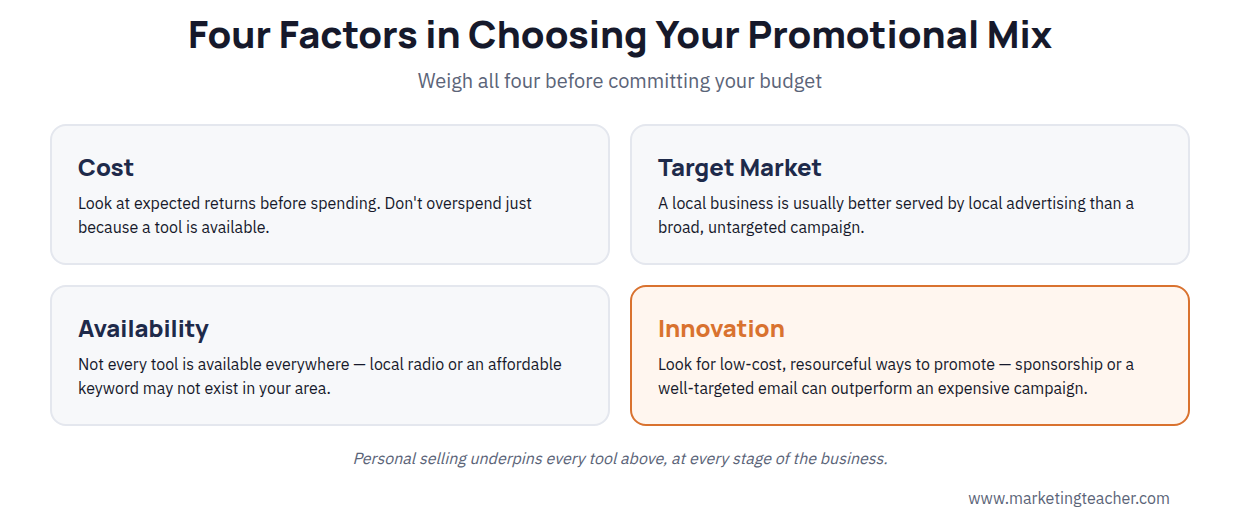
Several factors determine which promotional tool is the right one for a specific start-up and situation. Cost matters first: a business with a limited budget needs to look at the likely return before committing, and should not overspend simply because a tool is available. The target market matters just as much, since a local business is usually better served by local advertising, such as local newspapers, local pay-per-click campaigns, local billboards or local sponsorship, than by a broader campaign aimed at customers it cannot realistically serve. Availability is a further constraint, since not every tool exists in every area; a local radio station may not exist nearby, or a relevant pay-per-click keyword may be priced out of reach by better-funded competitors. Finally, innovation is worth actively looking for: sponsoring a local youth sports team, or sending a genuinely well-targeted email to a local opinion leader who might mention the business to their own audience, can deliver a disproportionately large result for a very small outlay.
Offline Tools for Promoting a Small Business
Alongside digital options, a start-up has a set of established offline promotional tools available to it: personal selling, sales promotion, advertising, public relations, trade fairs and exhibitions, and sponsorship. Of these, personal selling is likely to be the underpinning tool for almost every small business, since it applies at every stage of the marketing process, from the earliest conversations testing out a new idea with potential customers, through to the eventual point where a product is withdrawn and replaced with something new.
Why Personal Selling Matters So Much for a Start-Up
Personal selling can feel intimidating to a first-time business owner, but it is a skill that can be learned, and there are well-established techniques for guiding a conversation toward a sale. The underlying idea is straightforward: match the benefits of the product, service or solution to the specific needs of the customer in front of you, while keeping sight of the fact that the goal is a long-standing relationship rather than a single transaction. That may mean a sale does not happen on the first conversation, but the relationship built through it leads to multiple sales over time as trust and dialogue with the customer continue to develop.
Resource Constraints Are the Real Deciding Factor
Carson, Cromie, McGowan and Hill’s (1995) research on entrepreneurial marketing makes the point directly: a start-up’s promotional decisions are shaped as much by what it can actually afford and sustain as by which tool would, in theory, work best. This is why the cost and availability factors above usually end up mattering more in practice than which tool looks most sophisticated on paper, and why a resourceful, well-targeted use of a cheap tool so often outperforms an underfunded attempt at an expensive one.
Summary
Promoting a start-up means blending tools from the promotional mix, personal selling, sales promotion, advertising, public relations and more, described by Belch and Belch (2012), rather than relying on any single one. Weighing cost, target market, availability and opportunities for innovation before committing budget, and treating personal selling as the constant thread running through every stage of the business, gives a start-up a far better chance of promotional spending that actually pays off. Carson, Cromie, McGowan and Hill’s (1995) work on entrepreneurial marketing is a reminder that these decisions are ultimately made under real resource constraints, not in the abstract.
The slides, worksheet, lesson plan and poster for this lesson are free to download and free to use in your course — no sign-up, no permission needed.

