
What Is Mobile Marketing Analytics?
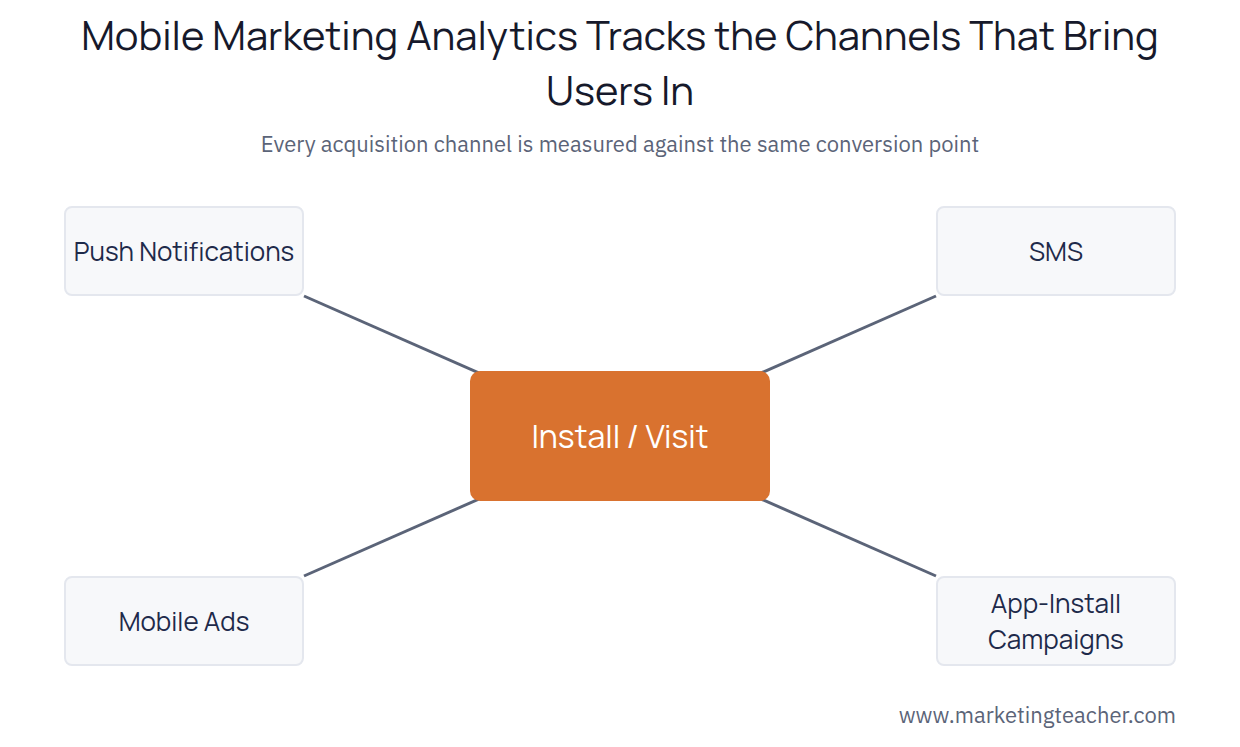
Mobile marketing analytics measures the performance of the campaigns and channels that bring users to a mobile app or mobile site in the first place — push notifications, SMS, mobile display and video ads, and app-install campaigns — rather than what those users do once they’ve arrived. This lesson is scoped to that campaign and channel level; measuring in-app behaviour once a user has actually opened the app is a separate discipline covered in Mobile App Analytics for Marketing.
Why Mobile Attribution Is Specifically Harder
Attributing a conversion to the right channel is harder on mobile than on desktop for a structural reason: a user might see a mobile display ad on one app, later search for the product in an app store, and install days afterward on a different device entirely — a path that’s much easier to lose track of than a single browser session with cookies. A field study of mobile display advertising found that its effectiveness on consumer attitudes and purchase intentions varied significantly by product type (Bart, Stephen and Sarvary, 2014), which matters directly for attribution: a campaign that looks like it’s underperforming on a blended average may actually be working well for the specific products it’s suited to, and poorly for others lumped into the same report.
What Mobile Marketing Analytics Actually Reports On
Three things account for most of what a mobile marketing analytics setup tracks: cost per install or cost per acquisition by channel, so spend can be compared against what each channel actually produces; return on ad spend for mobile-specific campaigns, since a channel that drives cheap installs of users who never buy anything is a worse investment than a pricier channel that drives paying customers; and channel-level conversion rates from ad click or notification tap through to a completed install or purchase, which shows where the handoff between channels is actually leaking value.
Cross-Device Tracking Is Incomplete, Not Broken
A user who sees an ad on their phone and converts later on a laptop creates a gap that no attribution system fully closes — privacy-focused changes across mobile operating systems have made this gap wider over recent years, not narrower. The practical response isn’t to distrust mobile attribution data entirely, but to treat it as a directional, incomplete picture that’s still useful for comparing channels against each other, while being cautious about treating any single attributed number as a precise, complete accounting of every conversion’s true origin.
Setting an Attribution Window
Every mobile attribution setup needs a defined attribution window — the length of time after someone sees or clicks an ad during which a resulting install or purchase still gets credited to that ad. A window that’s too short misses genuine conversions from people who took a few days to decide; a window that’s too long starts crediting an ad for installs it likely had nothing to do with, inflating that channel’s apparent performance. Click-through windows are conventionally shorter than view-through windows, since actually clicking an ad is a stronger signal of intent than simply having it appear on screen, and most attribution platforms let each channel’s window be configured separately rather than forcing one setting across push, SMS and paid ad campaigns alike.
Where This Differs From In-App Analytics
It’s worth being explicit about the boundary: mobile marketing analytics answers “which channel and campaign brought this user to us,” while mobile app analytics answers “what did this user do once they got here.” A campaign can look highly effective by channel-level metrics while the app itself has a leaky funnel losing most of those hard-won users before they ever convert — which is exactly why both views are needed together, not as substitutes for each other.
Summary
Mobile marketing analytics tracks the performance of the channels and campaigns that drive mobile app installs and mobile site visits — push, SMS, mobile ads, and install campaigns — measured through cost per install, return on ad spend, and channel-level conversion rates. Mobile attribution is specifically harder than desktop attribution because users move between apps, devices, and app stores in ways that are difficult to trace end to end, and effectiveness itself varies meaningfully by product type (Bart, Stephen and Sarvary, 2014). Reading these numbers as a directional comparison between channels, rather than a precise accounting of every conversion’s origin, is what keeps mobile marketing analytics useful despite its real attribution gaps.
The slides, worksheet, lesson plan and poster for this lesson are free to download and free to use in your course — no sign-up, no permission needed. See the teacher resources →
Assign this lesson to your class:
Using Canvas, Blackboard or Moodle? Copy the link and paste it into your course page or assignment. More ways to add lessons to your LMS.

