
Learning Outcome: By the end of this lesson, you will be able to explain what social media analytics involves, describe the process from raw data to marketing decision, and apply the framework to a realistic monitoring scenario.
This lesson is part of our Marketing Planning course. Study the full course and earn a certificate →
What Is Social Media Analytics?
Social media analytics is the practice of collecting and interpreting the vast amount of data that social platforms generate – posts, comments, shares, hashtags, and behavioural signals – and turning it into insight a business can actually act on. Moe and Schweidel (2017), writing in the Journal of Product Innovation Management, make the case that social media has often been treated narrowly as a promotional channel, when the data it generates is itself a rich, freely available source of insight into what customers actually think, expressed in their own words rather than filtered through a survey question. Ducange et al. (2017), reviewing the field in Soft Computing, describe this as “social big data” – too large and unstructured for manual review, but rich with patterns a systematic process can surface.
From Raw Data to a Marketing Decision
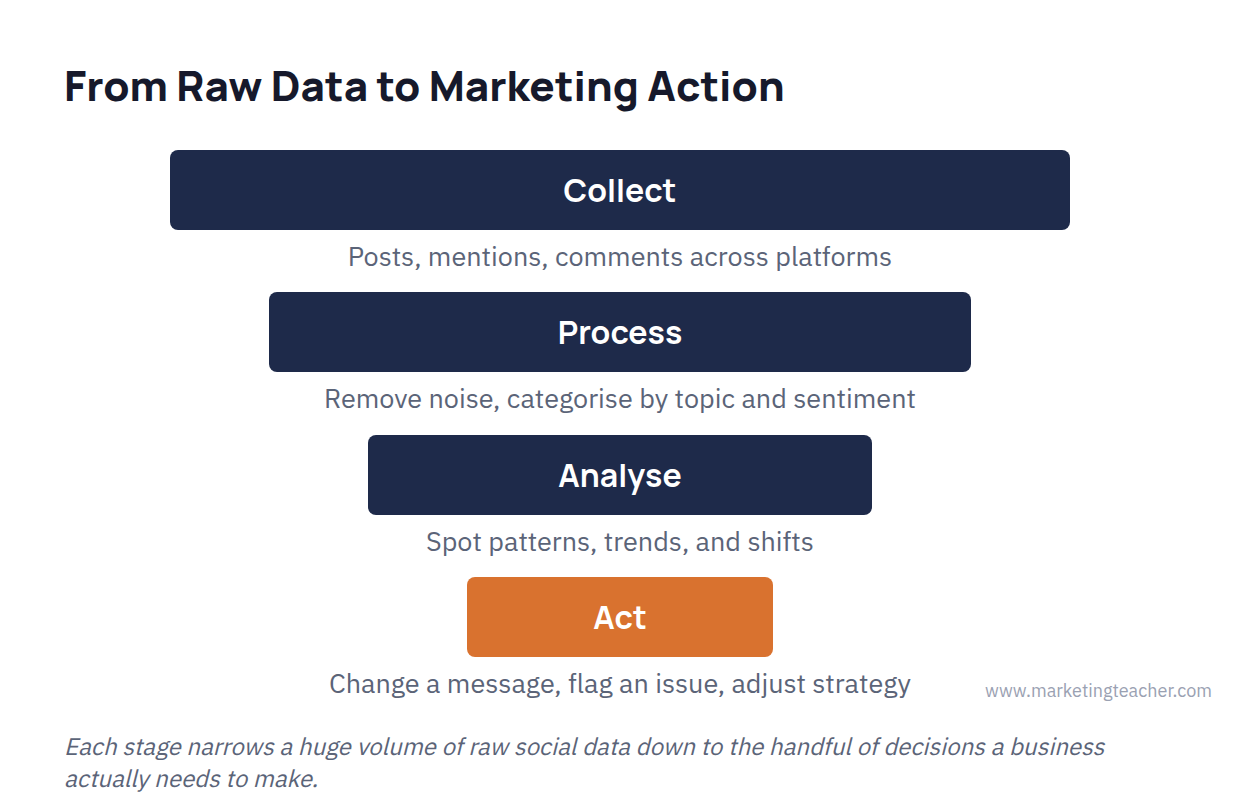
Turning that raw volume of posts and mentions into something useful follows a broadly consistent process. First, data is collected across the relevant platforms and search terms, capturing not just a brand’s own channels but mentions of it elsewhere. Second, that raw data is processed and organised – removing duplicates and irrelevant noise, and categorising posts by topic or sentiment. Third, the organised data is analysed for patterns: which topics are trending upward, which sentiment is shifting, which competitor is gaining share of voice. Finally, and most easily skipped under time pressure, the analysis needs to be translated into an actual marketing action – a changed message, a new content topic, or a flagged customer service issue – since a report that sits unread has produced no value at all.
Listening Versus Tracking
Two related but distinct activities sit inside social media analytics. Social listening looks broadly across the platform for any relevant conversation – mentions of a brand, its competitors, or its industry – even from accounts that never directly engage with the brand’s own page. Performance tracking, by contrast, measures a brand’s own published content: which posts got the most engagement, which format performed best, which time of day worked. Both matter, but they answer different questions – listening tells a business what the market is saying regardless of its own activity, while tracking tells it whether its own activity is working.
Example: Cavendish Home Goods Catches a Problem Early
The fictional retailer Cavendish Home Goods ran a routine weekly social listening sweep across mentions of its brand name, unrelated to its own posted content. The sweep surfaced a small but growing cluster of posts – only 14 in the first week, but 52 the next – complaining about a specific product’s packaging failing in transit. No one had complained directly to Cavendish’s own customer service channel yet. Acting on the listening data rather than waiting for direct complaints, Cavendish updated the packaging within three weeks and posted publicly about the fix, heading off what its own team estimated could have become a much larger reputational issue had it only been caught once formal complaints started arriving.
Common Pitfalls
A frequent mistake is tracking vanity metrics – follower counts or raw like totals – without connecting them to an actual business outcome such as traffic, leads, or sales. Sentiment analysis tools, which automatically classify posts as positive, negative, or neutral, are also imperfect: sarcasm and industry-specific slang routinely confuse automated classification, so a spike in “negative” sentiment is worth a human read-through before it’s treated as a real signal.
Competitive Benchmarking
Social media analytics isn’t limited to monitoring a brand’s own performance – comparing share of voice, sentiment, and content themes against named competitors is one of its most practical applications, since it reveals not just how a brand is doing in isolation but how it’s doing relative to the alternatives its own audience is also seeing. Zhang et al. (2022), describing a big-data-assisted social media analytics model in Information Processing & Management, note that this kind of competitive analysis can inform real-time pricing and positioning decisions, not only long-term content strategy, when the underlying data pipeline is built to support it.
Choosing the Right Tools
Most social platforms provide native analytics dashboards covering their own content for free, while third-party listening tools extend coverage across the wider web and competitor activity, typically at a cost that scales with volume. A small business can often start with native platform analytics alone and only invest in a dedicated listening tool once its monitoring needs genuinely outgrow what a single platform’s dashboard can show.
Reporting Findings to the Rest of the Business
Analytics only creates value once it reaches the people who can act on it, which often means translating a dense dashboard into a short, plain-language summary for colleagues outside the marketing team – a product manager, a customer service lead, or a senior executive rarely needs to see the full data set, but does need to know what changed and what it means for their own decisions. Building this translation step into a regular reporting rhythm, rather than treating analytics as a marketing-only concern, is often what separates an analytics practice that genuinely shapes the business from one that simply produces reports nobody outside the team reads.
Summary
Social media analytics turns the huge, unstructured volume of social data into decisions, through a process of collection, processing, analysis, and action. Listening and performance tracking answer different questions and both have a place in a complete approach. The value of analytics depends entirely on whether the resulting insight actually changes a marketing decision, not on how sophisticated the dashboard producing it looks.
Key Idea: Social media data is the customer’s own voice, offered freely and at scale – but only becomes useful the moment it changes what a business actually does next.
Part of a free mini course
This lesson is step 18 of 38 in Strategy and Analytics: A Free Mini Course. The free mini courses are ordered routes through a subject from the beginning — no sign-up and nothing to pay.
Written by Marketing Teacher.
Online course · certificate on completion
Study the full Marketing Planning course — and earn a certificate
Thirteen modules that take you from analysis and objectives through to budgets, implementation and control, written at Level 5, reaching Level 6, with a short quiz after each.
Teaching this topic?
The slides, worksheet, lesson plan and poster for this lesson are free to download and free to use in your course — no sign-up, no permission needed.

