
Learning Outcome: By the end of this lesson, you will be able to explain what distinguishes mobile marketing from other digital marketing, describe the key factors that drive consumer acceptance of it, and apply the framework to a realistic campaign scenario.
Want to go further? Study a full online course and earn a certificate →
What Makes Mobile Marketing a Distinct Discipline?
Shankar and Balasubramanian (2009), in a foundational synthesis of the field published in the Journal of Interactive Marketing, define mobile marketing as the two- or multi-way communication and promotion of an offer between a firm and its customers using a mobile device, medium, or technology. What sets mobile apart from marketing on a desktop website is not simply screen size, but three qualities specific to the device itself: it’s almost always within arm’s reach, it usually knows the user’s location, and it’s genuinely personal in a way a shared household computer never was. Together, these qualities mean mobile marketing can be timed, targeted, and personalised in ways other channels can only approximate.
What Actually Makes Someone Accept Mobile Marketing
Being reachable at any time and place is a double-edged advantage, and the research on consumer acceptance reflects that. Bauer et al. (2005), in an early and influential study in the Journal of Electronic Commerce Research, found that entertainment value and information value were the two strongest drivers of a consumer’s willingness to accept promotional content on their mobile phone. More recent work, including a meta-analysis by Maseeh et al. (2021) in the Journal of Business Research, confirms the same core pattern at larger scale: personalisation, entertainment, credibility, and informativeness all positively shape attitudes toward mobile advertising, while irritation – unwanted, poorly timed, or excessive contact – damages it. Consent matters too: unsolicited mobile messages sent without a customer’s prior agreement are reliably associated with negative attitudes, regardless of how good the offer inside them actually is.
Context Is the Real Advantage
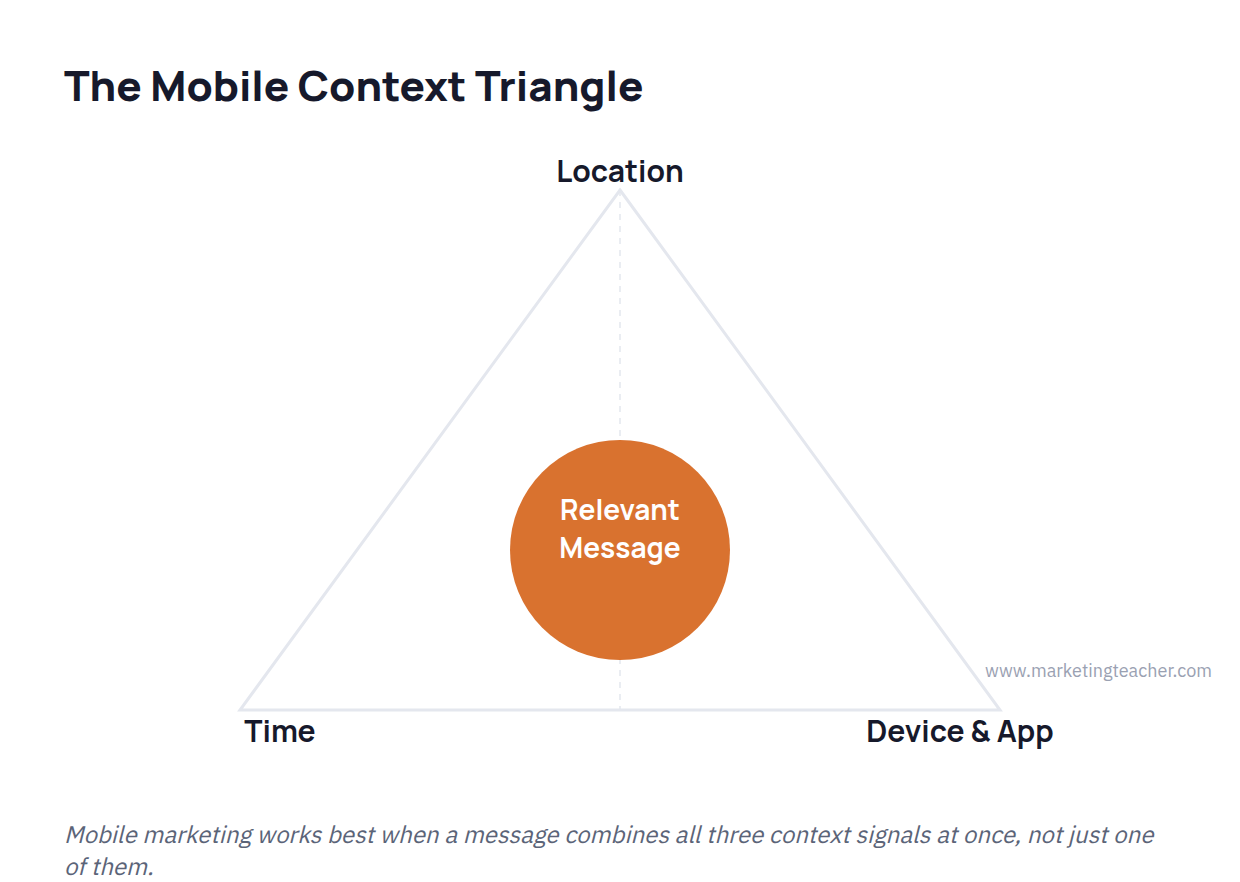
What genuinely separates mobile from other channels is the ability to combine three pieces of context that are each individually available elsewhere, but rarely all together: a person’s location, the time of day, and the specific device and app they’re using in that moment. Grewal et al. (2016), proposing a framework for mobile advertising in the Journal of Interactive Marketing, argue that campaign success depends on understanding these environmental and consumer context variables together, rather than treating mobile as simply a smaller version of desktop advertising. A message that’s relevant at one time and place can feel intrusive at another, even if the content itself never changes.
The Main Formats in Practice
Mobile marketing today spans several distinct formats: in-app advertising shown within other apps a user has installed; location-based offers triggered when a customer is physically near a relevant business; branded apps that a business builds and maintains itself; SMS and push notifications sent directly to a device; and mobile-optimised search and social advertising. Each format carries a different balance of reach and intrusiveness, and a strategy typically uses several together rather than relying on just one.
Example: Whitmore Cinemas Times an Offer Right
The fictional cinema chain Whitmore Cinemas had been sending the same promotional push notification to its entire app user base every Friday morning, regardless of where a customer lived or what films were showing near them. Response rates were low, and unsubscribe requests were climbing. Whitmore switched to a location- and time-aware approach instead: a notification only sent to customers within five miles of a specific cinema, timed for early afternoon, and referencing the actual film showing that evening at their nearest branch. Click-through rates on the new notifications were roughly three times higher than the old blanket approach, and unsubscribe requests fell by more than half within two months – the message hadn’t changed in tone, only in how precisely it matched the customer’s actual context.
Mobile Commerce and the Path to Purchase
Mobile devices increasingly host the entire purchase journey, not just the initial marketing contact – a customer might discover a product through a mobile ad, research it via mobile search, and complete the purchase through a mobile checkout, all within a single session. Aydin-Gokgoz et al. (2022), reviewing a decade of mobile marketing research in Foundations and Trends in Marketing, describe this as the transformation of mobile from an advertising channel into a full transactional environment in its own right, which raises the practical importance of a genuinely fast, frictionless mobile checkout alongside the marketing message that leads a customer there in the first place.
The Line Between Relevant and Intrusive
Because a phone is so personal and constantly present, the tolerance for irrelevant or excessive mobile contact is lower than for almost any other channel – a customer who tolerates an occasional email they don’t read closely may unsubscribe entirely from a mobile channel after just one poorly timed or overly frequent message. This makes permission, frequency, and relevance genuinely central to mobile marketing rather than simply good practice to keep in mind.
Summary
Mobile marketing is defined by a device that’s constantly present, personal, and location-aware, which allows for a level of contextual targeting other channels can’t easily match – but that same constant presence means poor targeting or excessive contact is punished quickly, through disengagement or lost consent. Entertainment, information, personalisation, and genuine relevance to a customer’s real-time context are what the research consistently identifies as the difference between mobile marketing that works and mobile marketing that simply annoys.
Key Idea: A phone’s biggest marketing advantage – that it’s always with the customer – is also its biggest risk, since the same closeness that makes a well-timed offer feel helpful makes a poorly timed one feel like an intrusion.
Part of a free mini course
This lesson is step 21 of 26 in Digital and Social Media: A Free Mini Course. The free mini courses are ordered routes through a subject from the beginning — no sign-up and nothing to pay.
Teaching this topic?
The slides, worksheet, lesson plan and poster for this lesson are free to download and free to use in your course — no sign-up, no permission needed. See the teacher resources →
Assign this lesson to your class:
Using Canvas, Blackboard or Moodle? Copy the link and paste it into your course page or assignment. More ways to add lessons to your LMS.
Written by Marketing Teacher.
Online course · certificate on completion
Study a full online course — and earn a certificate
Three courses that turn the free lessons into ordered modules, written at university Levels 4 to 6, with a short quiz after each.

