
Learning Outcome: By the end of this lesson, you will be able to explain what drives engagement on a Facebook brand page, describe the trade-off between organic reach and paid promotion, and apply the research to plan a realistic content schedule.
This lesson is part of our Foundations of Social Media Marketing course. Study the full course and earn a certificate →
What Does Marketing on Facebook Actually Involve Today?
A Facebook brand page lets a business post updates, run targeted advertising, sell directly through a shop tab, and build a community of people who have actively chosen to follow it. What has changed substantially since the platform’s early years is organic reach: Facebook’s algorithm now shows an unpaid brand post to only a small fraction of a page’s followers by default, which means a modern Facebook strategy usually blends organic community content with paid promotion rather than relying on posting alone. Cvijikj and Michahelles (2013), analysing engagement across Facebook brand pages in Social Network Analysis and Mining, found that the type of content, the day, and the time it’s posted all measurably affect likes, comments, and shares – engagement is not evenly distributed across a posting schedule, it clusters around specific content and timing choices.
What Kind of Content Actually Earns Engagement
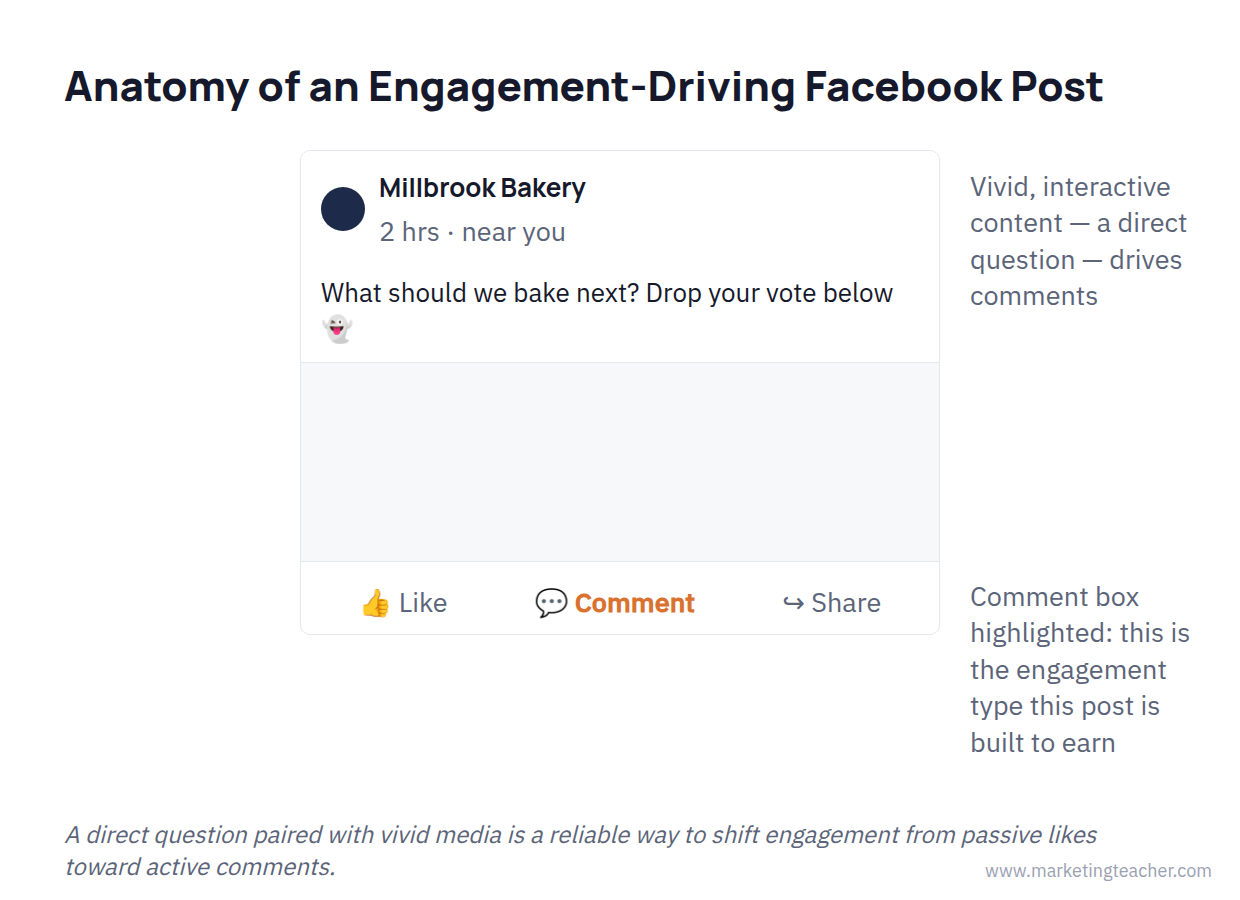
de Vries, Gensler and Leeflang (2012), in an early and still widely cited study in the Journal of Interactive Marketing, analysed 355 brand posts across eleven international brands and found that vivid, interactive content generated more likes, while posts that asked a direct question generated more comments – and that the balance of positive to negative comments on a post was itself linked to further engagement. In short, different engagement metrics respond to different content choices, so a page chasing comments needs a different approach than one chasing shares.
Organic Community Building Versus Paid Reach
Because organic reach is limited, a Facebook page’s follower count is best treated as the start of a relationship rather than a guaranteed audience for every post. Facebook’s own advertising platform allows a business to target paid posts by location, age, interest, and past behaviour with far more precision than a general organic post achieves, which is why most active Facebook marketing today runs some paid budget alongside organic posting – using free posts to build community and voice, and paid promotion to guarantee reach for the posts that matter most, such as a product launch or a seasonal offer.
Example: Millbrook Bakery’s Weekly Question Post
The fictional Millbrook Bakery ran a Facebook page with around 3,200 followers but had noticed its posts were barely reaching 200 people organically. Rather than posting only product photos, it began a weekly “what should we bake next?” question post, alongside its usual updates. The question posts consistently earned three to four times more comments than product photos, and Millbrook used the top suggestion each month as a real limited-edition item, tagging the customer who suggested it. Over four months, page follower growth roughly doubled compared with the previous four months, and the bakery credited the shift specifically to interactive posts rather than any change in ad spend.
Measuring What Matters
Likes are the easiest metric to track but the weakest signal of real commercial value; comments and shares indicate a stronger reaction, and click-throughs to a website or shop are closer still to a business outcome. A page that only tracks like counts can end up optimising for content that feels successful but drives little beyond itself. Setting a small number of clear goals – such as shop-tab visits or newsletter sign-ups from Facebook traffic – keeps the page’s content choices tied to something the business actually needs.
Groups and Community Features
Beyond the standard brand page, Facebook Groups offer a further layer of community that operates under different rules of engagement – a group tends to foster more genuine peer-to-peer conversation between customers than a page’s own comment sections, since members often join a group specifically to discuss a shared interest rather than to follow a brand’s announcements. A business running a well-moderated group around its product category, rather than the brand itself, can build a durable community asset that outlasts any single ad campaign, though it requires ongoing moderation effort a simple content calendar for a page does not.
Common Mistakes
Two patterns show up repeatedly in underperforming pages: posting only promotional content, which research consistently links to lower engagement than conversational or informative posts, and abandoning a page’s community after a paid campaign ends, which wastes the audience the campaign built. A sustainable approach treats paid and organic activity as complementary rather than as separate, disconnected efforts.
Video and Live Content
Facebook’s algorithm has also shown a consistent preference for video over static images in recent years, and live video in particular tends to receive priority placement in the feed while it’s actively broadcasting, since the platform favours content that keeps people watching in real time. A brand doesn’t need professional broadcast equipment to benefit from this – even a simple live Q&A session, hosted directly from a phone, can outperform a scheduled static post purely because of how the algorithm treats the format, provided the session offers something genuinely worth a viewer’s time rather than reading as an obligation to check a box.
Summary
Facebook marketing today depends on understanding that organic reach is limited by design, and that different content types drive different engagement outcomes – vivid content for likes, questions for comments. A blended strategy of organic community content and targeted paid promotion, measured against outcomes beyond the like count, is what the research and current platform mechanics both point toward.
Key Idea: A Facebook post’s format matters less than its intent – vivid content earns likes, a genuine question earns comments, and a page that mixes both, backed by a modest paid budget for its most important posts, will consistently outperform one relying on organic reach alone.
More in this series: Marketing on the social platforms
Facebook Marketing · Instagram Marketing · Twitter Marketing · TikTok Marketing · Snapchat Marketing · Influencer Marketing · Social Networks
Written by Marketing Teacher.
Online course · certificate on completion
Study the full Social Media Marketing course — and earn a certificate
Eleven modules on strategy, content, community, advertising and measurement, written at Level 4, with a short quiz after each.
Teaching this topic?
The slides, worksheet, lesson plan and poster for this lesson are free to download and free to use in your course — no sign-up, no permission needed.

