
Why Does Strategy Implementation Need Organisational Change?
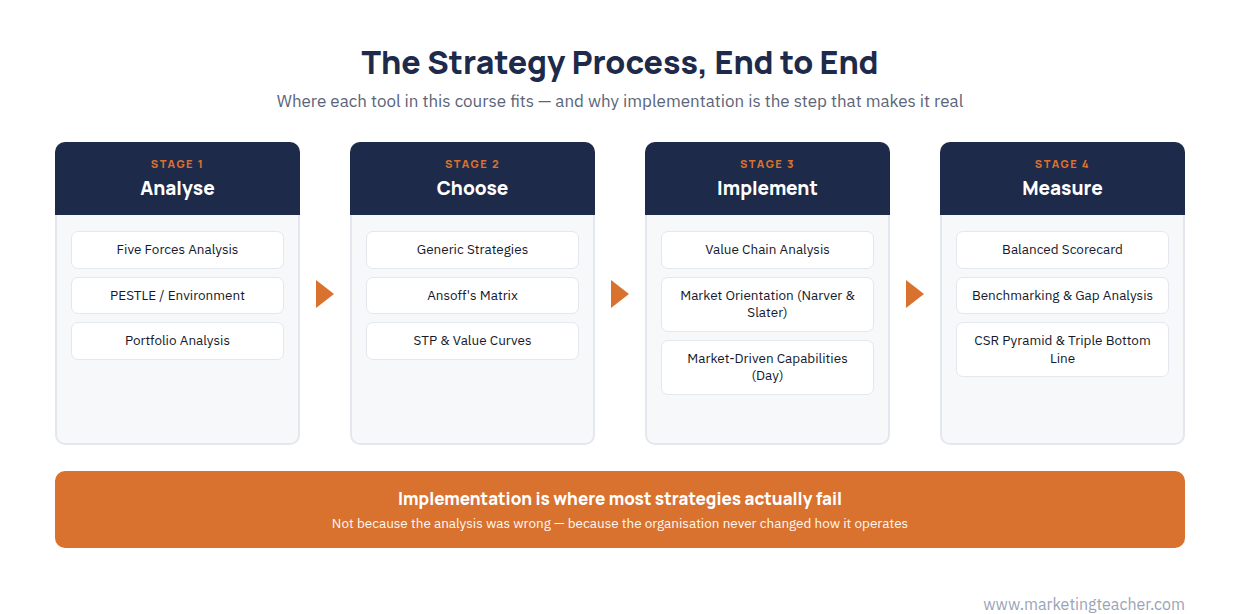
Every tool covered in this course so far — Five Forces, Generic Strategies, portfolio analysis, Ansoff’s Matrix, STP, Value Chain Analysis, the Balanced Scorecard, and the ethics and sustainability frameworks — helps a business decide what its strategy should be. None of them, on their own, deliver it. A strategy only becomes real when the organisation behind it actually changes how it operates: how decisions get made, how departments work together, and how closely the business tracks what customers and competitors are doing. This lesson closes the course by looking at what has to change inside an organisation for a chosen strategy to actually happen, using market-driven organisational change as the central example. Strategy academics generally distinguish formulation (deciding what to do) from implementation (actually doing it), and it is widely observed in practice that far more strategies fail at the implementation stage than at the formulation stage — not because the analysis was wrong, but because the organisation carrying it out never actually changed.
Becoming Market-Driven: Narver and Slater’s Three Components
Narver and Slater (1990) defined market orientation — the foundation of a market-driven organisation — as having three behavioural components. Customer orientation is the sufficient understanding of target buyers to create superior value for them on an ongoing basis, not just at the point of a single sale. Competitor orientation is an equivalent understanding of the short-term strengths, weaknesses, and long-term capabilities of current and potential competitors. Interfunctional coordination is the coordinated use of resources across every department — not just sales and marketing — in creating value for target customers. Their research found that businesses strong in all three components consistently outperformed those that were not, regardless of the specific strategy each business had chosen.
Day’s Market-Driven Capabilities
Market orientation describes an organisation’s outlook, but Day (1994) argued that outlook alone does not change anything — it has to be converted into capabilities, the bundles of skills and accumulated knowledge exercised through organisational processes. Day identified market sensing (the ability to anticipate market developments ahead of competitors) and customer linking (the ability to create and manage close customer relationships) as the two capabilities that most directly turn a market orientation into a market-driven organisation. Crucially, Day treated these as organisational routines that have to be deliberately built and practised, not attitudes that appear automatically once management wants them.
Capstone Example: A Fictional Regional Optician ChainConsider a fictional regional optician chain, Clearview Opticians, working through this course’s toolkit in sequence. A Five Forces analysis shows buyer power rising as online retailers undercut in-store prices. Generic Strategies analysis leads Clearview to choose differentiation through in-person eye-health expertise rather than competing on price. Ansoff’s Matrix supports this with market development into two new towns. STP identifies older, health-conscious customers as the priority segment. Value Chain Analysis shows the eye examination itself, not the retail counter, is where Clearview’s real advantage lies. None of this changes anything, however, until Clearview reorganises around it: staff incentives shift from units sold to examination quality (interfunctional coordination), competitor pricing is tracked monthly rather than reactively (competitor orientation), and the Balanced Scorecard is updated to weight customer-reported health outcomes alongside revenue (customer orientation, made measurable). The strategy only becomes real at this last step.
Common Barriers to Implementation
Kotter (1995) studied why so many organisational change efforts fail and found the same handful of errors recurring: leaders declaring victory too early, underestimating how deeply resistance to change is embedded in daily habits, and failing to anchor the change in the organisation’s culture before the original pressure for it fades. Applied to market-driven change specifically, the most common barrier is functional silos — a business can score well on customer orientation within its marketing department while product development and finance continue operating exactly as before, so the interfunctional coordination Narver and Slater identified as essential never actually forms. Anchoring the change in culture, in Kotter’s terms, means the new way of working has to survive the departure of whichever manager championed it — if customer orientation depends on one enthusiastic team leader rather than on how performance is measured and rewarded across the business, it tends to fade as soon as that person moves on.
This Course in One Picture
Across ten modules, this course has moved through a single recurring process: analyse the environment with Five Forces Analysis, choose a direction with Generic Strategies and Ansoff’s Matrix, sharpen that choice with STP and Value Chain Analysis, and then check whether it is actually being delivered with the Balanced Scorecard and the responsibility frameworks in Ethics, Sustainability and Strategy. Market-driven organisational change is where that whole sequence lands: a business’s tools are only as good as its willingness to actually change how it operates once the analysis is done.
Summary
Narver and Slater (1990) identified three components of market orientation: customer orientation, competitor orientation, and interfunctional coordination. Day (1994) showed that this orientation only matters once it is converted into organisational capabilities, particularly market sensing and customer linking. Kotter (1995) identified the recurring errors — declared victory too early, underestimated resistance, change not anchored in culture — that cause implementation efforts to fail. Together, they explain why every strategic tool covered in this course depends, in the end, on an organisation’s willingness to change how it actually operates.
The slides, worksheet, lesson plan and poster for this lesson are free to download and free to use in your course — no sign-up, no permission needed. See the teacher resources →
Assign this lesson to your class:
Using Canvas, Blackboard or Moodle? Copy the link and paste it into your course page or assignment. More ways to add lessons to your LMS.

