
How Small Businesses Can Use Affiliate Marketing
Why Affiliate Marketing Suits a Small Business
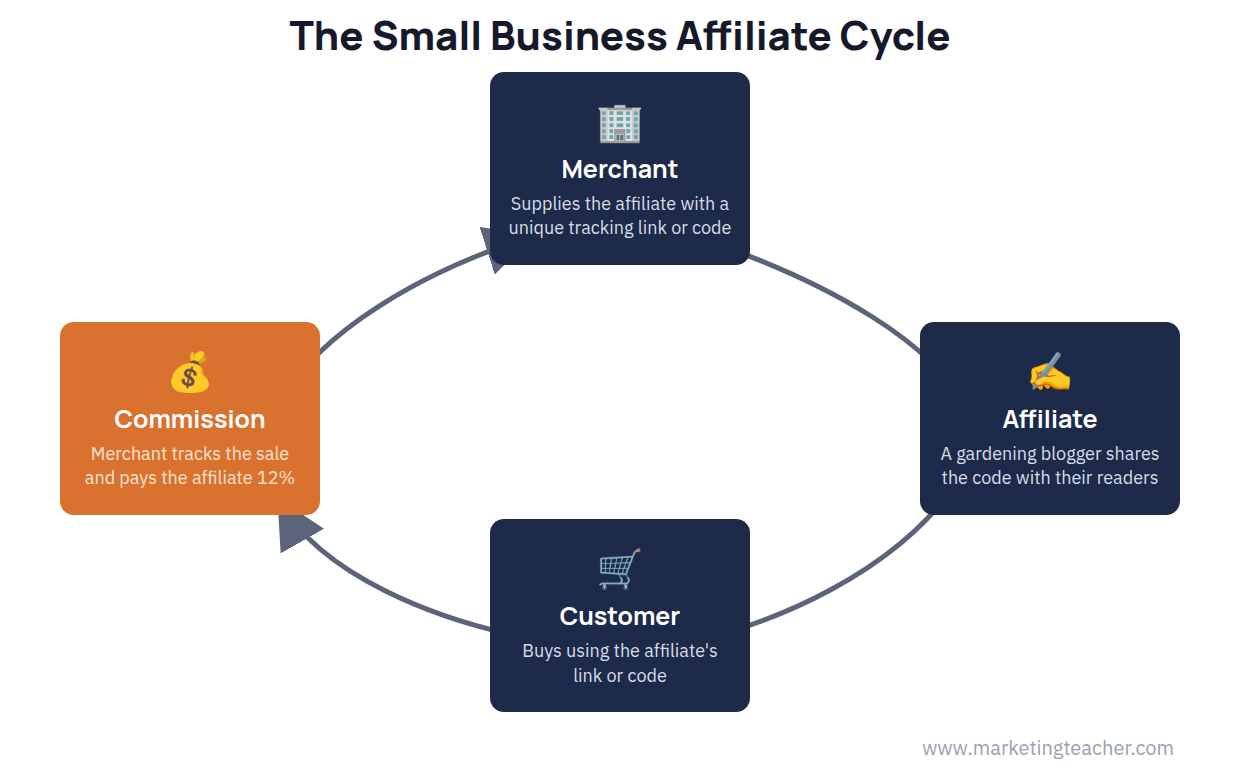
Affiliate marketing is an arrangement in which a business rewards a partner, its affiliate, for driving traffic or sales through the affiliate’s own website, blog or social channel. Chaffey and Ellis-Chadwick (2022) describe it as a commission-based approach that has become a mainstay of digital marketing more broadly, and its underlying structure suits a small business particularly well: the business only pays a commission once a sale or lead genuinely happens, rather than committing money upfront on advertising that might not convert. For a business with a small marketing budget, this shifts much of the financial risk onto the arrangement’s actual results rather than onto a guess about how well an advert will perform.
Finding Affiliates Who Already Reach Your Customers
The most effective affiliates for a small business are rarely found through a large, generic affiliate network; they are the bloggers, reviewers or social accounts that have already built an audience of people who look like the business’s own target customers. A specialist blog with a modest but genuinely engaged readership in exactly the right niche is usually a better fit than a broad affiliate site that reaches a huge but largely uninterested audience. Approaching a handful of well-matched partners directly, rather than signing up for every affiliate opportunity available, tends to produce far better results for a small marketing budget.
Choosing the Right Type of Affiliate
Affiliates come in several forms, and a small business rarely needs all of them at once. Content and review bloggers write about products in depth and tend to bring highly engaged, ready-to-buy readers; social media influencers reach a following built on personality and trust rather than search traffic; and cashback or voucher sites bring price-conscious shoppers who are comparing several retailers at once. A small business with a distinctive or higher-priced product is usually better matched to bloggers or influencers who can explain its value, while a business competing mainly on price may get more from voucher and cashback sites. Matching the affiliate type to what the business is actually selling matters as much as matching the audience.
Setting a Commission Structure and Tracking Sales Fairly
A small business needs to decide how affiliates are paid, typically a percentage of the sale value or a fixed amount per lead, and set that rate high enough to genuinely motivate an affiliate to promote the business rather than a competitor. Tracking is usually handled through a unique referral link or discount code assigned to each affiliate, which records exactly which sales came from which partner. Whatever method is used, it needs to work reliably and be visible to the affiliate too, since a partner who cannot see their own results, or who suspects a sale went untracked, will quickly lose interest in promoting the business.
What a Small Business Needs Before Recruiting Affiliates
Before approaching potential affiliates, a small business needs a few things in place: a working method for tracking referred sales, clear written terms covering commission rates and payment timing, and some ready-made marketing material, such as product images and suggested wording, that makes it easy for an affiliate to start promoting straight away. Carson, Cromie, McGowan and Hill’s (1995) research on entrepreneurial marketing is a useful reminder here that a smaller firm’s marketing decisions are shaped as much by what it can realistically sustain as by what would work best in theory; a small business is usually better served by a handful of well-supported affiliate relationships it can manage properly than by trying to recruit dozens at once.
Being Patient While the Network Builds
Affiliate marketing rarely produces an immediate flood of sales, and a small business should expect the first few months to be about building relationships and proving the arrangement works, rather than seeing significant volume straight away. An affiliate who sees their early referrals paid promptly and fairly is far more likely to keep promoting the business and to recommend it to other potential affiliates, which is usually how a small affiliate programme grows over time.
Summary
For a small business, affiliate marketing offers a way to reach new customers through partners who already have their trust, while shifting much of the financial risk onto actual results rather than upfront spend, as Chaffey and Ellis-Chadwick’s (2022) treatment of the channel makes clear. Success depends on choosing well-matched affiliates rather than joining a broad network, tracking sales fairly, and being realistic about how quickly the arrangement will grow, a pattern Carson, Cromie, McGowan and Hill’s (1995) work on entrepreneurial marketing suggests is typical of how resource-constrained small businesses need to plan.
The slides, worksheet, lesson plan and poster for this lesson are free to download and free to use in your course — no sign-up, no permission needed.

