
What Is a Buyer Persona?
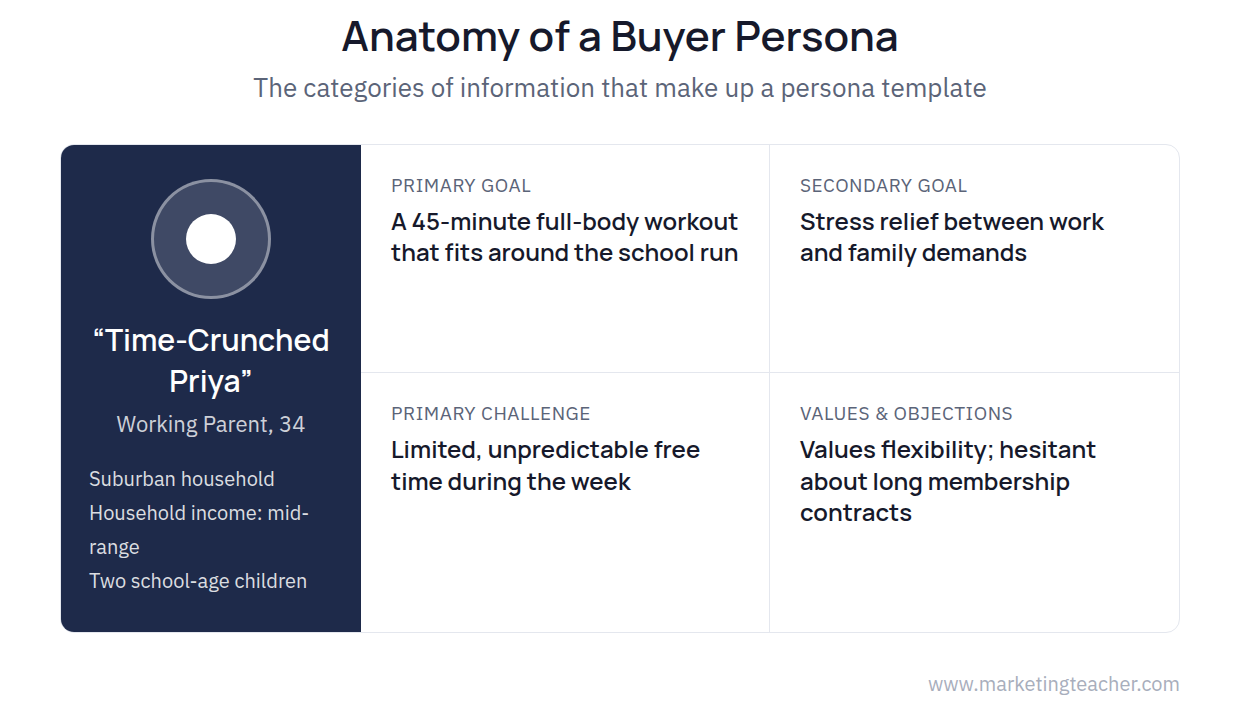
A buyer persona is a semi-fictional profile of an ideal or typical customer, built by combining real research data with informed generalisation, and used to guide marketing strategy and messaging. The concept has its roots in interaction design: Cooper (1999) introduced personas as a way for product teams to design around a specific, well-understood user rather than an abstract “average” customer, and marketers have since adapted the same idea to plan campaigns, content and positioning around a small number of representative buyer profiles.
Why Marketers Build Personas
Marketing decisions are easier to make well when they are made for a specific, vividly imagined person rather than an anonymous demographic segment; a persona gives a team a shared, concrete reference point so that every piece of content and every channel decision can be tested against “would this genuinely help or appeal to this person” rather than a vaguer sense of the target market. Revella (2015) argues that a well-built persona should be grounded in actual buyer interviews and behavioural data, not internal assumptions about who the team wishes its customers were.
Building a Persona: What Goes Into the Template
A typical persona template gathers information in several groups: a name and a representative job title or life stage; demographic details such as age, household income range, education and family situation; the person’s primary and secondary goals; the challenges or obstacles standing in the way of those goals; and the values or objections that most influence a buying decision. Bringing these details together, usually alongside a representative photo or illustration, turns an abstract segment into a specific, memorable individual the whole marketing team can picture and write for.
From Persona to Marketing Message
Once a persona is built, the natural next step is to write marketing messages that speak directly to that person’s goals, challenges and values rather than to a generic customer. A message built for “Time-Crunched Priya” leads with time efficiency and flexible scheduling, while a message aimed at a different persona entirely might lead with community and social support instead; the persona is what tells a marketing team which angle to lead with for which audience, rather than trying to fit every benefit into a single piece of messaging.
Personas Need Real Data, Not Just Imagination
A persona built entirely from internal assumptions, with no grounding in actual customer interviews, surveys or behavioural data, risks reflecting what a marketing team wishes were true about its customers rather than what is actually true. The more reliable approach draws on real interviews, support tickets, sales call notes and analytics data to identify genuine patterns, then uses those patterns, plus reasonable, clearly-labelled inference, to fill in the persona’s specific details.
How Many Personas Does a Business Need?
Most businesses find that somewhere between two and five personas cover the realistic range of their customer base without becoming unwieldy; building dozens of hyper-specific personas usually produces more administrative overhead than marketing value, since a marketing team can only realistically tailor content and messaging for a handful of distinct audiences at once. A useful test is whether two proposed personas would actually respond differently to the same piece of marketing; if not, they probably belong in the same persona rather than two separate ones.
A Persona Is Not the Same as a Market Segment
It is easy to confuse a persona with a market segment, but the two serve different purposes: a segment is a statistical grouping used to size and target an audience, while a persona is a narrative tool used to make that audience feel specific and real to the people writing for it. A single market segment can reasonably be represented by more than one persona if the group contains genuinely different goals or challenges, and a persona is generally most useful once a segment has already been chosen and a business wants to communicate with it more precisely.
Personas Remain Current Practice
Despite being a decades-old technique, buyer personas remain a standard, actively used tool in marketing planning, and recent practice has focused on validating personas against real analytics and, increasingly, AI-assisted pattern recognition across large customer datasets, rather than replacing the underlying concept. The core idea, that marketing works better when it is built for a specific imagined person than for an abstract segment, has proven durable even as the data used to build that person has become more sophisticated.
Summary
A buyer persona is a semi-fictional profile combining real research with informed generalisation, built from a template covering identity, demographics, goals, challenges and values (Cooper, 1999; Revella, 2015). Marketers use personas to write more specific, effective messaging than a generic segment allows, and the practice remains current today, with businesses increasingly validating their personas against real data rather than treating them as a one-time creative exercise.
The slides, worksheet, lesson plan and poster for this lesson are free to download and free to use in your course — no sign-up, no permission needed. See the teacher resources →
Assign this lesson to your class:
Using Canvas, Blackboard or Moodle? Copy the link and paste it into your course page or assignment. More ways to add lessons to your LMS.

