
What Is Persona-Based Marketing?
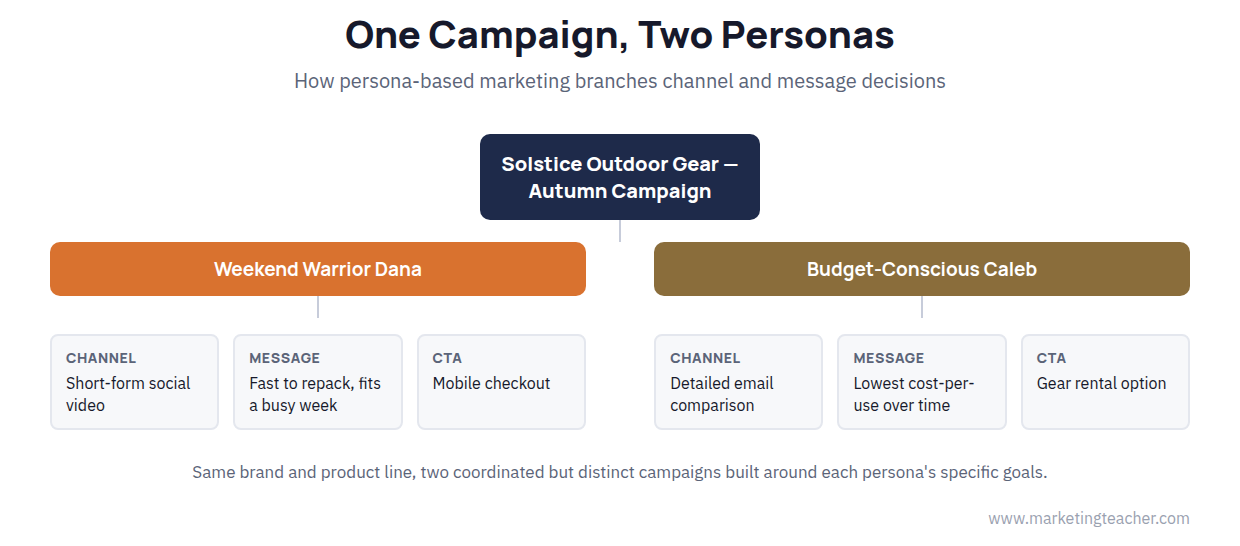
Once a business has built its buyer personas, the natural next step is to actually use them. Chaffey and Ellis-Chadwick (2022) define a persona as a fictional profile representing a particular target audience, essentially a “thumbnail” summary of a typical customer’s characteristics, needs, motivations and environment, used to help a business create communications that are genuinely more relevant to that audience. Persona-based marketing is the practice of planning campaigns, channels, content and messaging around those specific profiles rather than treating the whole target market as one undifferentiated audience, so that a business with three personas may end up running what are, in effect, three coordinated but distinct campaigns.
Building Personas Detailed Enough to Act On
Chaffey and Ellis-Chadwick (2022) note that a persona only becomes genuinely useful for digital marketing once it goes beyond a simple summary of demographics: an effective persona also captures psychographic detail, such as values, attitudes and motivations, and maps how that person’s content needs change as they move through the stages of the buying process, from initial awareness through to purchase and beyond. Built this way, a persona tells a marketing team not just who they are talking to, but what that specific person needs to see at each stage of their journey, which is precisely the detail persona-based marketing turns into channel and messaging decisions.
From Persona to Channel Strategy
Different personas tend to gather information and make decisions in different places, so the first practical decision persona-based marketing drives is channel choice. A persona built around a busy professional who researches purchases during a commute points toward mobile-optimised content and short-form video; a persona built around a methodical researcher who compares options carefully points toward detailed comparison guides, case studies and email nurture sequences instead. Rather than spreading a single campaign thinly across every available channel, a business can concentrate its effort and budget on the channels each specific persona actually uses. This does not mean abandoning every other channel entirely, but it does mean deciding deliberately where the bulk of the budget and creative effort for each persona’s campaign should go, rather than distributing both evenly by default.
Tailoring Messaging and Content for Each Persona
Channel choice only helps if the message itself changes too. Revella (2015) argues that a persona is most valuable at the exact moment a marketing team has to choose which benefit to lead with, since different personas are typically motivated by different goals and held back by different obstacles, even when they are considering the exact same product. A persona whose primary goal is saving time wants messaging that leads with speed and convenience; a persona whose primary obstacle is a lack of confidence in a category wants messaging that leads with reassurance, guidance and social proof. Writing one message that tries to do both jobs at once usually ends up doing neither particularly well.
Coordinating Campaigns Without Fragmenting the Brand
Running distinct campaigns per persona does not mean running inconsistent ones. The channel and the specific benefit emphasised can vary by persona while the underlying brand voice, visual identity and core product claims stay the same, so that a prospect who happens to see content aimed at a different persona still recognises the same business behind it. Most marketing teams solve this by keeping a shared content and brand foundation, then layering persona-specific angles, formats and channels on top of it, rather than building entirely separate creative from scratch for every persona.
Measuring and Refining Persona-Based Campaigns
Because each persona’s campaign runs somewhat independently, it can also be measured independently: click-through rates, conversion rates and cost per acquisition can all be compared persona by persona rather than only in aggregate. A persona whose campaign consistently underperforms is a signal worth investigating, sometimes the channel choice was wrong, sometimes the messaging missed the real motivation, and sometimes the persona itself needs revisiting against fresh customer data, since a persona built two years ago on an earlier customer base can quietly stop matching who is actually buying today. Treating persona-based marketing as a cycle of launch, measure and refine, rather than a one-time creative exercise, is what keeps the approach genuinely effective over time.
Summary
Persona-based marketing takes the buyer personas a business has already built, detailed enough to include psychographics and buying-journey content needs (Chaffey & Ellis-Chadwick, 2022), and puts them to work shaping real campaign decisions: which channels to prioritise, which benefit to lead with, and what kind of content will actually land with a specific kind of customer. Combined with the practical discipline of matching messaging to a persona’s genuine goals and obstacles (Revella, 2015), the approach lets a business run several coordinated, distinct campaigns instead of one generic message stretched thin across an entire market. Measuring performance persona by persona, and refining channels and messaging accordingly, is what turns personas from a one-off creative exercise into an ongoing marketing advantage.
The slides, worksheet, lesson plan and poster for this lesson are free to download and free to use in your course — no sign-up, no permission needed. See the teacher resources →
Assign this lesson to your class:
Using Canvas, Blackboard or Moodle? Copy the link and paste it into your course page or assignment. More ways to add lessons to your LMS.

