
What Is Personal Selling?
Personal selling is direct, face-to-face (or one-to-one) communication between a salesperson and a prospective buyer, aimed at matching the benefits of a product, service or solution to that buyer’s specific needs (Kotler & Armstrong, 2018). Unlike advertising, which broadcasts the same message to a mass audience, personal selling is adaptive: a skilled salesperson listens, asks questions, and adjusts the message in real time based on what the client actually says. This makes it especially valuable for complex, high-value or highly customised offerings, where a generic advertisement cannot answer every buyer’s individual concerns. A single advertisement might reach thousands of people in one broadcast, but it cannot pause to answer a specific question about installation, financing or technical fit the way a salesperson can in the middle of a conversation.
The Seven-Step Personal Selling Process
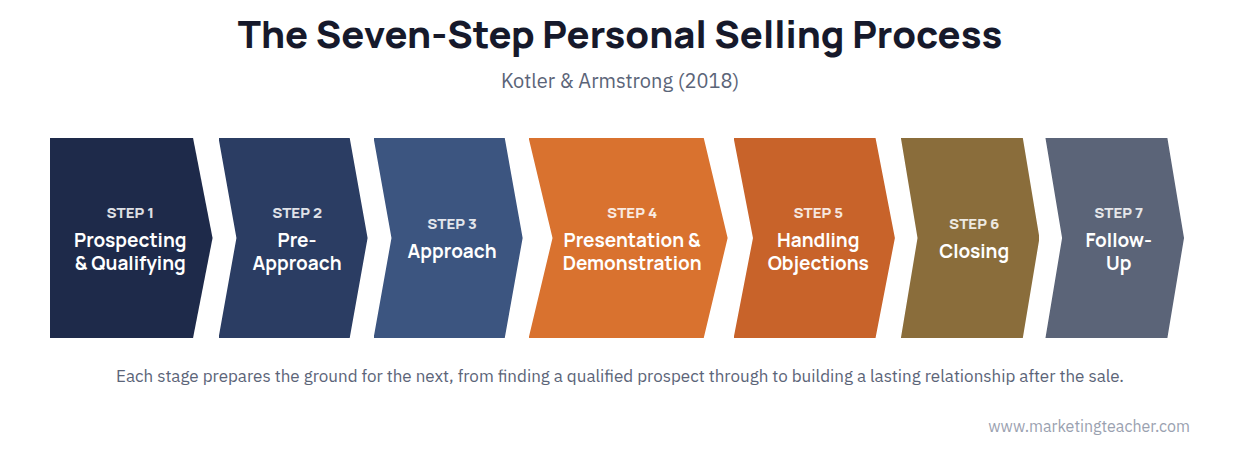
Kotler and Armstrong (2018) describe personal selling as a structured process rather than a single event, typically broken into seven stages: prospecting and qualifying, the pre-approach, the approach, presentation and demonstration, handling objections, closing, and follow-up. Treating selling as a process rather than an improvised conversation helps a salesperson prepare properly at each stage and avoid rushing straight to a pitch before genuinely understanding the client’s needs.
Prospecting, Pre-Approach and Approach
Prospecting is the search for potential new customers, and qualifying means checking that a prospect genuinely has the need, authority and budget to buy before investing further time in them. The pre-approach follows: researching the prospect’s business, setting clear objectives for the meeting, and deciding what to bring, so that the eventual contact feels informed rather than generic. The approach itself, the first face-to-face or virtual contact, matters disproportionately: a confident, well-prepared opening in the first minute or two signals to the client that their time is being respected and sets the tone for everything that follows.
Presentation, Questioning and Objection Handling
During the presentation, the strongest salespeople focus on benefits relevant to the specific client rather than reciting a list of product features, and let the client do much of the talking. Rackham’s (1988) SPIN framework, built around situation, problem, implication and need-payoff questions, remains a widely taught structure for this stage, since it guides a salesperson from understanding a client’s current situation through to helping the client articulate why solving a problem actually matters to them. Objections, hesitations, doubts or a flat “no”, are a normal part of this stage rather than a sign of failure, and are best met by asking why the client feels that way rather than arguing directly against it.
Closing and Following Up
Closing is the stage many inexperienced salespeople avoid, often out of a fear of hearing “no”, yet without a clear ask, even a strong presentation rarely converts into a sale. Directly requesting the business, summarising everything agreed and then asking for the order, or simply pausing after a summary and letting the client respond, are all legitimate ways to close. Weitz, Castleberry and Tanner (2004) emphasise that the sale itself is not the end of the process: genuine follow-up, checking that the product or service is meeting expectations, builds the kind of long-term partnership that turns a single transaction into repeat business and referrals.
How Personal Selling Differs from Other Promotional Tools
Within the wider marketing mix, personal selling tends to suit situations that advertising alone cannot handle well: complex or technical products, large purchase values, and offerings where an ongoing buyer-seller relationship matters after the sale. It is typically more resource-intensive per customer than advertising, since it relies on individual attention rather than one message reaching thousands of people at once, but it can also close negotiated, tailored deals that a one-size-fits-all advertisement never could. Many organisations use personal selling alongside advertising and other promotional tools rather than instead of them, using mass communication to build initial awareness and personal selling to carry a specific, qualified prospect the rest of the way to a signed deal.
Summary
Personal selling is one-to-one communication built around understanding and meeting a specific buyer’s needs, structured into seven stages running from prospecting through to follow-up (Kotler & Armstrong, 2018). Careful preparation before contact, disciplined questioning during the presentation (Rackham, 1988), and treating objections as requests for more information rather than rejections, all separate a genuinely persuasive salesperson from one who is simply reciting a pitch. Because the relationship does not end at the sale, following up afterward (Weitz, Castleberry & Tanner, 2004) is what turns a single sale into a lasting, repeat-business partnership, and is part of why personal selling remains central to marketing complex or high-value products and services.
The slides, worksheet, lesson plan and poster for this lesson are free to download and free to use in your course — no sign-up, no permission needed. See the teacher resources →
Assign this lesson to your class:
Using Canvas, Blackboard or Moodle? Copy the link and paste it into your course page or assignment. More ways to add lessons to your LMS.

