
What Is Public Relations?
Public relations, usually shortened to PR, is the management function that builds and maintains goodwill between an organisation and the various groups, or “publics,” whose support it depends on, from customers and employees to investors, regulators and the wider community (Cutlip, Center & Broom, 2006). The Public Relations Society of America (2012) defines it more simply as “a strategic communication process that builds mutually beneficial relationships between organizations and their publics.” Both definitions point at the same idea: PR is not one single technique but a management discipline that uses many different activities to shape how an organisation is perceived over time.
How PR Differs From Advertising
PR is one part of the wider marketing communications mix, and is often confused with advertising because both aim to influence public perception, but the mechanism is different. Advertising is paid, controlled media: the organisation buys space and controls the exact message, timing and placement. PR relies heavily on earned media: a journalist, blogger or event organiser decides whether and how to cover a story, so the organisation has influence over the message but not full control of it. This lack of control is also why PR is not the free option some assume it to be; skilled PR staff and agencies are a real, ongoing cost, even without a media-buying budget attached.
The Four Models of Public Relations
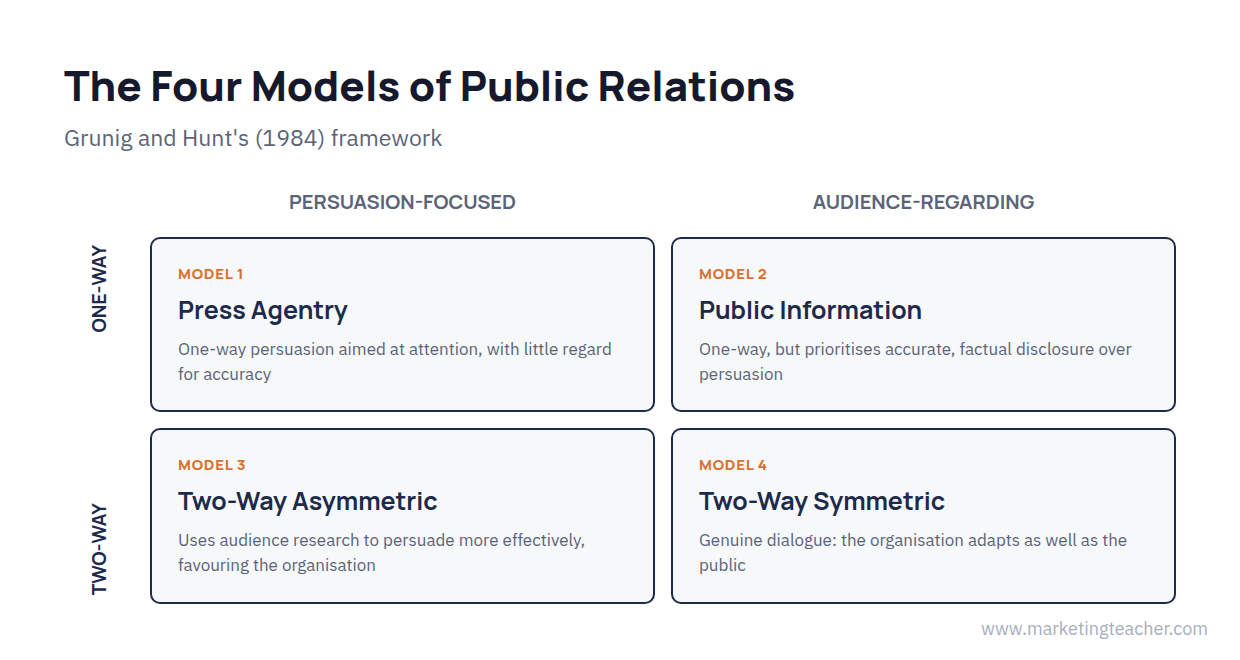
Grunig and Hunt (1984) proposed four models that describe how organisations have historically practised PR, arranged along two dimensions: whether communication flows one way or two ways, and how much the model regards the audience’s own interests rather than just the organisation’s. The press agentry model uses one-way persuasion with little regard for accuracy, aiming purely to attract attention. The public information model is also one-way, but prioritises accurate, factual disclosure over persuasion, the model most associated with government and non-profit communication. The two-way asymmetric model uses research to understand an audience, then applies that insight to persuade more effectively, still favouring the organisation’s interests over the public’s; this is why, alongside the two one-way models, it is still described as asymmetric. The two-way symmetric model is the only one of the four that is genuinely symmetric: it treats PR as a real dialogue, using research and feedback to adjust the organisation’s own behaviour as well as its message, and is generally regarded as the most ethical and sustainable of the four.
The PR Toolkit
A PR programme draws on a wide set of tools, most of which build goodwill indirectly rather than driving an immediate sale. Media relations covers press releases, media conferences and background briefings that give journalists accurate information ahead of a story. Corporate literature, from annual reports to a company website, communicates with specific publics such as investors or jobseekers. Executives are frequently trained to give interviews, speeches and presentations, since a well-handled interview can pre-empt misleading coverage. Sponsorship and charitable giving associate an organisation with a cause its publics already care about, while facility visits let sceptical or curious publics see an operation for themselves rather than relying on secondhand reports. Lobbying, meanwhile, is PR directed specifically at legislators and regulators rather than the general public, pressing for a change in law or policy on a client’s behalf.
Earned, Owned and Shared: PR in a Digital Media Mix
Traditional PR theory splits media into “paid” (advertising) and “earned” (press coverage secured through PR), but Dietrich’s (2014) PESO model adds two categories that matter for a modern PR programme: owned media, such as a company blog or newsletter that the organisation fully controls, and shared media, the social platforms where a story spreads through likes, shares and comments rather than a single publication decision. A single announcement, such as a product recall or a sustainability report, is now typically run across all four categories at once: a company blog post (owned) is pitched to journalists (earned), summarised for social channels (shared), and occasionally boosted with a small paid budget to guarantee reach (paid). Treating these as one coordinated system, rather than PR’s job stopping once a press release goes out, is now standard practice.
Measuring Whether PR Is Working
Because PR’s payoff is reputational rather than an immediate transaction, measuring it is harder than measuring a paid campaign’s click-through rate. Counting press clippings or social mentions shows activity but not impact, so more rigorous programmes track shifts in stakeholder attitudes through surveys, monitor the tone (not just the volume) of coverage, and, where possible, connect PR activity to downstream indicators such as reduced customer complaints, improved employer-review scores, or steadier investor sentiment during a crisis. A PR programme that generates plenty of coverage but no measurable change in how key publics feel about the organisation has not actually achieved its goal.
Summary
Public relations is the management function that builds and protects goodwill between an organisation and its publics (Cutlip, Center & Broom, 2006; PRSA, 2012), using tools from media relations and corporate literature to sponsorship and lobbying. Grunig and Hunt’s (1984) four models show that PR can range from one-way persuasion to genuine two-way dialogue, and Dietrich’s (2014) PESO framework shows how earned coverage now sits alongside owned and shared channels in a coordinated media mix. What separates effective PR from noise is whether it changes, not just informs, how key publics actually feel about the organisation.
The slides, worksheet, lesson plan and poster for this lesson are free to download and free to use in your course — no sign-up, no permission needed. See the teacher resources →
Assign this lesson to your class:
Using Canvas, Blackboard or Moodle? Copy the link and paste it into your course page or assignment. More ways to add lessons to your LMS.

