
What Is Marketing Return On Investment?
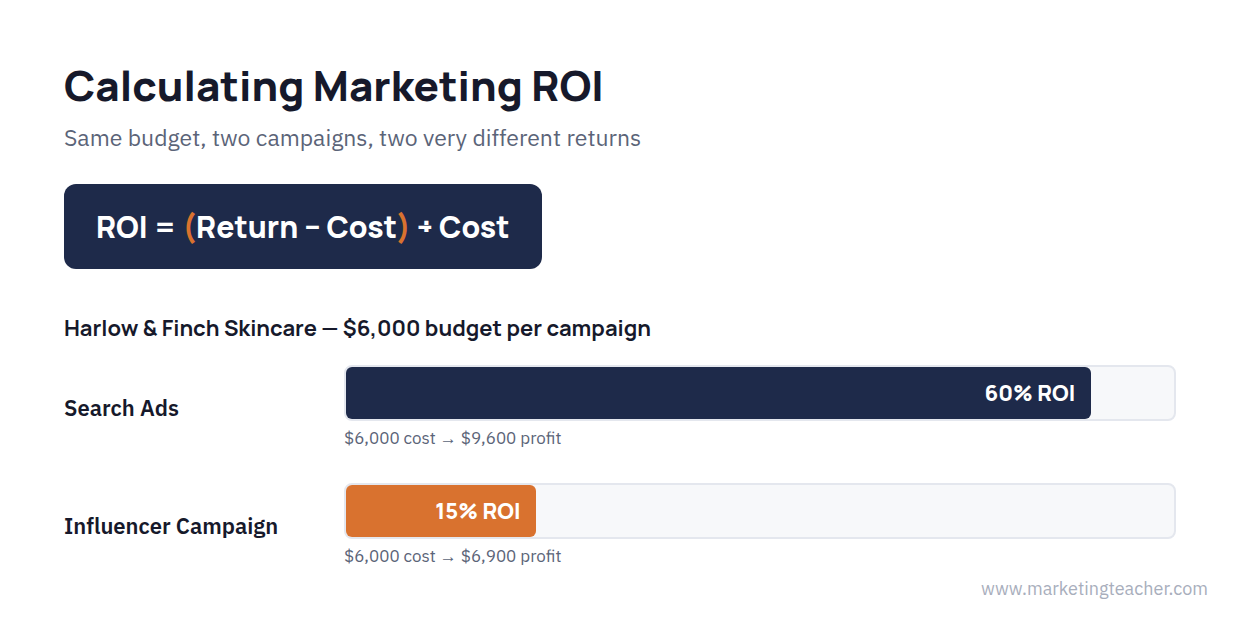
Return On Investment, or ROI, measures the financial return a marketing activity generates relative to what it cost, expressed as ROI = (Return − Cost) ÷ Cost, usually shown as a percentage (Farris, Bendle, Pfeifer & Reibstein, 2010). A campaign that costs $10,000 and generates $15,000 in attributable profit has an ROI of 50%: for every dollar spent, the business got that dollar back plus half a dollar more. No business can keep growing without knowing which of its marketing activities are actually paying for themselves, which is why ROI has become one of the most requested numbers a marketing team is asked to produce, whether the audience is a finance director, an investor, or a small business owner reviewing where next month’s budget should go.
Why This Number Carries So Much Weight
Marketing spend competes with every other line item in a company’s budget, and unlike a factory upgrade with a predictable payback period, marketing’s return can look softer and harder to defend, which puts pressure on marketers to demonstrate accountability in financial terms (Kotler & Keller, 2016). A calculated ROI does two jobs at once: it can flag a channel or campaign that is quietly losing money despite looking busy on the surface, and it can also make the case for putting more budget behind something that is working, since a strategy generating a strong return is usually worth scaling before a weaker one is defended out of habit. Both directions matter equally; ROI is a tool for reallocating a budget, not just a way to justify what has already been decided.
What Counts as “Return” and “Cost”
The formula looks simple, but most disagreements about ROI come from what gets included on each side of it. Cost should include the full cost of running the activity, not just the media spend, so agency fees, staff time and production costs belong in the denominator, not just what was paid to a platform. Return should be the profit the activity generated, not the revenue, since revenue ignores the cost of goods sold and can make an unprofitable campaign look successful. A campaign that drove $50,000 in sales on a product with a 20% margin generated $10,000 in gross profit, not $50,000, and using the larger number will overstate ROI substantially.
The Attribution Problem
The hardest part of calculating marketing ROI honestly is deciding which sales to credit to which activity, since most customers encounter a brand through several touchpoints before buying. A customer might see a social ad, later click a search ad, and finally convert after an email reminder; crediting the full sale to just one of these touchpoints, usually whichever the marketing team wants to defend, is a common and avoidable distortion. Simple approaches split the credit evenly across touchpoints or weight it toward the first or last interaction, and while neither is perfect, being explicit about which rule was used, and applying it consistently across campaigns, matters more than chasing a perfectly accurate but unreachable number.
ROI Versus ROAS: Two Numbers That Get Confused
ROI is often confused with a related metric, Return On Ad Spend (ROAS), which simply divides revenue by ad spend without ever accounting for the cost of goods sold or non-media costs. A campaign can report an impressive 5:1 ROAS while still losing money once true product and overhead costs are factored in, particularly on low-margin products. ROAS is useful as a fast, in-platform metric for comparing one ad set against another within the same campaign, but it should not be presented to a finance team as if it were the same thing as ROI. Keeping the two clearly labelled, and being explicit about which one is being reported, avoids a conversation where a marketing team’s “great ROAS” is later revealed to be a mediocre or negative real ROI.
Summary
Marketing ROI, calculated as (Return − Cost) ÷ Cost, gives marketers a financial answer to whether an activity is paying for itself, and it carries real weight because marketing budgets are under constant scrutiny compared with other business costs. As Harlow & Finch’s comparison shows, the channel that looks most impressive on engagement is not always the one delivering the strongest return, which is exactly the gap ROI is designed to expose. Getting the number right depends on using full costs, profit rather than revenue, and a consistent, honestly-applied approach to attributing credit across the touchpoints that led to a sale.
The slides, worksheet, lesson plan and poster for this lesson are free to download and free to use in your course — no sign-up, no permission needed. See the teacher resources →
Assign this lesson to your class:
Using Canvas, Blackboard or Moodle? Copy the link and paste it into your course page or assignment. More ways to add lessons to your LMS.

