
What Is Promotion in the Marketing Mix?
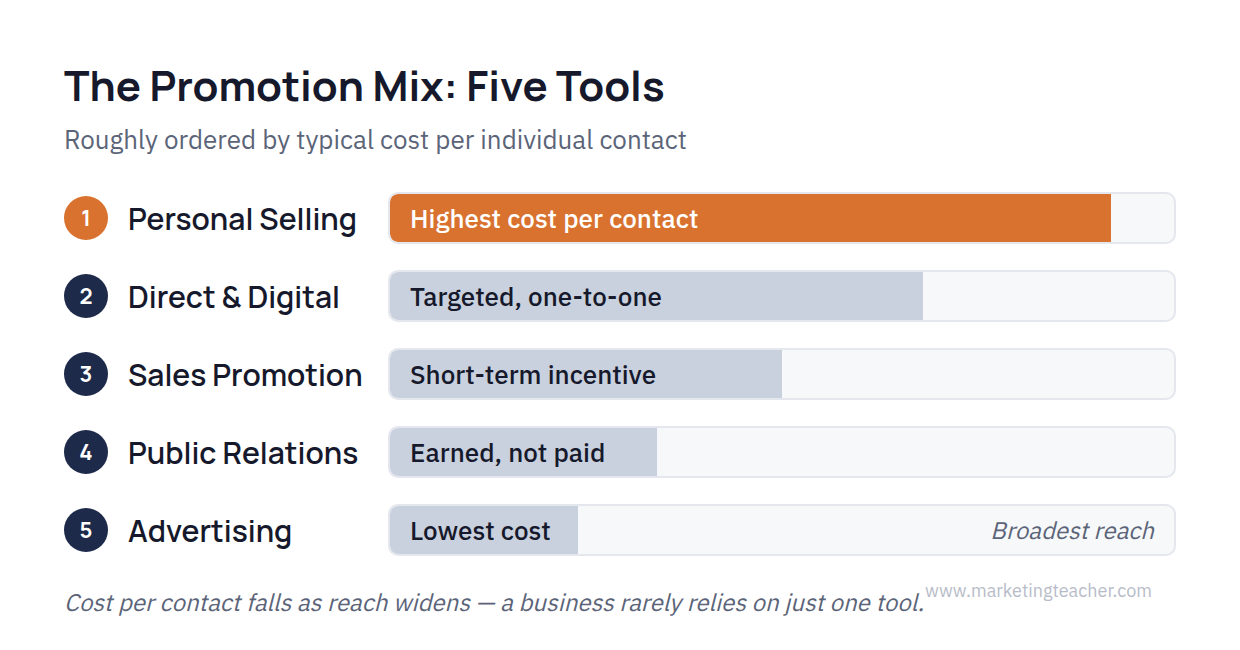
Promotion answers a very specific question: once a business knows what it is selling, at what price, and through which channel, how does it actually tell customers about it? Kotler and Armstrong (2018) define the promotion mix as the specific blend of promotion tools a company uses to persuasively communicate customer value and build customer relationships. Unlike product, price and place, which shape the offer itself, promotion is entirely about communication — and getting that communication right is often what decides whether a good offer actually reaches the people it was built for.
Advertising
Advertising is any paid, non-personal form of communication about an idea, product or service, delivered through a mass channel such as television, search, social media or outdoor sites. Its great strength is reach: a single advertisement can be seen by thousands or millions of people at a relatively low cost per person, which is why it tends to dominate the budgets of businesses selling to large consumer markets. Its weakness is precisely the opposite of personal selling’s strength — advertising talks at an audience rather than to an individual, so it is far better at building awareness and shaping perception than at closing an individual sale.
Personal Selling
Personal selling is a face-to-face or one-to-one presentation by a salesperson, aimed at making a sale and building a lasting customer relationship. Because a trained salesperson can adapt the message in real time, answer objections, and read a buyer’s reaction, this tool is highly persuasive — but it is also, by a wide margin, the most expensive way to reach a single customer. It tends to be used where the value of an individual sale is high enough to justify the cost, such as selling cars, home improvements, or business equipment, and it is the dominant promotional tool in most business-to-business markets.
Sales Promotion
Sales promotion covers short-term incentives designed to encourage the immediate purchase of a product or service — money-off coupons, competitions, free samples, loyalty points, and offers such as buy-one-get-one-free. Where advertising and personal selling build a longer-term case for a brand, sales promotion is built for speed: it gives a buyer who is already close to a decision a reason to act now rather than later. Used too often, though, it can train customers to wait for the next discount rather than buy at full price, so it works best as an occasional accelerant rather than a constant crutch.
Public Relations
Public relations (PR) builds good relationships with a business’s various publics — customers, the press, investors, and the wider community — by generating favourable coverage and managing its overall reputation. Unlike advertising, PR is not directly paid for by the business placing it, which is exactly why it can be so powerful: a positive news story or an independent review often carries far more credibility with an audience than an advert ever could, precisely because it does not read as something the business paid to say about itself.
Direct and Digital Marketing
Direct and digital marketing involves communicating directly with carefully targeted individual customers, often through email, targeted social media, search advertising, or a company’s own app or website, with the aim of getting an immediate response and building a one-to-one relationship. Kotler and Armstrong (2018) note that this tool has grown faster than any other element of the promotion mix, since digital channels let even a small business target a narrow audience with a precision that used to be available only to businesses large enough to fund a dedicated sales team.
Push Strategy vs Pull Strategy
A business also has to decide how its promotion mix moves a product toward the customer. A push strategy uses personal selling and trade promotions to push a product through distribution channels — the manufacturer promotes the product to wholesalers and retailers, who in turn promote it to the end customer. A pull strategy does the opposite: it spends on advertising and consumer promotion to build demand directly with end customers, who then pull the product through the channel by asking retailers to stock it. Kotler and Armstrong (2018) point out that most businesses use some combination of both rather than relying on either one alone, adjusting the balance depending on the product and the market.
Choosing the Right Promotional Mix
There is no single correct promotion mix — the right blend depends on several factors. A business selling to other businesses will usually lean more heavily on personal selling, since B2B purchases tend to be larger, more complex, and made by a small number of decision-makers, while a business selling low-cost consumer goods will typically lean toward advertising to reach a much larger audience efficiently. The stage a buyer has reached also matters: advertising and PR are generally more efficient for building initial awareness, while personal selling and sales promotion become more useful once a buyer is closer to actually deciding. A product’s stage in its own life cycle plays a role too — a newly launched product usually needs heavier advertising and PR to build awareness from nothing, while a mature product already established in the market can rely more on sales promotion to defend its position against competitors.
Summary
Promotion is the element of the marketing mix concerned with communicating an offer to the customer, through five main tools: advertising, personal selling, sales promotion, public relations, and direct and digital marketing. A business chooses its particular blend based on whether it is pushing a product through the channel or pulling demand from customers, who it is selling to, how ready its buyers are to purchase, and where its product sits in its life cycle. Getting that blend right, and making every tool tell the same story, is what turns a good offer into one that customers actually notice and act on.

The slides, worksheet, lesson plan and poster for this lesson are free to download and free to use in your course — no sign-up, no permission needed. See the teacher resources →
Assign this lesson to your class:
Using Canvas, Blackboard or Moodle? Copy the link and paste it into your course page or assignment. More ways to add lessons to your LMS.

