
What Is Sentiment Analysis?
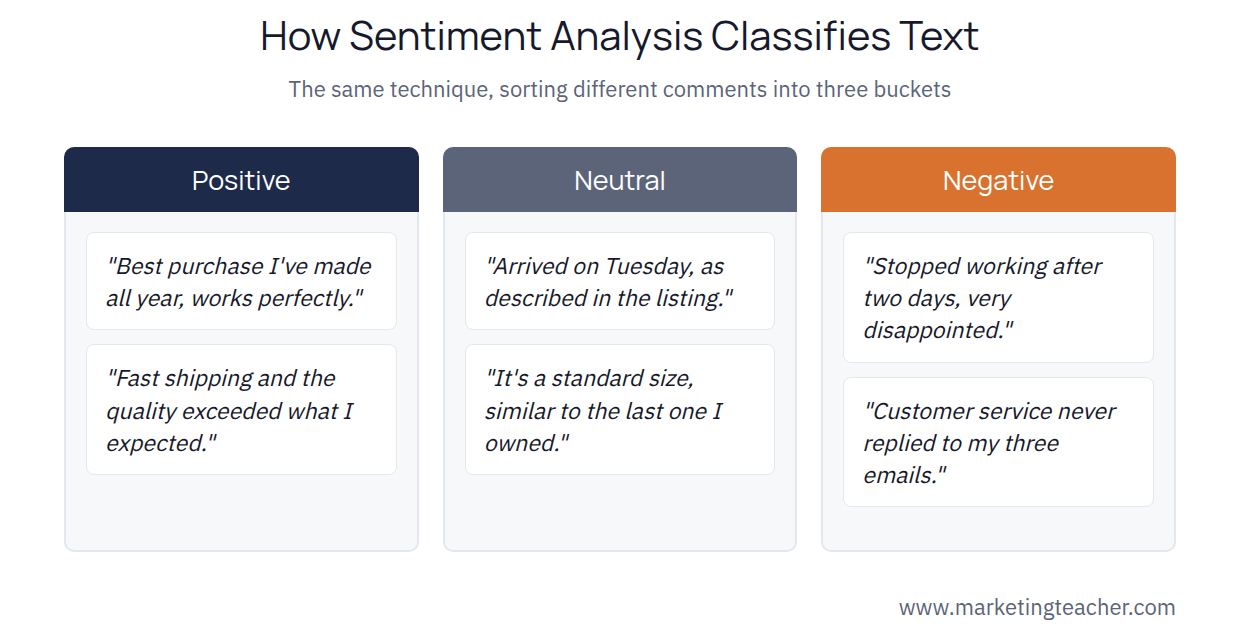
Sentiment analysis, also called opinion mining, is a computational technique that classifies a piece of text — a review, a comment, a social media post — as expressing a positive, negative, or neutral opinion (Pang and Lee, 2008). Rather than a person reading through every comment one at a time, a sentiment analysis tool applies the same classification rule across thousands or millions of pieces of text at once, giving a marketer a scaled-up view of how an audience actually feels.
Where Marketers Actually Use It
The technique shows up anywhere customers leave text a business can collect: product reviews, social media mentions of a brand or campaign, comments on an advertisement, or open-ended survey responses. A marketing team can track how the sentiment attached to a brand name shifts week to week, spot a sudden spike in negative comments after a product change before it turns into a wider complaint pattern, or compare sentiment across competitors mentioned in the same online conversations. It’s also increasingly used to test messaging before a full launch — running early ad copy or campaign concepts past a smaller sample audience and reading the sentiment of the reactions can flag a tone problem well before the budget for a wider rollout is committed.
How the Classification Actually Works
At its core, a sentiment analysis tool is trained on large volumes of text that have already been labelled positive, negative, or neutral, and it learns which words, phrases and patterns tend to go with each label (Pang and Lee, 2008). Once trained, it applies that same pattern-matching to new, unlabelled text. This is why the diagram above shows genuinely similar-looking comments landing in different buckets — the tool isn’t reading for meaning the way a person does, it’s matching statistical patterns it learned from its training data, which is both its main strength (speed, scale) and the source of its main weaknesses (below).
Where the Technique Breaks Down
Sentiment analysis struggles with exactly the kind of language that makes human communication rich: sarcasm (“great, it broke after one day” reads as positive on pure word-matching), mixed opinions in a single comment (“the shipping was awful but the product is excellent”), and industry-specific or slang terms a general-purpose tool was never trained on. A tool that isn’t tuned for a specific market or language will also misread cultural or regional phrasing that a native reader would catch instantly. None of this makes the technique useless — it makes it a strong first pass that still benefits from a human spot-checking a sample of the results, exactly as Northgate did.
Beyond a Single Score: Aspect-Based Sentiment
A single overall sentiment score for a product can hide more than it reveals, since a review might be glowing about the product itself but frustrated about delivery, or the reverse. A more useful version of the technique, sometimes called aspect-based sentiment analysis, breaks a single piece of text down by the specific aspect being discussed — price, quality, customer service, shipping — and scores each aspect separately. This is what let Northgate Skincare, in the example above, isolate a specific fragrance complaint rather than being told only that “sentiment is down,” which on its own gives no clue where to look for the actual problem.
Reading Sentiment Alongside Other Signals
Sentiment analysis works best combined with other data rather than trusted alone: a sentiment score paired with sales figures, return rates, or customer service ticket volume gives a far more reliable picture than sentiment on its own. A spike in negative sentiment that coincides with a genuine product issue is a signal worth acting on quickly; a spike that doesn’t line up with any other metric is worth a closer read before drawing conclusions, since it may simply reflect a classification error on ordinary, ambiguous language.
Summary
Sentiment analysis classifies text — reviews, social posts, survey comments — into positive, negative or neutral categories, letting marketers track audience opinion at a scale no human team could read manually (Pang and Lee, 2008). It’s used to monitor brand perception over time, catch emerging product complaints early, and compare sentiment across competitors, but it struggles with sarcasm, mixed opinions and specialised language because it matches learned patterns rather than genuinely understanding meaning. The most reliable use of it combines the sentiment score with other business data and a human spot-check of the actual text, rather than treating the classification as the final word on its own.
The slides, worksheet, lesson plan and poster for this lesson are free to download and free to use in your course — no sign-up, no permission needed. See the teacher resources →
Assign this lesson to your class:
Using Canvas, Blackboard or Moodle? Copy the link and paste it into your course page or assignment. More ways to add lessons to your LMS.

