
Learning Outcome: By the end of this lesson, you will be able to explain what a neural network is, describe the three-layer structure marketers use to build one, and apply the idea to a realistic customer-prediction problem.
Want to go further? Study a full online course and earn a certificate →
What Is Neural Network Marketing?
A neural network is a computing technique loosely modelled on how neurons in the brain pass signals to one another – layers of simple processing units, usually called nodes, that each take in numbers, apply a weight to them, and pass a signal forward. De Bruyn et al. (2020), writing in the Journal of Interactive Marketing, distinguish neural networks and related deep-learning methods from traditional statistical modelling by their capacity for what they call “higher-order learning”: the model adjusts its own internal weights as it sees more data, rather than a marketer specifying the exact relationship between variables in advance, the way a conventional regression model requires. Applied to marketing, this means a neural network can be shown thousands of past customer records and gradually learn, on its own, which combinations of behaviour tend to predict an outcome a business cares about.
The Three-Layer Structure
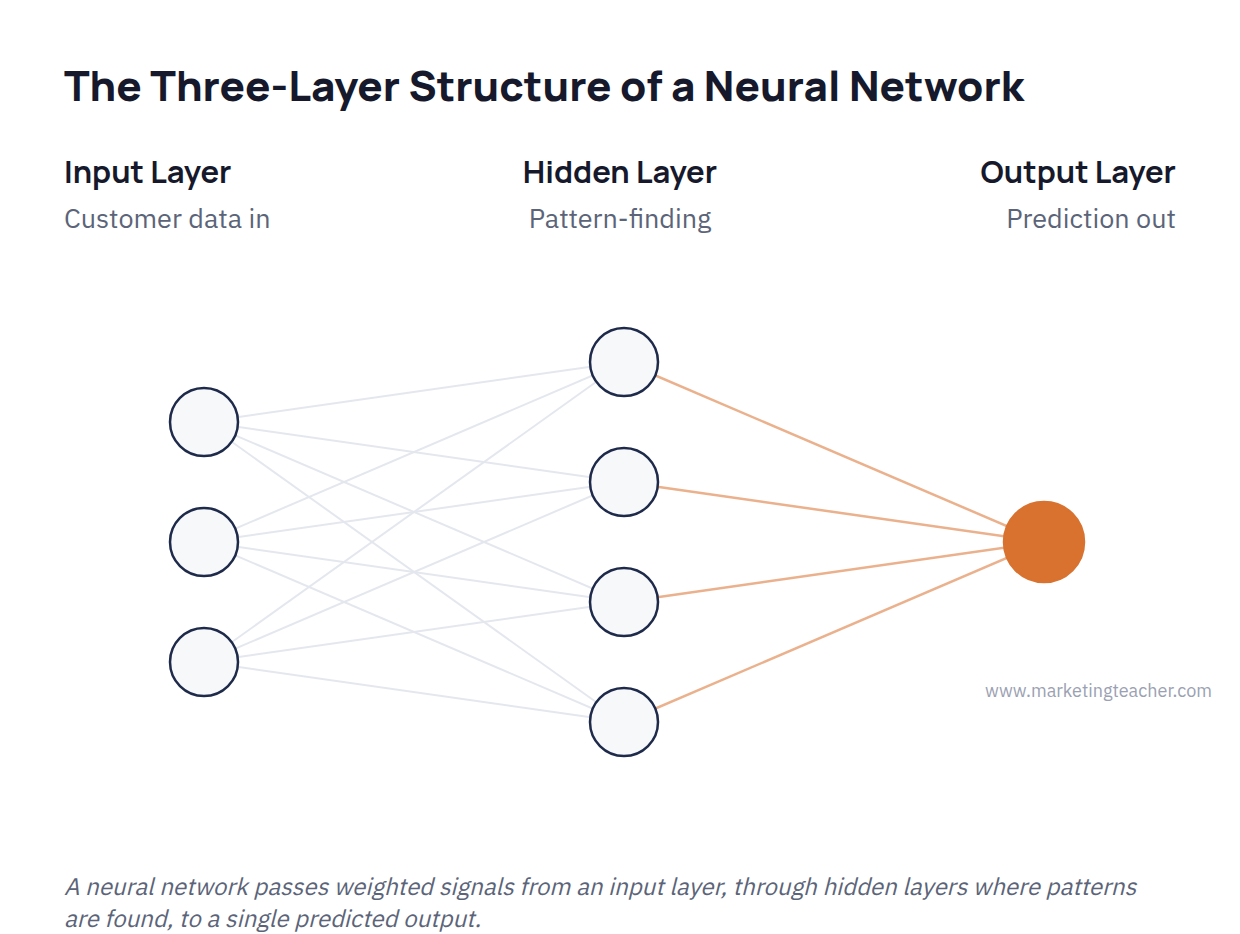
Most neural networks used in marketing share the same basic shape. An input layer receives the raw data about a customer – things like order frequency, time since last purchase, or pages viewed. This feeds into one or more hidden layers, where the actual pattern-finding happens: each node combines signals from the previous layer, weights them, and passes on a new signal. Finally, an output layer produces the answer the business actually wants, such as a single score predicting how likely a customer is to cancel a subscription. Training the network means repeatedly adjusting the weights between nodes until its predictions line up closely with real, known outcomes from historical data.
How Marketers Actually Use This
The most common marketing application is customer churn prediction: feeding a network historical data on customers who did and didn’t cancel, so it can flag current customers showing a similar pattern before they leave. Wilson et al. (2019), in the Journal of Business & Industrial Marketing, tested neural network models directly against traditional regression models using real B2B marketing research data, and found the neural network models produced predictions that were as accurate as, or more accurate than, logistic regression across the datasets tested – one reason these techniques have moved from academic papers into everyday marketing software rather than staying a purely theoretical exercise. Beyond churn, the same underlying technique supports demand forecasting, dynamic pricing, product recommendation engines, and automatically tagging the content of images and video for a media library.
Example: Bramwell Outdoors Predicts Who Will Cancel
The fictional subscription retailer Bramwell Outdoors, which mails a themed outdoor-gear box every month, trained a simple neural network on eighteen months of customer records – order history, how often subscribers logged in to customise a box, and how they responded to previous emails. The model’s output layer produced a single churn-risk score between 0 and 1 for every active subscriber. Customers scoring above 0.7 were shown to cancel within the following two months at more than four times the rate of customers scoring below 0.3. Rather than emailing every subscriber the same generic retention offer, Bramwell targeted only the highest-risk group with a personalised discount, and measured a reduction in that group’s cancellation rate from 34% to 21% over the following quarter – a far more efficient use of the retention budget than a blanket campaign.
Why the Model Is Only as Good as Its Data
A neural network cannot correct for poor-quality training data on its own. If the historical records used to train it are incomplete, biased toward one type of customer, or simply too small a sample, the resulting predictions inherit those same weaknesses, no matter how sophisticated the underlying maths looks. There is also a real risk of overfitting – a model that has essentially memorised the quirks of its training data rather than learning a genuinely useful pattern, and so performs poorly once it sees new customers it has never encountered before. Because a neural network’s internal weights are not easily interpreted by a human reading them, marketers should also build in a human review step before acting on a prediction, rather than treating the model’s output as an unquestionable verdict, and should handle any personal customer data used for training in line with the relevant data protection regulation.
Where This Sits Alongside Other AI Tools
Neural networks are one specific technique within the much broader field of marketing analytics, and they are not always the right tool for the job. A simpler statistical model is often just as accurate for a small, well-understood dataset, and far easier for a marketing team to explain to stakeholders. Neural networks tend to earn their extra complexity when the underlying pattern is genuinely non-linear or involves many interacting variables at once – exactly the kind of problem where a human analyst, or a simpler model, would otherwise struggle to spot the relationship.
Key Idea: A neural network doesn’t understand marketing – it finds hidden statistical patterns across layers of weighted connections and uses them to predict a number, such as a customer’s likelihood to churn, for someone new. A marketer’s job is to make sure the training data is clean, representative, and reviewed by a human before its output drives a real decision.
Summary
A neural network is built from layers of simple, weighted nodes – an input layer, one or more hidden layers, and an output layer – trained on historical data until its predictions match known outcomes closely enough to trust. Marketers use this structure for churn prediction, demand forecasting, dynamic pricing, and recommendation engines, and independent testing has shown these models can match or beat traditional statistical approaches on real marketing data. The technique’s value depends entirely on the quality of the data behind it and on marketers treating its predictions as a decision-support tool that still needs human judgement, not as an automatic answer.
More in this series: Marketing and emerging technology
Marketing and AI (Artificial Intelligence) · Marketing and ChatGPT · Marketing and Machine Learning · Marketing and IOT (Internet of Things) · Marketing and Industry 4.0 · Neural Network Marketing · Transforming Marketing: The Power of Blockchain Technology · Augmented Reality (AR) in Marketing · Metaverse Marketing
Teaching this topic?
The slides, worksheet, lesson plan and poster for this lesson are free to download and free to use in your course — no sign-up, no permission needed. See the teacher resources →
Assign this lesson to your class:
Using Canvas, Blackboard or Moodle? Copy the link and paste it into your course page or assignment. More ways to add lessons to your LMS.
Written by Marketing Teacher.
Online course · certificate on completion
Study a full online course — and earn a certificate
Three courses that turn the free lessons into ordered modules, written at university Levels 4 to 6, with a short quiz after each.

