
What Does Machine Learning Actually Do in Marketing?
Machine learning is software that improves its own predictions by finding patterns in data, rather than following one fixed set of rules a person wrote in advance. In marketing, that distinction matters: a traditional rule might say “email anyone who hasn’t bought in 90 days,” while a machine learning model looks across thousands of past customers and works out, often more accurately, which specific customers are actually likely to respond to that email at all. A recent review of artificial intelligence in marketing found this kind of pattern-finding is now widely used across predictive analytics, customer segmentation and personalised recommendations (Kopalle et al., 2022).
The Learning Loop
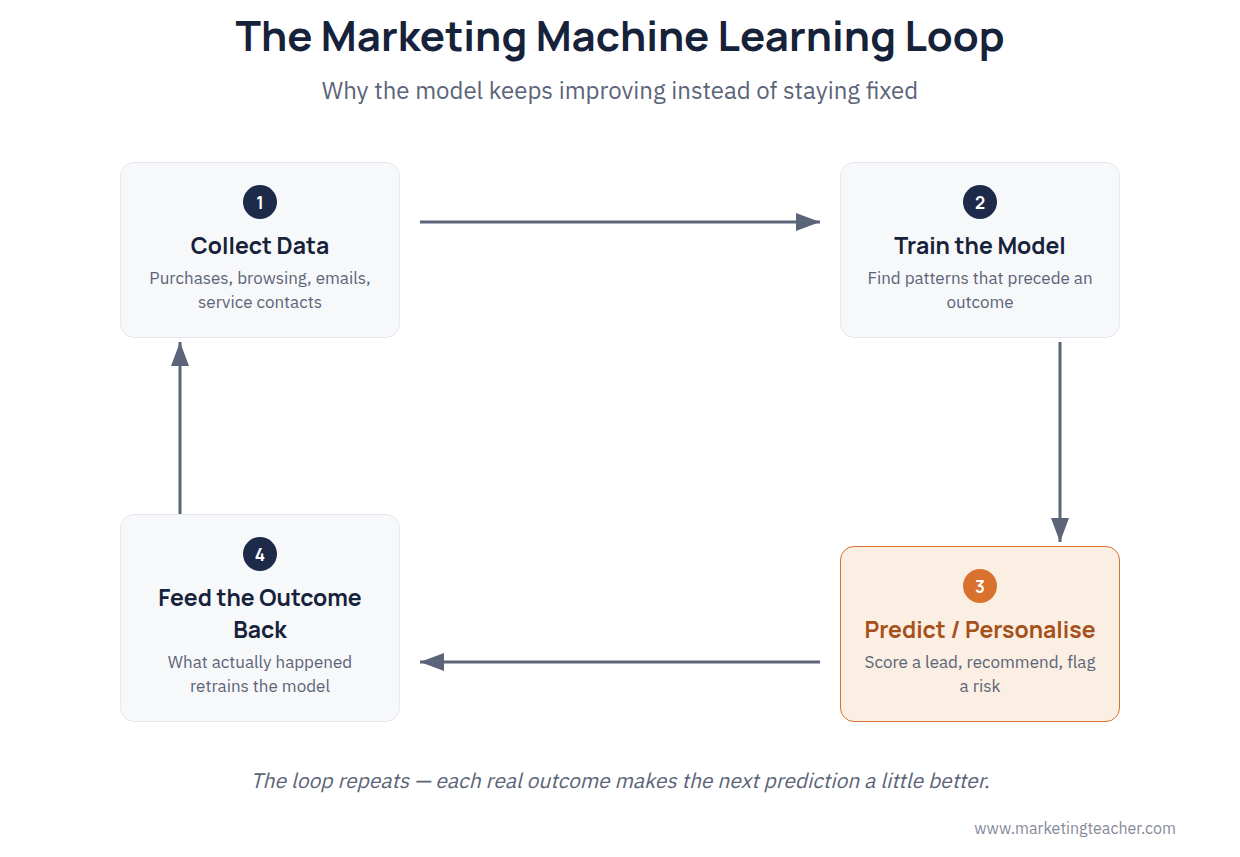
The diagram above sets out the basic cycle behind most marketing applications of machine learning. It starts with collecting data — purchase history, browsing behaviour, email opens, customer service contacts. A model is then trained on that data, learning which patterns tend to precede an outcome the business cares about, such as a purchase, a cancellation, or a complaint. The trained model is then used to predict or personalise: scoring a lead, recommending a product, or flagging a customer at risk of leaving. Crucially, the outcome of that prediction — did the customer actually buy, did they actually leave — feeds back into the data, so the next version of the model can learn from what actually happened. This loop, repeated many times, is what allows the model to keep improving rather than staying fixed at its first attempt.
Where This Shows Up for Marketers
Kopalle et al. (2022) point to several places this loop already shapes everyday marketing decisions. Customer segmentation and personalisation use the same underlying idea covered in AI-driven personalisation: grouping customers by predicted preference rather than by simple, manually defined categories such as age or location. Churn prediction flags customers whose recent behaviour resembles that of others who cancelled in the past, giving a business the chance to intervene before they actually leave. Recommendation engines — the “customers who bought this also bought” logic behind many retail websites — are themselves a direct product of this same pattern-learning approach. Online advertising uses the same idea at a much larger scale: automated ad-buying systems use machine learning to decide, in the fraction of a second before a web page loads, which of many possible ads a particular visitor is statistically most likely to respond to. All of it depends on the underlying customer data described in CRM and Big Data; a model is only ever as good as the data it is trained on.
Machine Learning Doesn’t Replace Marketing Judgement
A model only ever learns from the past, which creates a real limitation: if customer behaviour shifts — a new competitor arrives, a product goes out of fashion, an economic shock changes spending habits — a model trained on the old pattern can carry on confidently making predictions that no longer hold. Machine learning is also only as fair as the data it learns from; if past data reflects a bias (for example, only certain customer groups were ever offered a particular promotion), the model can learn and repeat that same bias without anyone intending it to. None of this makes the technology less useful, but it does mean a marketer still has to decide what to do with a prediction — a model can flag a risk or suggest a segment, but choosing the actual offer, message and relationship the business wants with that customer remains a marketing decision, not a purely technical one.
Summary
Machine learning brings a genuinely different approach to marketing data: instead of following fixed rules, it learns patterns from past customer behaviour and improves as it sees more outcomes, through a repeating loop of collecting data, training a model, predicting or personalising, and feeding the result back in. This shows up across segmentation, churn prediction and recommendation engines, and depends entirely on the quality of the underlying customer data feeding it. Its central limitation is that it only knows the past: when markets shift or when the training data carries a hidden bias, a model can be confidently wrong, which is exactly why marketing judgement about what to do with a prediction remains a human responsibility.
The slides, worksheet, lesson plan and poster for this lesson are free to download and free to use in your course — no sign-up, no permission needed. See the teacher resources →
Assign this lesson to your class:
Using Canvas, Blackboard or Moodle? Copy the link and paste it into your course page or assignment. More ways to add lessons to your LMS.

