
Learning Outcome: By the end of this lesson, you will be able to explain what a social media audit is, apply the Five Ws framework to structure one, and turn audit findings into a prioritised list of actions for a digital marketing plan.
This lesson is part of our Foundations of Social Media Marketing course. Study the full course and earn a certificate →
What Is a Social Media Audit?
Social media has become a place where consumers generate their own content about brands, products, and services, and a large share of what shows up in a search for any company now consists of exactly this kind of user-generated content rather than material the company itself published. That makes a social media audit an important part of digital marketing planning: it is a systematic examination of the social conversation around a brand, used to discover, categorise, and evaluate what is actually being said, rather than relying on assumption or memory. As Quesenberry (2015) puts it, an audit gives a marketer a structured way to see the competitive social landscape clearly enough to decide how to feed the wider digital marketing funnel and to monitor ongoing discussion of their own brand.
The Five Ws Framework
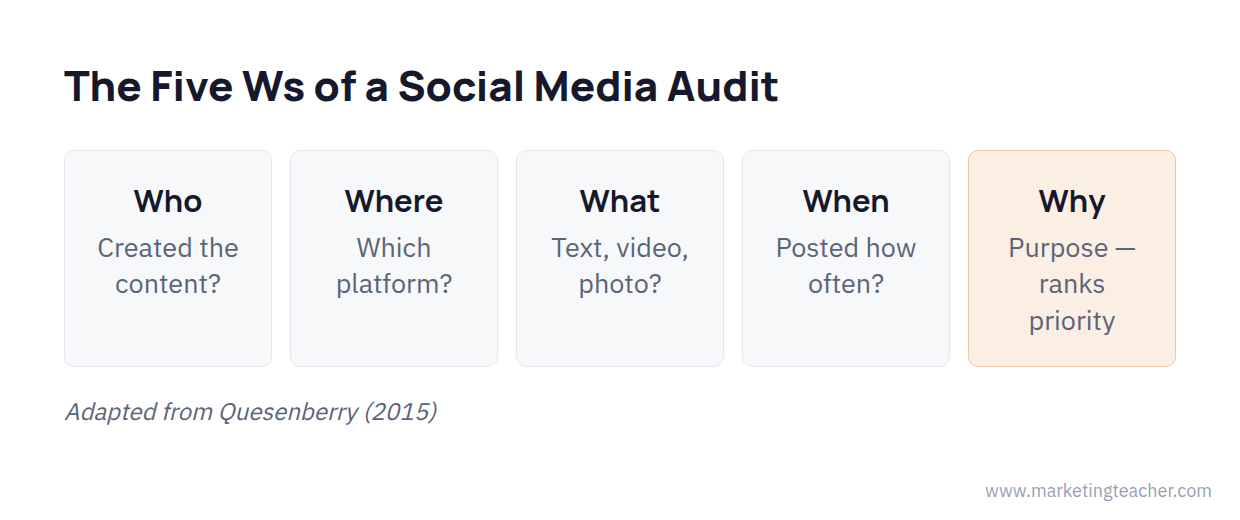
Quesenberry’s auditing method borrows a structure long used in journalism: who, what, where, when, and why. Add “how” to that list and the source is older still – Rudyard Kipling’s poem “The Elephant’s Child” opens with the same six serving-men: “What and Why and When / And How and Where and Who.” Marketing Teacher’s adapted version keeps the audit to five focused questions, each aimed at a single piece of social content:
1. Who is creating the content? Is it the brand itself, an influencer, or a competitor?
2. Where does the content appear? Which platform is being used – YouTube, Instagram, a review site, a forum?
3. What is the content, specifically? Text, video, a photo, a story, a star rating? What does the feedback underneath it look like?
4. When was it posted, and how often does similar content appear? What was its reach, and was it shared onward?
5. Why was it created? Is it part of a deliberate campaign, a genuine complaint, or simply one customer’s unprompted opinion?
Working through every piece of relevant content against these five questions turns a vague sense of “what people are saying online” into a structured, comparable data set.
Example: Thornfield Outdoor Gear’s Competitive Audit
The fictional outdoor equipment retailer Thornfield Outdoor Gear ran a Five Ws audit covering its own social presence alongside its two closest competitors over a single month. Logging 60 posts and mentions in total, the audit showed that 38 of them were user-generated (customers posting their own trail photos and gear reviews) rather than brand-published content – a much higher share than Thornfield’s marketing team had assumed. Under “where,” the audit revealed that one competitor was getting almost all of its engagement from a single platform (a hiking-focused forum) that Thornfield had no presence on at all. Under “why,” a cluster of posts turned out to be complaints about a competitor’s sizing chart, an opening Thornfield’s own product pages did not yet address clearly either. None of these findings came from guesswork; each was a direct count against one of the five questions, which is what let the team rank them by how many mentions and how much reach stood behind each one.
Turning the Audit Into Action
An audit is only useful once its findings are ranked and prioritised, not simply logged. After working through the Who/Where/What/When/Why questions for every relevant post, the next step is to score each recurring pattern – typically on a simple 1–10 scale – against how directly it affects the brand’s own social media marketing strategy. A platform where competitors dominate and the brand has no presence scores differently from a single one-off complaint; a recurring, high-reach complaint about a genuine product weakness scores higher still, since it points to something the marketing team can actually fix rather than merely monitor. This ranking step is what separates a social media audit from a simple listening exercise: the goal is not just to know what is being said, but to decide what to do about it, in order of how much it matters.
Key Idea: A social media audit works by breaking an overwhelming amount of online conversation into five specific, comparable questions – who, where, what, when, and why – and it only delivers value once those findings are ranked by importance and turned into a prioritised list of actions, rather than left as a simple record of what was said.
How Often to Repeat the Audit
A social media audit is not a one-off exercise. Because platforms, competitors, and the conversation itself all change, a quarterly repeat is a reasonable default for most brands, with a lighter monthly check on the “where” and “why” questions if a competitor is known to be running an active campaign. The most common mistake is treating the first audit as definitive and never repeating it, which means a genuine shift – a competitor launching on a new platform, or a recurring complaint that has since been fixed – goes unnoticed for months. A second common mistake is auditing only the brand’s own channels and skipping competitors entirely, which removes the comparative context that makes the Five Ws findings meaningful in the first place; a complaint level that looks alarming in isolation can turn out to be normal for the category once a competitor’s numbers are logged against the same five questions.
Summary
A social media audit is a structured way to examine the social conversation around a brand, relative to its competitors, using the Five Ws framework: who created the content, where it appears, what it consists of, when and how often it was posted, and why it exists. Because so much of this content is user-generated rather than brand-published, an audit often surfaces gaps and opportunities a marketing team would otherwise miss. The audit’s real value comes at the ranking stage, when raw observations are scored by importance and converted into a prioritised set of actions for the digital marketing plan.
Teaching this topic?
The slides, worksheet, lesson plan and poster for this lesson are free to download and free to use in your course — no sign-up, no permission needed. See the teacher resources →
Assign this lesson to your class:
Using Canvas, Blackboard or Moodle? Copy the link and paste it into your course page or assignment. More ways to add lessons to your LMS.
Written by Marketing Teacher.
Online course · certificate on completion
Study the full Social Media Marketing course — and earn a certificate
Eleven modules on strategy, content, community, advertising and measurement, written at Level 4, with a short quiz after each.

