
What Is Viral Marketing?
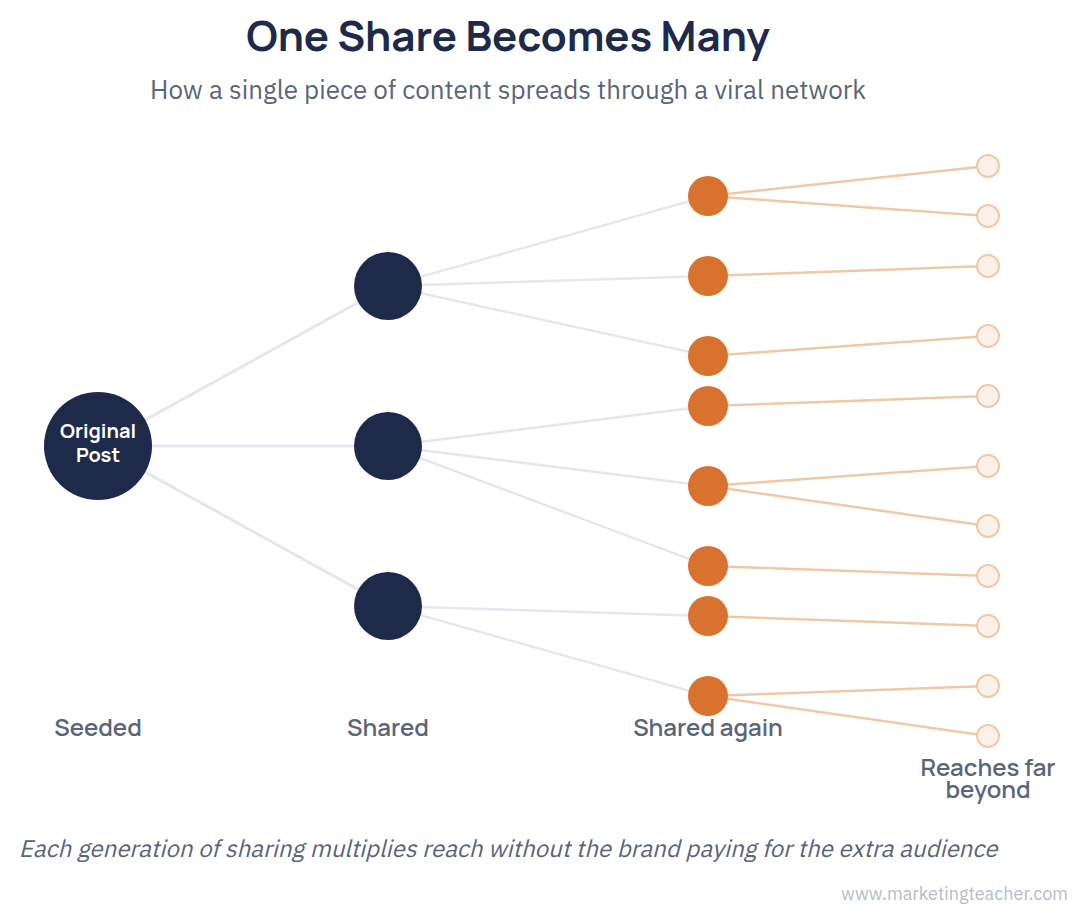
Viral marketing is essentially online word-of-mouth: a message, image, or video that people find compelling enough to pass along to others without the brand having to buy its way in front of every one of those extra viewers. The name comes from the way it spreads, one person forwarding it to several others, each of whom forwards it again, so that reach grows exponentially rather than in the straight line a traditional paid advertisement follows. Because sharing costs the brand nothing beyond producing the content in the first place, a genuinely viral campaign is one of the most cost-effective ways to build awareness. Kaplan and Haenlein (2011) describe successful viral marketing as a kind of choreography rather than an accident: the message, the medium, and the social structure it spreads through all have to work together, much like partners in a dance, or it never takes off.
How a Viral Campaign Spreads
A viral campaign can travel through almost any digital channel, most commonly email and social media, though a message can just as easily move through a messaging app, a forum, or a video-sharing platform. Marketers refer to the specific format a viral message takes, whether that is an image, a joke, a quiz, a short video, a game, an e-card, or a dedicated micro-site built just for the campaign, as its agent or mechanic: the vehicle that carries the underlying idea from one person to the next. Because a viral campaign is designed to be forwarded rather than broadcast, it is usually planned as one element within a wider integrated marketing communications campaign rather than as a standalone activity, working alongside paid advertising, social media marketing, and email marketing rather than replacing them.
What Makes Content Go Viral?
Not every piece of content spreads, and understanding why some does is now backed by real research rather than guesswork. Berger and Milkman (2012) analysed thousands of shared articles and found that content triggering high-arousal emotions, whether positive, such as awe and amusement, or negative, such as anger and anxiety, is shared far more often than content that leaves people merely sad or mildly interested, because strong emotion is what motivates someone to actively pass something on. Practical experience adds a shorter version of the same idea: a viral piece tends to be funny, surprising, or a little outrageous, takes a clear point of view on something people already feel strongly about, or does something so unexpected that it has no obvious connection to the product being marketed at all. None of these guarantee virality on their own, but a campaign missing all of them rarely spreads far.
Benefits and Risks of Losing Control
A successful viral campaign is genuinely valuable to a business: it builds a large amount of brand awareness cost-effectively, extends and reinforces the messages of other campaigns already running, adds a sense of buzz and novelty that a traditional advert rarely achieves, and can carry a brand’s message to audiences well beyond its usual core market. The catch is that once a viral campaign is released, the brand loses almost all control over it. A television advert can be pulled from air the moment it stops working; a video already spreading across social media and being reshared by strangers cannot be recalled in the same way, and there is no way to control exactly when it accelerates, when it slows down, or which audiences it eventually reaches, some of whom may not be a good fit for the brand at all. A message can also be taken out of its original context as it spreads, which is why every viral idea needs to be tested against how it might look if it reaches an audience the brand never intended to reach.
Summary
Viral marketing spreads a message the way word-of-mouth always has, just at digital speed and scale, using agents such as images, videos, quizzes, and micro-sites carried mainly through email and social media. Berger and Milkman’s (2012) research shows that strong emotional arousal, not simply quality or budget, is what drives people to share, while Kaplan and Haenlein (2011) frame a successful campaign as a deliberate combination of message, medium, and audience. The reward for getting this right is cost-effective reach that a paid campaign alone cannot match; the trade-off is that once a viral campaign is released, the brand can no longer control its pace, its reach, or the context in which it is eventually seen.
The slides, worksheet, lesson plan and poster for this lesson are free to download and free to use in your course — no sign-up, no permission needed. See the teacher resources →
Assign this lesson to your class:
Using Canvas, Blackboard or Moodle? Copy the link and paste it into your course page or assignment. More ways to add lessons to your LMS.

