
What Is Virtual Commerce?
Virtual commerce, or v-commerce, is the buying and selling of goods and services inside virtual environments — online games, social platforms, and virtual or augmented reality spaces — rather than through a conventional website or app storefront. It builds on a long line of research into how customers experience shopping in digital environments generally (Novak, Hoffman and Yung, 2000), but narrows in specifically on transactions completed inside a persistent virtual space: a player buying a cosmetic item inside a game, a shopper trying on a virtual outfit before ordering the physical version, or a brand selling a limited-edition digital collectible that only exists inside one platform.
How Virtual Commerce Differs From Ordinary E-commerce
Ordinary e-commerce moves a familiar retail experience — browse, add to cart, checkout — onto a website or app. Virtual commerce goes further: the shopper is represented by an avatar, moves through a three-dimensional space, and often interacts socially with other avatars while shopping, which changes both what gets sold and how. Research into virtual-world user acceptance found that a sense of presence and social interaction inside the environment meaningfully shapes whether users adopt and keep using it (Fetscherin and Lattemann, 2008), which is exactly the dynamic v-commerce depends on and ordinary e-commerce does not.
Virtual Commerce vs. Metaverse Marketing — Related but Different
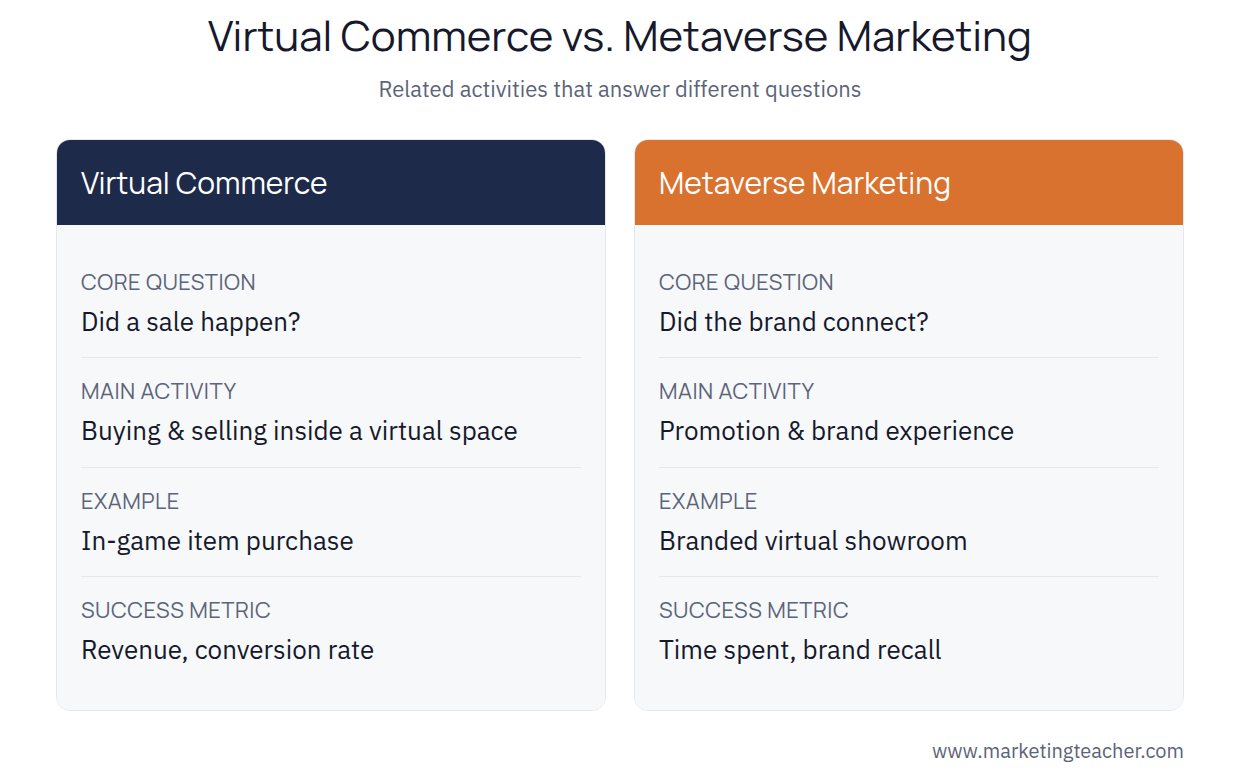
Virtual commerce and metaverse marketing are easy to conflate but answer different questions. Virtual commerce is about completing a transaction inside a virtual environment — the sale itself. Metaverse marketing is about promoting a brand and building awareness inside that environment, whether or not a sale happens on the spot. A brand can run metaverse marketing — a branded virtual event, an influencer appearance — with no v-commerce attached at all, and a v-commerce transaction can happen with no metaverse-style marketing campaign behind it, such as a simple in-game purchase prompted only by an on-screen button. In practice the two are often combined, but treating them as the same activity leads to confusing a successful brand campaign with an unsuccessful sales channel, or the reverse.
The Appeal for Brands
Virtual commerce lets a brand create shopping experiences that simply aren’t possible in a physical store or a flat webpage: a customer can examine a product from every angle, see it “worn” on their own avatar, or unlock a version of it that only exists in that platform. It also opens access to audiences who spend significant time inside games and virtual social platforms and who may be harder to reach through conventional retail or advertising channels altogether.
The Challenges Brands Actually Run Into
Two problems come up repeatedly once a brand moves past the pilot stage. The first is data security and privacy: virtual environments often require users to hand over personal or payment information to complete a purchase, and protecting that information is harder in a fast-moving, highly interconnected virtual space than in a conventional, well-audited checkout flow. The second is interoperability — a digital item bought inside one platform typically cannot be carried into another, which limits how much lasting value a customer can actually attach to a virtual purchase, and makes brands cautious about how much they invest in any single platform’s version of virtual commerce. A third, less obvious problem is measurement: standard e-commerce analytics don’t map cleanly onto an avatar-mediated purchase, so brands often have to build bespoke tracking just to know whether a virtual storefront is actually paying for itself.
Where This Is Headed
Adoption of virtual commerce still varies enormously by platform and audience, and plenty of early pilots have quietly been shelved once the novelty wore off. The pattern that seems to persist is narrower than the early hype suggested: v-commerce works best where it offers something a normal storefront genuinely cannot, such as trying an item on a personal avatar or owning something that only exists in that specific community, rather than being used as a gimmicky wrapper around an otherwise ordinary purchase.
Summary
Virtual commerce (v-commerce) is the buying and selling of goods and services inside virtual environments such as games, social platforms, and VR spaces, distinct from ordinary e-commerce because it involves avatar-mediated, socially interactive shopping (Fetscherin and Lattemann, 2008) and distinct from metaverse marketing, which is about promotion rather than the transaction itself. It offers brands genuinely new kinds of shopping experience and access to hard-to-reach audiences, but still faces real data-security and interoperability challenges, and tends to succeed only where it offers something a conventional storefront cannot (Novak, Hoffman and Yung, 2000).
The slides, worksheet, lesson plan and poster for this lesson are free to download and free to use in your course — no sign-up, no permission needed. See the teacher resources →
Assign this lesson to your class:
Using Canvas, Blackboard or Moodle? Copy the link and paste it into your course page or assignment. More ways to add lessons to your LMS.

