
What Are Marketing Analytics?
Marketing analytics is the discipline of collecting, measuring and interpreting data about marketing activity in order to understand what’s working, what isn’t, and why. It turns marketing from a function that’s judged mainly on creativity and instinct into one that can also be judged on measurable outcomes — website visits that turned into leads, campaigns that turned into sales, channels that returned more than they cost. A widely cited foundational article on the field frames marketing analytics as increasingly essential precisely because the sheer volume and variety of data now available to marketers — from digital behaviour, transactions, and social platforms — has outgrown what traditional, simpler measurement approaches were built to handle (Wedel and Kannan, 2016).
Three Broad Categories of Marketing Analytics
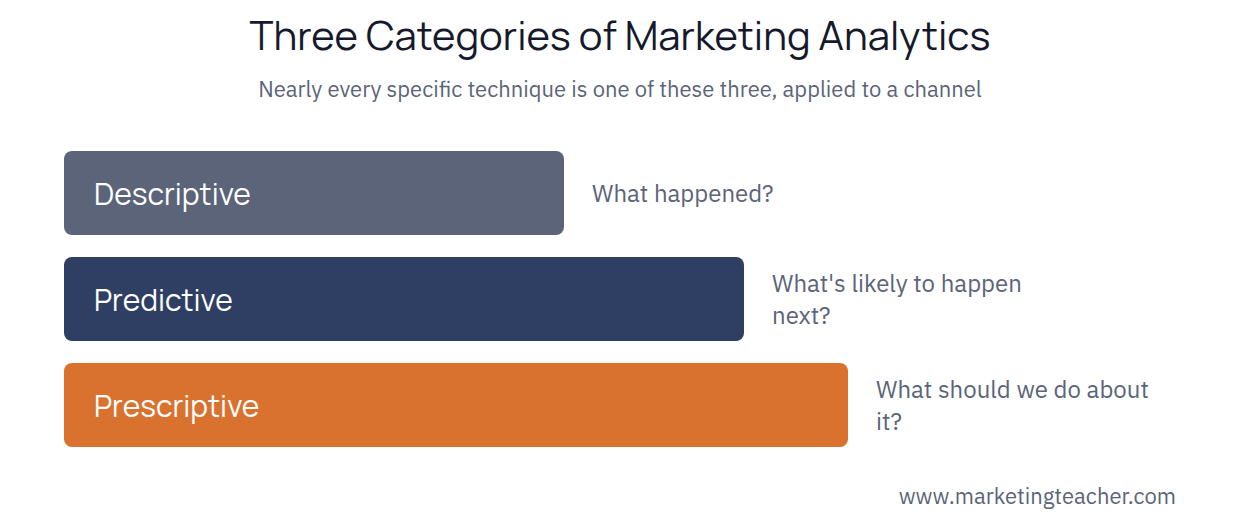
Most specific marketing analytics techniques fall into one of three broad categories. Descriptive analytics answers “what happened” — website traffic reports, campaign click-through rates, sales-by-channel breakdowns — and is the most common starting point because it’s the easiest to produce and understand. Predictive analytics answers “what’s likely to happen next,” using patterns in past data to forecast future outcomes such as which customers are likely to churn or which leads are likely to convert. Prescriptive analytics goes a step further and answers “what should we do about it,” using models and rules to recommend a specific action rather than just a forecast, such as automatically adjusting an ad budget toward the channel a model predicts will perform best.
Why This Has Become Central to Marketing
Marketing used to rely heavily on aggregate, delayed measures — total sales at the end of a quarter, brand-awareness surveys run once or twice a year — which made it hard to know quickly whether a specific campaign or channel was actually responsible for a result. Digital channels changed that by generating granular, near-real-time data on individual actions: a click, a page view, an abandoned cart, a completed purchase, all attributable to a specific campaign or channel. That shift is what makes the volume and variety of data marketers now have access to genuinely different in kind, not just in scale, from what earlier measurement approaches were designed around (Wedel and Kannan, 2016) — and it’s what makes a dedicated analytics discipline necessary rather than optional.
The Techniques Sit on Top of This Foundation
Specific marketing analytics techniques — predictive customer scoring, sentiment analysis, geoanalytics, mobile attribution, and many others — are all applications of this same underlying discipline to a particular type of data or business question. Understanding the three broad categories above makes it much easier to place any specific technique in context: a new analytics tool or method is almost always doing one of these three things, just applied to a specific channel or data source, rather than introducing an entirely new kind of analysis.
Common Data Sources Behind Marketing Analytics
Marketing analytics typically pulls from several data sources rather than one: website and app analytics platforms tracking visitor behaviour, customer relationship management (CRM) systems holding purchase and interaction history, advertising platforms reporting spend and performance by channel, and social media platforms providing engagement and sentiment data. The real analytical work usually happens in connecting these sources to each other rather than examining any one of them alone, since a customer’s full journey — seeing an ad, visiting a website, abandoning a cart, eventually returning to purchase — is only visible when data from several of these sources is joined into a single view.
What Marketing Analytics Requires to Work
None of these categories deliver value on their own without two supporting conditions: reasonably clean, well-organised data to analyse, and a decision-making process that actually incorporates what the analysis shows. A business can run sophisticated predictive models and still make decisions exactly as it always has if those model outputs never reach the people setting strategy, or if the underlying data is too fragmented or inconsistent to trust. Marketing analytics is a tool for better decisions, not a replacement for making them.
Summary
Marketing analytics is the discipline of collecting, measuring and interpreting marketing data, and it has become central to modern marketing because digital channels generate far more granular, attributable data than earlier measurement approaches were built to handle (Wedel and Kannan, 2016). Its three broad categories — descriptive, predictive and prescriptive — provide a useful lens for understanding almost any specific analytics technique a marketer encounters, from sentiment analysis to geoanalytics to mobile attribution. As with any analytics discipline, its value depends on clean underlying data and a real decision-making process that acts on what the analysis shows.
The slides, worksheet, lesson plan and poster for this lesson are free to download and free to use in your course — no sign-up, no permission needed. See the teacher resources →
Assign this lesson to your class:
Using Canvas, Blackboard or Moodle? Copy the link and paste it into your course page or assignment. More ways to add lessons to your LMS.

