
What Is Metaverse Marketing?
Metaverse marketing is the practice of promoting a brand’s products, services or identity inside a persistent, shared virtual world — a “metaverse” — rather than through a website, app, or social media feed. The goal is usually awareness, engagement, or brand experience rather than an immediate transaction; when a purchase is the point, that’s the related but distinct activity of virtual commerce. Interest in the topic accelerated sharply once major technology and social platforms began investing heavily in virtual-world products, and a wide-ranging academic review of the emerging field found that the metaverse raises genuinely new questions for marketing practice and research, not just a repackaging of existing digital channels (Dwivedi et al., 2023).
Why Brands Are Interested
Traditional digital advertising is getting harder to make an impact with: audiences are used to banner ads and skippable pre-rolls, and attention is fragmented across dozens of platforms. A persistent virtual world offers something different — an audience that spends extended, voluntary time inside a branded or brand-adjacent space, rather than glancing at an ad for a few seconds before moving on. That difference in attention and immersion is the main reason brands have experimented with a presence in virtual worlds even where the audience is still comparatively small.
Common Metaverse Marketing Tactics
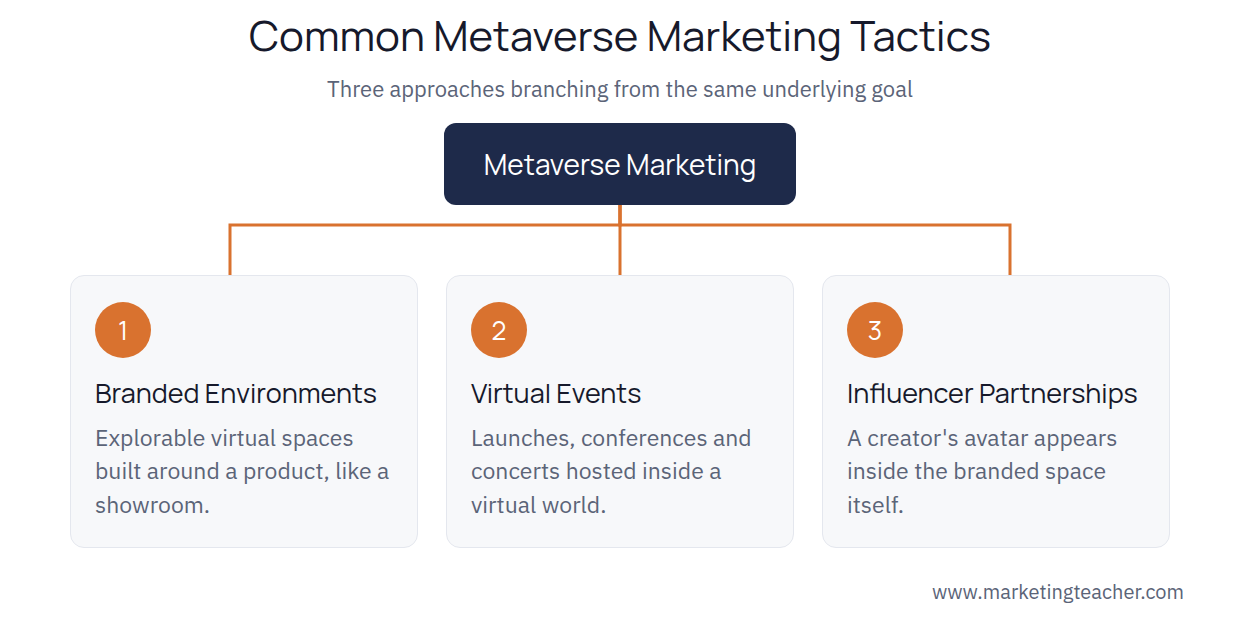
Most metaverse marketing activity falls into a few recurring formats. Branded environments let users explore a space built around a product or brand, such as a virtual showroom where visitors can examine a car model from every angle. Virtual events — product launches, conferences, concerts — recreate the energy of a live event without a physical venue, often with interactive elements a physical event couldn’t offer. Influencer partnerships work much as they do elsewhere, but with a creator’s avatar appearing inside the branded space itself rather than posting about a product from outside it.
Starting Small Before Scaling Up
Because the discipline is still young and the tools for measuring it are still maturing, most successful metaverse marketing programmes start with a limited, low-cost pilot rather than a flagship campaign: a single branded space open for a short event window, or a small-scale collaboration with one creator, before committing to a permanent presence. That approach lets a brand learn what its own audience actually responds to inside a virtual world, and avoid sinking a large budget into a platform or format that turns out not to suit that audience at all.
Why Measurement Is Genuinely Different Here
Standard digital-marketing metrics like click-through rate and impressions don’t translate cleanly into a persistent virtual space, because the goal usually isn’t a click at all — it’s time spent, depth of interaction, or how an experience is remembered afterward. Marketers working in this space have had to build new measures, such as time spent inside a branded environment, the number of meaningful interactions completed there, or a lift in brand recall measured after the fact, rather than assuming an ad-platform dashboard will capture what actually happened.
Brand Safety Is a Real, Ongoing Risk
A brand operating inside a persistent virtual world doesn’t fully control what happens around it. User-generated content, other companies’ activity, and unmoderated social spaces sit right next to a branded environment, and a company can find its name associated with content it never approved and can’t easily remove. Serious metaverse marketing programmes budget for active moderation and monitoring of the space around a brand’s presence, not just the space itself — treating brand safety as an ongoing operational cost rather than a one-time setup step.
A Realistic View of Adoption
Virtual-world audiences remain a fraction of the size of mainstream digital platforms, and plenty of early corporate metaverse experiments have been quietly wound down once the initial novelty faded. That doesn’t make the underlying idea worthless — the academic literature reviewing the field treats the metaverse as a genuine, ongoing area of marketing practice rather than a passing trend (Dwivedi et al., 2023) — but it does mean a metaverse campaign should be judged against a realistic, still-developing audience, not against the reach of an established social platform.
Summary
Metaverse marketing is the promotion of a brand inside a persistent, shared virtual world, distinct from virtual commerce because its goal is usually engagement and brand experience rather than a direct transaction. Common tactics include branded environments, virtual events, and influencer partnerships, all judged by measures like time spent and brand recall rather than clicks and impressions. The field is still developing and its audience remains comparatively small, but it represents a genuinely new area of marketing practice rather than a repackaged digital channel (Dwivedi et al., 2023), and any brand entering it needs an active plan for brand safety, not just a presence.
The slides, worksheet, lesson plan and poster for this lesson are free to download and free to use in your course — no sign-up, no permission needed. See the teacher resources →
Assign this lesson to your class:
Using Canvas, Blackboard or Moodle? Copy the link and paste it into your course page or assignment. More ways to add lessons to your LMS.

