
Learning Outcome: By the end of this lesson, you will be able to explain how voice search changes the way people phrase queries, describe what this means for how content should be written, and apply the principles to a realistic optimisation scenario.
This lesson is part of our Marketing Planning course. Study the full course and earn a certificate →
What Is Voice Search Optimisation?
Voice search optimisation is the practice of adapting a website’s content so it can be found and, increasingly, read aloud by voice assistants such as those built into phones, smart speakers, and cars. McLean and Osei-Frimpong (2019), studying the variables that drive adoption of in-home voice assistants in Computers in Human Behavior, found that usefulness and the ability to multitask while using the assistant were among the strongest reasons people adopted the technology in the first place – people reach for a voice assistant specifically when their hands or eyes are otherwise occupied, which shapes both when voice search happens and what kind of answer a person actually wants from it.
Why Spoken Queries Are Different From Typed Ones
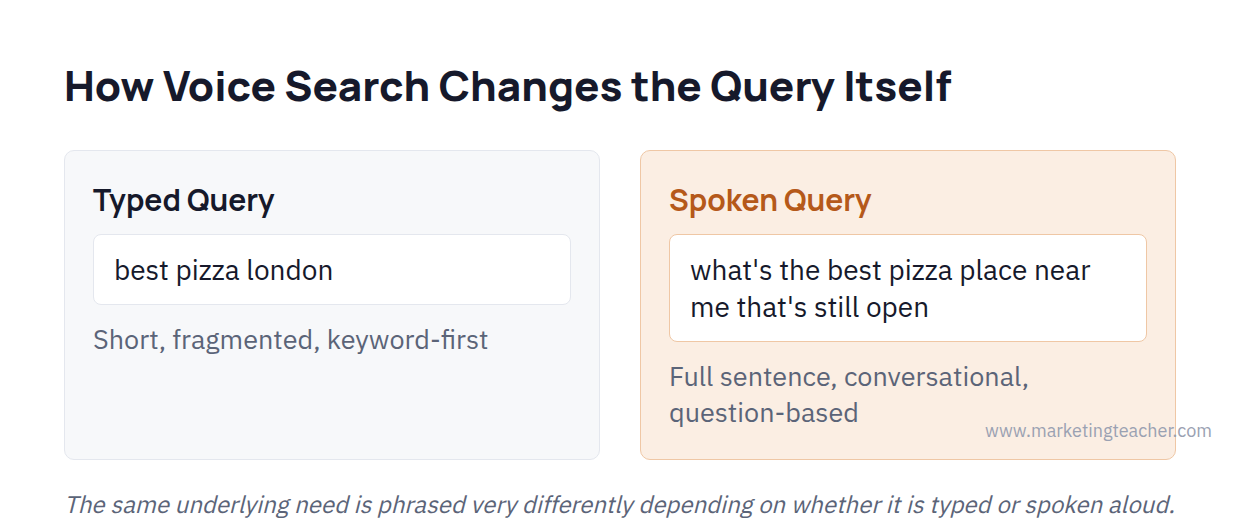
The core difference voice search introduces isn’t the technology itself but the language people use with it. A typed search tends toward short, fragmented keyword phrases – “best pizza London” – because typing favours brevity. A spoken query tends toward full, natural sentences – “what’s the best pizza place near me that’s still open” – because speaking a sentence costs no more effort than speaking a phrase, and conversational habits carry over into how people talk to a device. Guy (2016), analysing a large sample of real mobile voice queries against typed queries submitted to the same search engine, found that voice queries were measurably longer and closer to natural spoken language, with question phrasing appearing far more often than in typed search – direct evidence for the shift this lesson describes, not just an assumption about how people probably talk to their phones. This shift toward longer, more conversational, and more question-based phrasing means content optimised purely around short exact-match keywords increasingly misses a growing share of real search behaviour.
What Actually Changes in How Content Should Be Written
Optimising for voice search means writing content that directly answers the kind of full question a person would actually ask aloud, ideally within the first sentence or two of a section, since many voice assistants read out only a short extracted answer rather than an entire page. Structuring content around clear questions as headings – much like the heading structure used throughout this lesson – genuinely helps here, because it mirrors how a person phrases a spoken query and gives the assistant an obvious, self-contained answer to extract. Local information matters disproportionately too: a large share of voice queries include an implicit or explicit “near me,” making accurate, structured location and business information a practical priority rather than a nice-to-have.
The Single-Answer Problem
Voice search introduces a competitive dynamic that doesn’t exist on a typed search results page: where a typed search shows ten or more results a user can scroll through, a voice assistant typically reads out just one answer. This makes ranking well for a voice query closer to winning an all-or-nothing outcome than typed search’s more forgiving spread of visible options, which raises the practical stakes of getting a page’s structure and clarity right for any query a business particularly cares about.
Example: Ferndale Vets Rewrites Its FAQ Page
The fictional veterinary practice Ferndale Vets noticed through its website analytics that a growing share of its organic traffic was arriving from long, full-sentence search phrases rather than short keyword terms. It rewrote its FAQ page so each entry was phrased as a complete spoken-style question – “what should I do if my dog won’t eat?” rather than “dog not eating” – with a direct, one- or two-sentence answer immediately following each heading before any further detail. Over the following three months, Ferndale began appearing as the extracted voice answer for several of its local “near me” queries, and phone bookings attributed to organic search rose by around a fifth, which the practice’s own tracking linked specifically to the rewritten FAQ page rather than any other site change made in that period.
Beyond Search: The Rise of AI-Generated Answers
Voice assistants are only one part of a broader shift toward conversational, direct-answer interfaces – AI chatbots and AI-generated search summaries increasingly extract and present a single answer in a similar way, whether or not the query was actually spoken aloud. The same writing principles that help a page perform well for a spoken voice query – a clear question, followed immediately by a direct, self-contained answer – also tend to help it get selected as the source for an AI-generated text summary, meaning voice search optimisation and AI-answer optimisation now overlap substantially rather than being two separate concerns.
What Voice Search Doesn’t Change
The fundamentals of good SEO – accurate, genuinely useful content, a fast-loading page, and a site Google trusts enough to rank in the first place – remain exactly as important as before. Voice search optimisation isn’t a separate discipline that replaces conventional SEO; it’s an additional layer of attention to phrasing and structure sitting on top of the same underlying foundation.
Summary
Voice search shifts real user queries toward longer, more conversational, question-based phrasing, driven partly by the hands-free, multitasking contexts in which people actually use voice assistants. Because most voice assistants read out a single extracted answer rather than a list of results, structuring content as clear questions with direct, immediate answers has become a practical priority, particularly for local, “near me”-style queries, without displacing any of the fundamentals of solid SEO underneath.
Key Idea: People don’t talk to a voice assistant the way they type into a search box – they ask it a full question, out loud, the way they’d ask a person – so content that answers a real spoken question directly and immediately will consistently outperform content written only around short typed keywords.
Teaching this topic?
The slides, worksheet, lesson plan and poster for this lesson are free to download and free to use in your course — no sign-up, no permission needed. See the teacher resources →
Assign this lesson to your class:
Using Canvas, Blackboard or Moodle? Copy the link and paste it into your course page or assignment. More ways to add lessons to your LMS.
Written by Marketing Teacher.
Online course · certificate on completion
Study the full Marketing Planning course — and earn a certificate
Thirteen modules that take you from analysis and objectives through to budgets, implementation and control, written at Level 5, reaching Level 6, with a short quiz after each.

