
What Is Blockchain, and Why Does It Matter to Marketers?
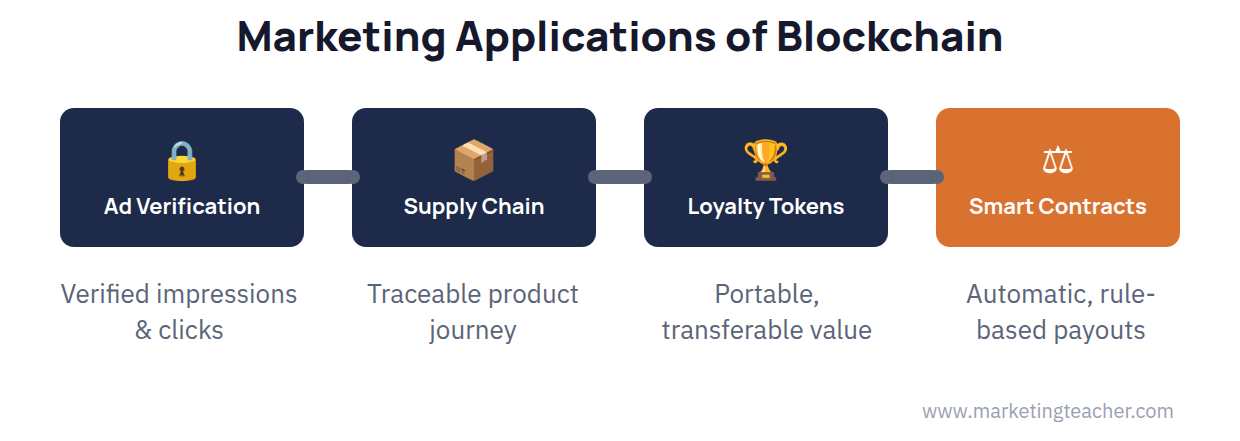
Blockchain is a shared, tamper-resistant digital record that many computers hold copies of at once, rather than a single company controlling one central database. Once an entry is added to the chain, it cannot quietly be changed or deleted, and everyone with access to the network can see the same version of events. Rejeb, Keogh and Treiblmaier (2020) reviewed the ways this kind of shared, verifiable record can benefit marketing specifically, and identified several genuinely practical applications rather than just a theoretical curiosity. For marketers, the appeal is trust: a blockchain record lets two parties who do not fully trust each other, an advertiser and a publisher, or a brand and a customer, agree on a shared set of facts without needing a middleman to vouch for them.
Making Digital Advertising Harder to Fake
Digital advertising has a persistent fraud problem: bots can generate fake clicks and impressions, and it is often hard for an advertiser to be certain a real human actually saw or clicked on an advert before paying for it. Rejeb, Keogh and Treiblmaier (2020) point to blockchain’s ability to create a permanent, shared record of each advertising transaction as a direct answer to this, since every impression, click or payment can be logged in a way no single party can quietly alter afterward. The same transparency problem shows up in affiliate marketing, where a merchant needs to trust that a claimed referral genuinely came from an affiliate’s promotion rather than being manufactured after the fact; a blockchain-based tracking record gives both sides the same tamper-proof log of exactly what happened and when.
Tracing a Product Back Through the Supply Chain
A second use lets a brand record every stage a product passes through, from raw material to shop shelf, on a shared ledger that a customer can check for themselves. This matters most for claims that are otherwise hard to prove, such as a product being genuinely organic, ethically sourced or authentic rather than counterfeit. Instead of asking customers to simply trust a label or certificate, the brand can point to an unbroken, publicly checkable record of custody.
Loyalty Points That Work Like Currency
Loyalty programmes are usually locked inside one company’s own database: the points a customer earns with one airline or one coffee chain generally cannot be spent anywhere else. Blockchain-based loyalty schemes turn points into a token that can, in principle, be transferred, combined with points from a partner brand, or exchanged, giving the customer something closer to a portable currency than a number trapped in a single app. For marketers, this can make a loyalty scheme more attractive to join in the first place, since the reward is not stranded with one business alone.
Smart Contracts That Pay Out Automatically
A related application is the smart contract, a set of rules written directly into the blockchain that carries out an action automatically once its conditions are met, without either side needing to chase the other. In marketing, this suits any arrangement built around a verifiable outcome: an influencer or affiliate payment can be set to release automatically once the agreed number of verified clicks, sign-ups or sales is recorded on the shared ledger, rather than the two parties negotiating over a spreadsheet at the end of the month. This removes a common source of disputes in performance-based marketing, since both sides are working from the same automatically enforced record rather than two separate sets of figures.
The Practical Limits Marketers Still Face
None of this works unless enough other people, customers, partner businesses, and platforms, are using a compatible system, and building that critical mass is slower and harder than building a single company’s own app. Rejeb, Keogh and Treiblmaier (2020) frame several of blockchain’s marketing applications as areas that still need more research and real-world testing rather than settled, off-the-shelf solutions, and cost and technical complexity remain genuine barriers for a business without in-house technical expertise. A marketer considering blockchain should treat it as a promising but still-maturing tool, worth watching closely and piloting on a small scale, rather than something every business needs to adopt immediately.
Summary
Blockchain gives marketers a shared, tamper-resistant record that two parties can rely on without needing to fully trust each other, and Rejeb, Keogh and Treiblmaier’s (2020) review points to genuine applications in reducing ad fraud, proving supply chain claims, and making loyalty points more portable. The technology is still maturing, and the biggest practical barrier is usually getting enough partners and customers onto a compatible system rather than the technology itself, which is why most marketing uses of blockchain today are careful pilots rather than sitewide rollouts.
The slides, worksheet, lesson plan and poster for this lesson are free to download and free to use in your course — no sign-up, no permission needed. See the teacher resources →
Assign this lesson to your class:
Using Canvas, Blackboard or Moodle? Copy the link and paste it into your course page or assignment. More ways to add lessons to your LMS.

