
What Is Marketing Strategy?
A marketing strategy is a plan for how a business will use its resources and capabilities to create superior value for a chosen group of customers, in a way that is difficult for competitors to copy, so that it can meet its objectives (Hooley, Piercy and Nicoulaud, 2008). It sits below the corporate strategy of the whole organisation but above the day-to-day marketing tactics that customers actually see, such as an advert, a price cut or a new product launch.
It helps to think of strategy as the answer to three linked questions: where do we want to compete, how will we compete there, and what do we need to do to make that happen. Get the first two questions wrong and no amount of clever tactics will save the business – a beautifully executed campaign for the wrong market, at the wrong price, still fails.
Strategy Versus Tactics
Marketing strategy and marketing tactics are often confused, but they operate at different levels. Strategy sets the direction: which markets and customer segments to target, how the business will position itself against competitors, and what it is trying to achieve over the medium to long term (Kotler and Armstrong, 2018). Tactics are the short-term, day-to-day activities used to carry that strategy out – the specific marketing mix decisions on product, price, place and promotion.
A useful test is time and reversibility. Choosing to target price-sensitive students rather than affluent professionals is a strategic decision – it shapes years of product design, pricing and communication. Running a two-week discount promotion is tactical – it can be changed or dropped with little lasting damage. Businesses that confuse the two often end up “tactic-hopping”: trying a new promotion, then a new price, then a new slogan, without ever settling on a clear strategic direction.
Where Marketing Strategy Sits in the Business
Most organisations plan on three linked levels, and marketing strategy is only one of them (Johnson, Scholes and Whittington, 2008). At the top, corporate strategy decides which industries and markets the business will be in at all – for example, a decision to expand into a new country or exit a declining category. Below that, business (or competitive) strategy decides how each part of the business will compete within its chosen market, often expressed through a generic approach such as those set out in Generic Strategies. Marketing strategy then sits at the functional level: it works out how the marketing function will support that competitive approach by choosing which customers to serve and how to reach them.
Because these levels are linked, a marketing strategy that ignores the corporate strategy above it will struggle for resources and buy-in, however sound it looks on paper. A regional bakery chain whose corporate strategy is slow, profitable growth is unlikely to fund a marketing strategy built around rapid, loss-leading expansion, however attractive the market opportunity might appear in isolation.
The Three Stages of a Marketing Strategy
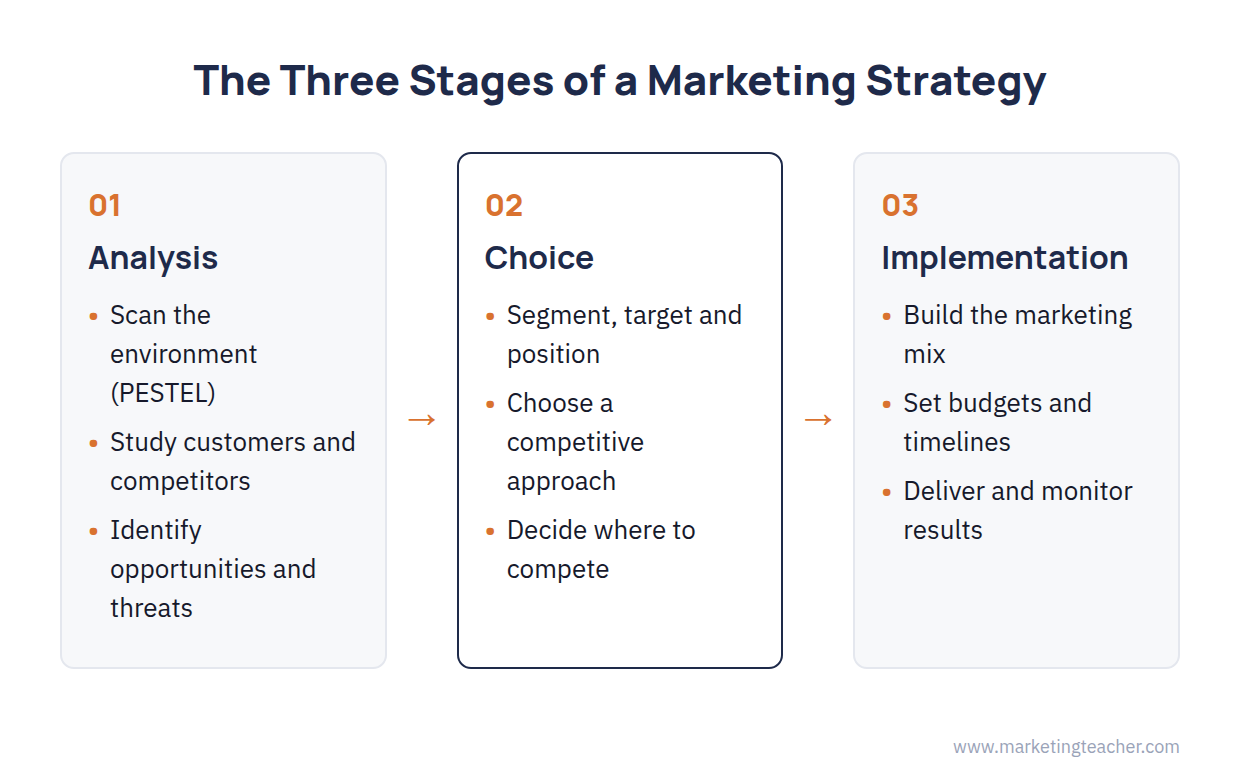
A marketing strategy is usually built in three stages, echoing the wider strategic planning process described by McDonald (2007): analysis, choice, and implementation.
Analysis comes first. The business needs an honest picture of its external environment – using a tool such as PESTEL to scan for wider political, economic, social, technological, environmental and legal change, alongside a close look at customers and competitors. Without this step, strategy is guesswork dressed up as planning.
Choice follows. Armed with the analysis, the business decides which customer groups to serve and how it wants to be seen by them – the process of segmentation, targeting and positioning that sits at the heart of most marketing strategy. It also decides, at a competitive level, whether it will compete mainly on cost, on differentiation, or on serving a narrow niche particularly well.
Implementation turns the choice into action: the marketing mix, budgets, timelines and the people and systems needed to deliver them. A strategy that is never implemented, or implemented inconsistently across teams, delivers no more value than having no strategy at all.
Why a Clear Marketing Strategy Matters
A clear marketing strategy focuses scarce resources on the customers and activities most likely to deliver results, rather than spreading effort thinly across everyone. It also gives different teams – sales, product development, customer service – a shared sense of direction, so that a pricing decision made in one department does not quietly undermine a positioning promise made in another. Without a strategy, businesses tend to fall back on reactive, short-term tactics such as discounting whenever sales dip, which can erode the very positioning they are trying to build.
Summary
Marketing strategy is the medium-to-long-term plan for how a business will create superior value for a chosen group of customers in a way competitors find hard to copy. It sits beneath corporate strategy and above day-to-day marketing tactics, and it is built through three connected stages: analysing the environment and customers, choosing which segments to target and how to position against competitors, and implementing that choice through the marketing mix. The modules that follow in this course look at each of these stages – and the tools used within them – in much more depth.
The slides, worksheet, lesson plan and poster for this lesson are free to download and free to use in your course — no sign-up, no permission needed.

