
What Does It Take to Run Your Own Affiliate Program?
Most introductions to affiliate marketing are written from the affiliate’s side — someone joining a merchant’s program to earn commission by promoting its products. This lesson looks at the other side of that relationship: what’s involved when a business becomes the merchant and builds a program for others to join, rather than joining someone else’s.
Why a Business Chooses to Run Its Own Program
Running an affiliate program gives a merchant a level of control and accountability that other channels don’t offer in quite the same way. Because affiliates are typically paid only when they generate a defined outcome — a sale, a lead, a signup — the arrangement is close to genuinely pay-for-performance, which keeps costs tied to results rather than to exposure that may or may not convert. It also gives a business access to markets and customer segments it might otherwise struggle to reach on its own, through affiliates who already have an audience’s trust, and it can do this at a lower risk than opening a new sales channel or entering a new market directly, since the affiliate absorbs much of the up-front promotional effort. This combination — performance-based cost, extended reach, and shared risk — is precisely why affiliate programs have remained popular with merchants even as the wider digital marketing landscape has changed considerably (Mangió and Di Domenico, 2022).
Affiliate Network or In-House Software?
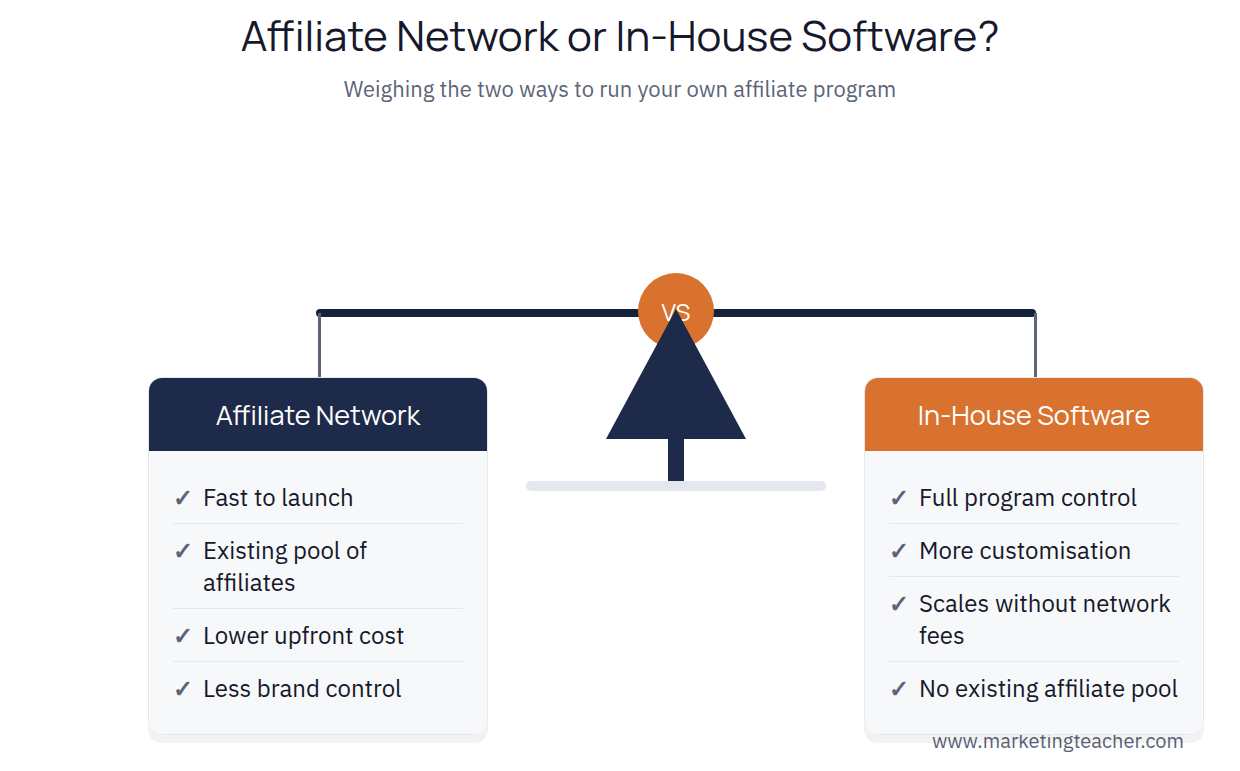
Once a business decides to run a program, the first real decision is where to run it: through an established affiliate network, or on dedicated in-house software.
An affiliate network acts as an intermediary that already has a pool of affiliates, along with the tracking, reporting and payment infrastructure built in. Joining one is comparatively fast and low-effort — a merchant sets up a listing and starts recruiting from an existing pool rather than building an audience of affiliates from nothing. The trade-off is control: a merchant on a network has less say over how affiliates represent the brand, less flexibility to customise how the program works, and is bound by whatever functionality and reporting limits the network’s software imposes as the program grows.
Specialised in-house affiliate software takes the opposite trade-off. It gives a merchant far more control over program rules, creative guidelines, and how affiliates are vetted and managed, along with more flexibility in how commissions, tiers and reporting are structured. The cost is that a merchant has to build its own affiliate relationships from scratch rather than drawing on a network’s existing pool, and the software itself typically costs more upfront. For a program that’s expected to scale significantly, that additional cost is often justified by the greater control and the absence of a network’s usage-based fees eating into margins over time.
Vetting and Managing Affiliates
Whichever route a merchant takes, the program is only as good as the affiliates in it and how well they’re managed. A poorly vetted affiliate can misrepresent a brand, use misleading claims to drive clicks, or rely on tactics — like bidding on the merchant’s own branded search terms — that inflate reported performance without adding real value. Clear program terms, regular performance review, and a willingness to remove underperforming or non-compliant affiliates matter more to a program’s long-term health than the number of affiliates recruited into it (Mangió and Di Domenico, 2022).
Setting Realistic Expectations
A new affiliate program rarely produces meaningful volume in its first few months. Recruiting the right affiliates, agreeing terms, and giving affiliates time to build the promotional content or audience relationships that actually drive conversions all take longer than a merchant typically expects going in. Budgeting patience alongside commission rates is as important as the commercial terms themselves, and setting a realistic review point — six months rather than six weeks — helps avoid abandoning a program just as its best affiliates are starting to gain traction with their own audiences.
It’s also worth deciding upfront how commission structures will handle affiliates who bring in genuinely new customers versus those who simply capture sales a business would have made anyway. A flat commission on every sale rewards both equally, which can make a program look more expensive than it actually is once the true incremental impact is accounted for. Tiered commissions, or bonuses tied specifically to new-customer acquisition, are a common way merchants keep the pay-for-performance logic honest as a program matures.
Summary
Becoming the merchant in an affiliate relationship gives a business pay-for-performance reach into new customer segments at comparatively low risk (Mangió and Di Domenico, 2022). The central practical choice is between an affiliate network’s speed and existing pool of affiliates and in-house software’s greater control and scalability — a choice that, as a program grows, many merchants revisit rather than commit to permanently at the outset.
The slides, worksheet, lesson plan and poster for this lesson are free to download and free to use in your course — no sign-up, no permission needed.

