
How Do You Run a Viral Campaign on a Small Budget?
Viral marketing gets talked about as if it’s a matter of luck, but a small business can improve its odds considerably by planning deliberately rather than hoping something takes off. This lesson is a practical, small-budget companion to the broader idea of viral marketing — it focuses on what a business with a limited budget and no media-buying team can actually do to give a piece of content a genuine chance of spreading.
What Makes Content Worth Sharing
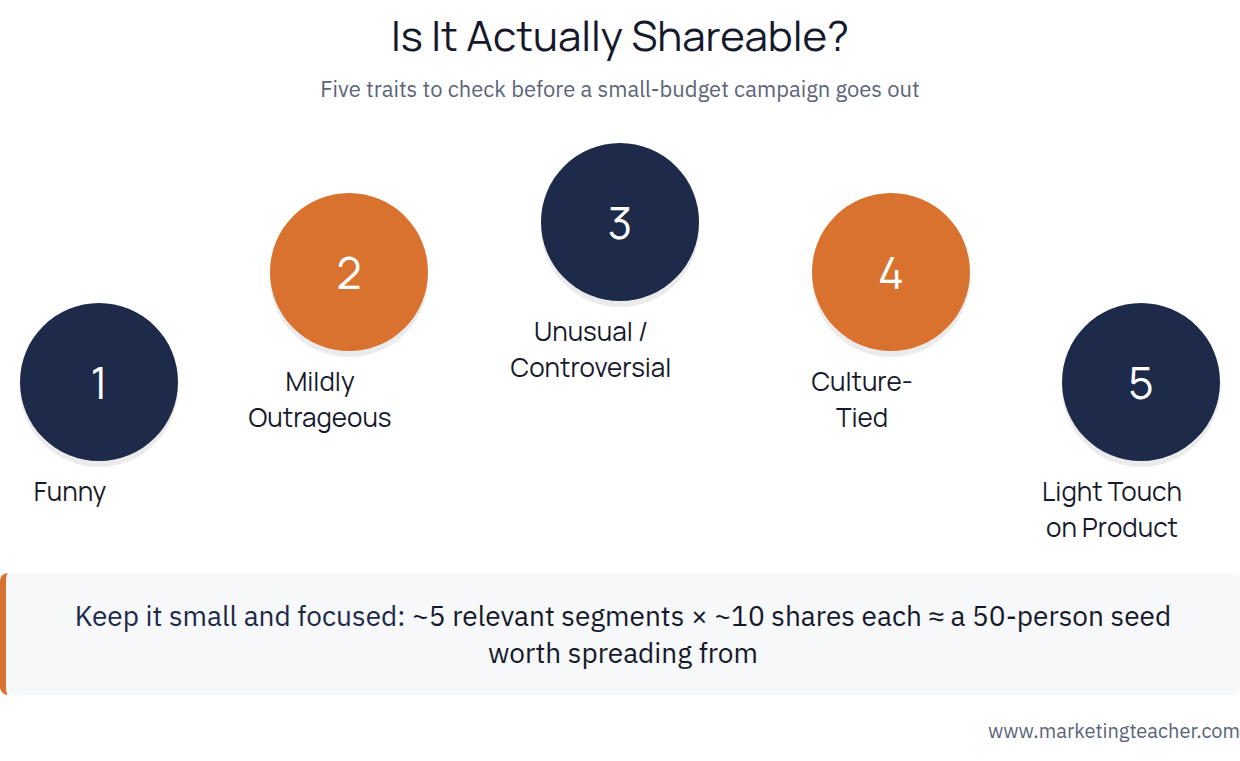
Before spending any money or time, it’s worth checking a piece of content against a short list of the traits that consistently show up in things people actually pass on: it makes people laugh, it’s mildly outrageous or surprising, it’s unusual or a little controversial, it pokes gently at a shared cultural moment, and — often overlooked — it doesn’t read like an advert. Content that is obviously and heavily selling something gets shared far less than content that simply entertains or informs, even when a product sits quietly in the background. Emotional intensity is doing most of the work here: research on why people share content online has repeatedly found that high-arousal emotions, whether positive (amusement, awe) or negative (anger, anxiety), drive sharing far more reliably than neutral or mildly positive content (Kaplan and Haenlein, 2011). A calmly informative post rarely goes anywhere; a post that makes someone feel something strongly enough to want their friends to feel it too has a real chance.
Start Smaller and More Focused Than You’d Expect
The instinct with a viral campaign is to aim as wide as possible, but a small business is usually better served starting narrow. Picking a handful of tightly defined customer segments and seeding content directly into their existing networks tends to outperform a single broad, generic push. If a business identifies five realistic customer segments and each contact within them typically shares with around ten friends who fit the same profile, that’s already a meaningful first wave of roughly fifty relevant people — a small, focused seed that keeps spreading only if the content is actually worth passing on, without paying for reach that never converts. Keeping the initial push small and focused, rather than broad and shallow, was itself the practical advice this lesson has always centred on, and it holds up well against more recent research: entrepreneurial and small-business word-of-mouth spreads most effectively through networks the business already has some access to — existing customers, local contacts, and community ties — rather than through cold, anonymous mass reach (Stokes and Lomax, 2002).
Where the Product Should Sit
One of the most common mistakes a small business makes is putting its product too close to the centre of the content. The connection between the entertaining or interesting element and the thing being sold should be light — visible enough that people associate the good feeling with the brand, but not so heavy that the content reads as an advert. A general rule worth applying before publishing anything: if a friend forwarded this to you with no context, would you assume it was made by the company, or would you assume it was made by an actual person who happened to enjoy it? The closer it feels to the second, the better its chances.
Give It Room to Spread Before Judging It
A genuinely small-budget campaign won’t show results in the first few hours the way a paid ad might. Sharing happens in waves, and each wave typically takes longer to gather momentum than a business expects, particularly when the seeding was deliberately kept small and focused rather than broad. It’s worth resisting the temptation to declare a campaign a failure after a day or two of quiet — the content, seeding groups, and product tie-in are the levers to check first, not the timeline itself, and a modest campaign that spreads slowly through relevant networks is often worth more in the long run than a large paid push that spreads quickly through irrelevant ones.
Summary
Running a viral campaign on a small budget comes down to a few practical, repeatable choices: build content around genuine emotional pull rather than a sales message (Kaplan and Haenlein, 2011), keep the product connection light, and seed it deliberately into a small number of relevant existing networks rather than paying for broad, generic reach (Stokes and Lomax, 2002). None of this guarantees a campaign will spread widely, but it consistently improves the odds for a business without a media budget to fall back on.
The slides, worksheet, lesson plan and poster for this lesson are free to download and free to use in your course — no sign-up, no permission needed.

