
This is the suggested answer to the Shell Directional Policy Matrix exercise on Brackwater Industrial.
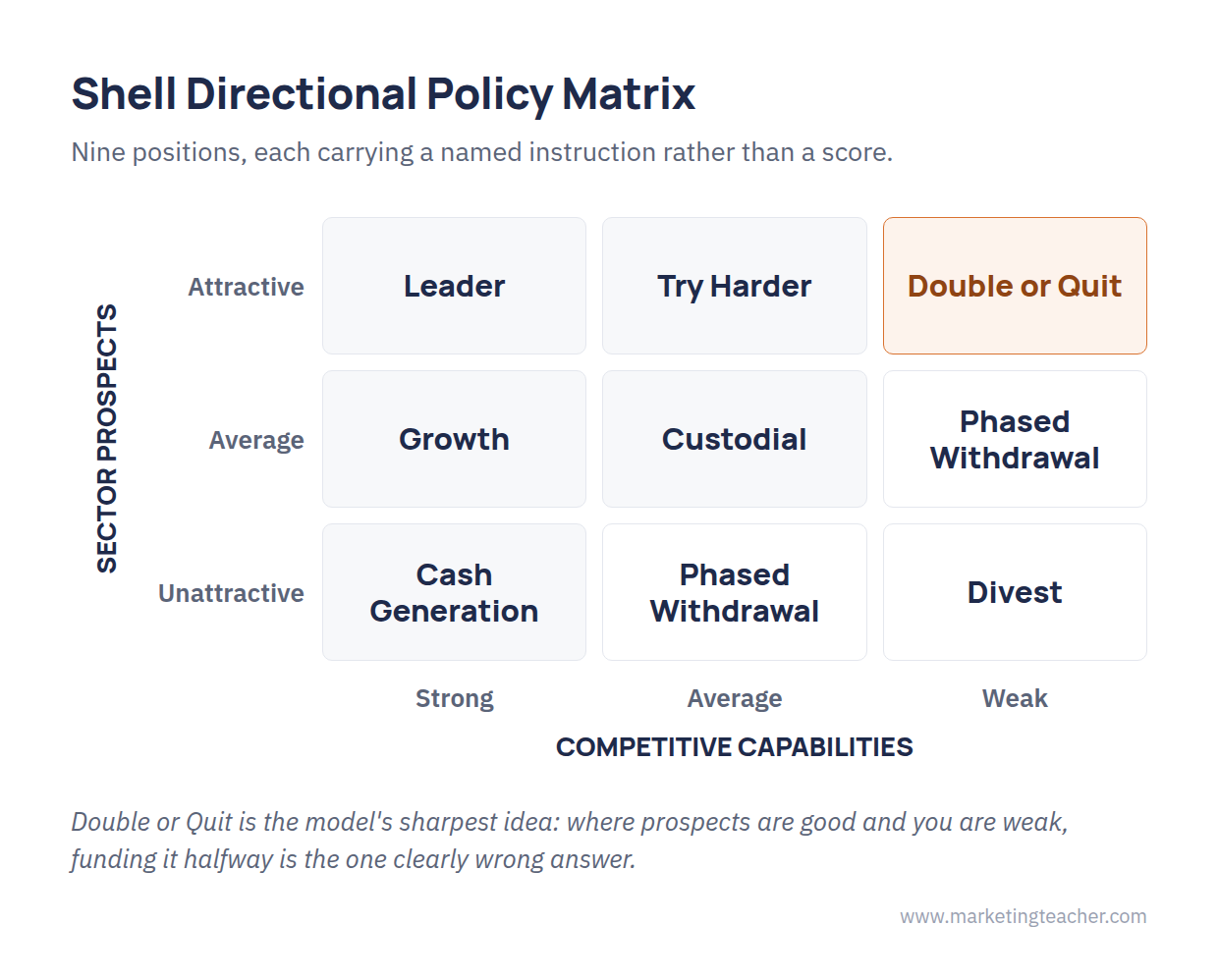
Marine Coatings: Cash Generation
Sector prospects are unattractive on growth but lifted by market quality — fifteen years of steady margins and secure supply is exactly what that criterion rewards, and it is the axis most portfolio models miss. Competitive capabilities are strong on every count. A strong position in a low-growth sector is Cash Generation: run it tightly, keep the research team, and treat the surplus as the group’s funding source rather than as this division’s to spend.
Battery Casings: Double or Quit
Attractive sector prospects, weak capabilities — late entry, small share, a production line a generation behind. This is the model’s sharpest cell. The division can be funded properly, which means new plant and the share to justify it, or exited while the asset still has a buyer. What it cannot be is funded a little, which is how a company spends real money for years and arrives nowhere.
Legacy Pipework: Phased Withdrawal
A declining sector, thin margins, a modest share and an ageing plant. Not Divest outright, because the position is average rather than weak and the plant still runs: withdraw in stages, take what cash remains, and avoid the write-off that an abrupt exit would force.
The same portfolio, judged on the GE Business Screen’s composite scores, appears in the GE Business Screen exercise.
The slides, worksheet, lesson plan and poster for this lesson are free to download and free to use in your course — no sign-up, no permission needed.

