
What Are the Three Major Types of Buying Situations?
Not every business purchase gets the same amount of attention. A factory reordering the same box of printer paper behaves nothing like a hospital buying its first MRI scanner, even though both are “business buying.” Marketing academics Patrick J. Robinson, Charles W. Faris and Yoram Wind first classified this spectrum of buyer involvement in 1967, naming three major types of buying situations (Robinson, Faris and Wind, 1967). Kotler, Armstrong and Opresnik (2018) carry the same three-way classification into their own definition of business buyer behaviour, adding how each situation changes the odds for the supplier already holding the account versus one trying to win it. The two sources agree on the core idea — buyer involvement rises with risk and novelty — and Kotler, Armstrong and Opresnik’s version is the one most used in marketing teaching today because it ties each situation directly to a supplier’s strategy, not just a buyer’s mindset. This business-buying spectrum has a cousin on the consumer side too — the five-stage consumer buyer decision process compresses or expands the same way depending on risk and familiarity.
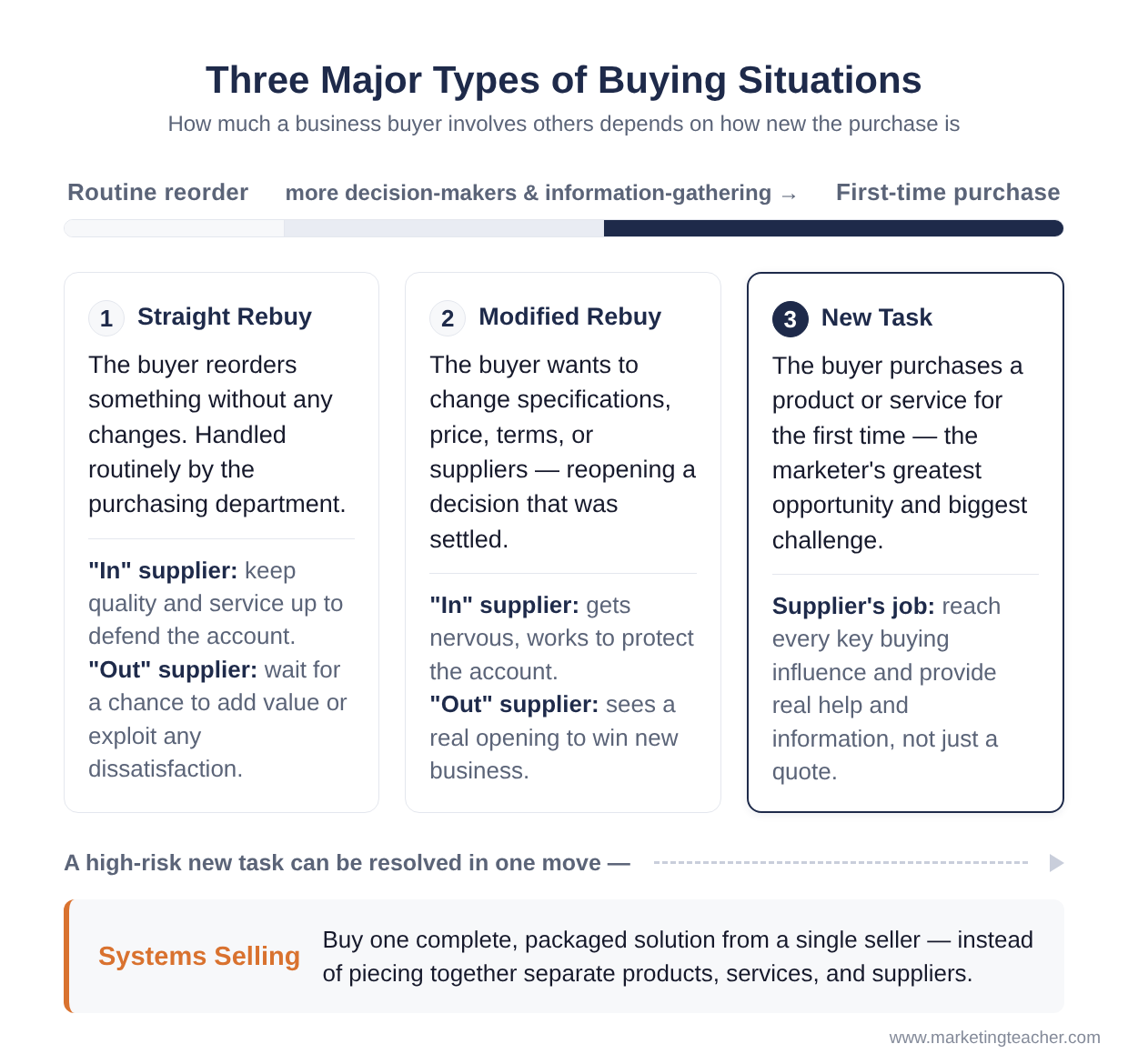
Straight Rebuy: Buying on Autopilot
In a straight rebuy, the buyer reorders something without any modifications, and the purchasing department usually handles it on a routine basis (Kotler, Armstrong and Opresnik, 2018). Think of a restaurant chain reordering the same napkins from the same supplier every month. The “in” supplier’s job is simple: keep product and service quality consistent enough that nobody has a reason to look elsewhere. The “out” supplier’s job is harder — it has to find a new way to add value, or wait for the in supplier to slip up, before it even gets a chance to quote.
Modified Rebuy: Reopening the Conversation
A modified rebuy happens when the buyer wants to change product specifications, prices, terms, or suppliers (Kotler, Armstrong and Opresnik, 2018). Nothing about the relationship is guaranteed anymore. The “in” supplier can feel the pressure and usually puts its best offer forward to protect the account, while “out” suppliers see a genuine opening — the decision has been reopened, and a better price, faster delivery, or a more flexible contract can win the business outright.
New Task: Starting From Zero
A new task is a first-time purchase of a product or service the company has never bought before (Kotler, Armstrong and Opresnik, 2018). The greater the cost or risk, the more people get pulled into the decision and the more information everyone wants before committing. Kotler, Armstrong and Opresnik call this “the marketer’s greatest opportunity and challenge” — a supplier that wins a new task relationship can go on to hold it through years of straight and modified rebuys, but winning it in the first place means reaching every one of those decision-makers, not just the one who happens to answer the phone.
Systems Selling (or Solutions Selling): Skipping the Rebuy Ladder
Many business buyers would rather buy one complete solution to a problem from a single seller than piece it together themselves from several suppliers (Kotler, Armstrong and Opresnik, 2018). This is systems selling, sometimes called solutions selling, and it is often the strategy that turns a daunting new task into a single decision instead of years of separate purchases for hardware, installation, training, and support — usually won and held through sustained personal selling rather than a one-off pitch. Research on this strategy distinguishes two ways a supplier can deliver it: a systems seller builds every part of the solution itself, while a systems integrator coordinates components bought in from outside firms on the customer’s behalf (Davies, Brady and Hobday, 2007) — a useful distinction, since customers rarely ask which kind of supplier they are dealing with, only whether the whole thing works.
Rolls-Royce’s TotalCare programme is a current example. An airline buying a jet engine is not just buying a piece of metal: under TotalCare, Rolls-Royce bundles the engine with predictive maintenance planning, overhaul work, parts logistics, and round-the-clock health monitoring, and charges for it with a single price per engine flying hour rather than a separate bill for every repair (Rolls-Royce, 2026). That price transfers the cost risk of unplanned maintenance from the airline to Rolls-Royce itself. Instead of the airline running its own new task process to find an engine, then a separate one to find a maintenance provider, then another to arrange spare-parts logistics, Rolls-Royce turns all three into one sale.
Summary
Business buyers face three major types of buying situations: the straight rebuy, where the purchasing department reorders on autopilot; the modified rebuy, where specifications, price, terms, or the supplier itself are back up for negotiation; and the new task, where a first-time purchase pulls in the most people and the most scrutiny. Each situation calls for a different supplier strategy — defend, compete, or educate. Systems selling offers a way to resolve a high-stakes new task in one move, bundling products and services into a single solution rather than leaving the buyer to assemble one piece at a time.
The slides, worksheet, lesson plan and poster for this lesson are free to download and free to use in your course — no sign-up, no permission needed. See the teacher resources →
Assign this lesson to your class:
Using Canvas, Blackboard or Moodle? Copy the link and paste it into your course page or assignment. More ways to add lessons to your LMS.

