
What Is Business-to-Business Marketing?
Business-to-business, or B2B, marketing covers the exchange of goods and services that organisations purchase for purposes other than their own personal consumption, most often to use in producing something else, to resell, or to run their own operations (Kotler and Armstrong, 2018). This sits in contrast to business-to-consumer, or B2C, marketing, where the end buyer is an individual consuming the product themselves. Many businesses that consumers know as retailers, such as a large supermarket chain, are themselves B2B customers further up the supply chain, since they purchase in bulk from producers before reselling to the public.
How B2B Buyers Differ From Consumers
Business buyers behave quite differently from individual consumers in several consistent ways (Kotler and Armstrong, 2018). They tend to buy in far larger quantities and are frequently more geographically concentrated, often clustered in the same industrial regions, whereas individual consumers are spread across every populated area. Because a single organisational sale can be worth far more than a single consumer sale, and because more than one person is usually involved in a business’s decision to buy, B2B purchasing tends to be a longer, more deliberate process involving a formal decision-making unit rather than one individual’s snap decision. B2B demand is also frequently derived demand: the number of car tyres a tyre manufacturer sells rises and falls with the number of cars being manufactured, not with any marketing the tyre manufacturer does directly to drivers.
The Three Main Types of B2B Customer
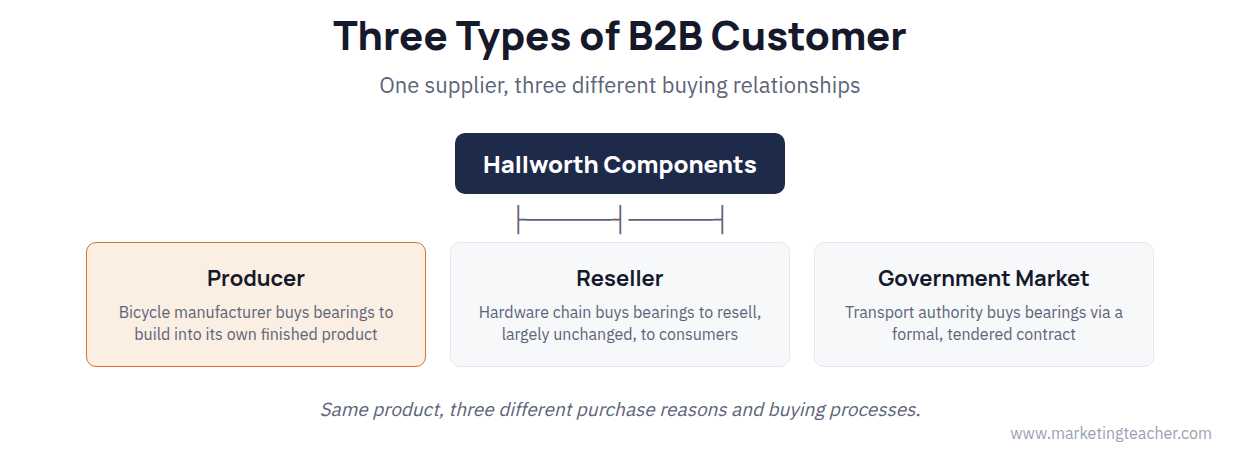
B2B customers generally fall into three broad groups (Kotler and Armstrong, 2018). Producers buy goods and services to use in making their own products, as Hallworth’s bicycle manufacturer does with its bearings. Resellers, such as wholesalers and retailers, buy finished goods to sell on largely unchanged, profiting from the margin between what they pay and what they charge. Government markets buy goods and services, everything from office supplies to major infrastructure, on behalf of citizens, typically through a more formal, tender-based purchasing process that rewards suppliers able to meet strict specifications and compliance requirements rather than simply the lowest price.
Why the Marketing Mix Still Applies, With Adjustments
The same underlying marketing mix principles apply in B2B markets as in B2C, but the emphasis shifts. Because there are fewer, larger buyers, B2B marketing relies more heavily on direct relationships, technical sales support and tailored proposals than on the mass-media advertising that dominates many consumer categories. Segmentation is often based on industry, company size or buying behaviour rather than the demographic or lifestyle segmentation more common in consumer markets. Price is frequently negotiated per contract rather than fixed on a shelf, and distribution decisions often involve a much shorter, more direct channel between producer and business customer than the multi-stage channels typical of consumer goods. Even promotion changes emphasis: trade publications, industry exhibitions and a specialist sales team’s technical credibility often do more to win a B2B contract than the broad-reach advertising that a consumer brand would rely on to reach the same size of audience.
Derived Demand and Its Marketing Implications
Because B2B demand is derived from demand further down the chain, a B2B marketer’s fortunes are often tied to a market they don’t sell into directly. A components supplier can find its own sales rising or falling in step with consumer demand for the finished product its components go into, even if the supplier does nothing differently at all. This makes market intelligence about the end-consumer market, not just about the immediate business customer, a genuinely important part of effective B2B marketing, since a shift in consumer taste several steps down the chain can be the real signal a B2B marketer needs to watch. It also means demand can swing more sharply than in consumer markets: a small dip in consumer purchases can ripple backwards into a much larger swing in orders for the raw materials and components several stages up the supply chain, an effect worth planning for rather than being caught out by.
Summary
Business-to-business marketing covers exchanges between organisations rather than sales to an individual end consumer, and B2B buyers behave differently from consumers in scale, concentration, decision-making and the derived nature of their demand (Kotler and Armstrong, 2018). Producers, resellers and government markets are the three broad types of B2B customer, and while the core marketing mix still applies, its emphasis shifts toward direct relationships, negotiated pricing and shorter distribution channels than typical consumer marketing.
The slides, worksheet, lesson plan and poster for this lesson are free to download and free to use in your course — no sign-up, no permission needed. See the teacher resources →
Assign this lesson to your class:
Using Canvas, Blackboard or Moodle? Copy the link and paste it into your course page or assignment. More ways to add lessons to your LMS.

